
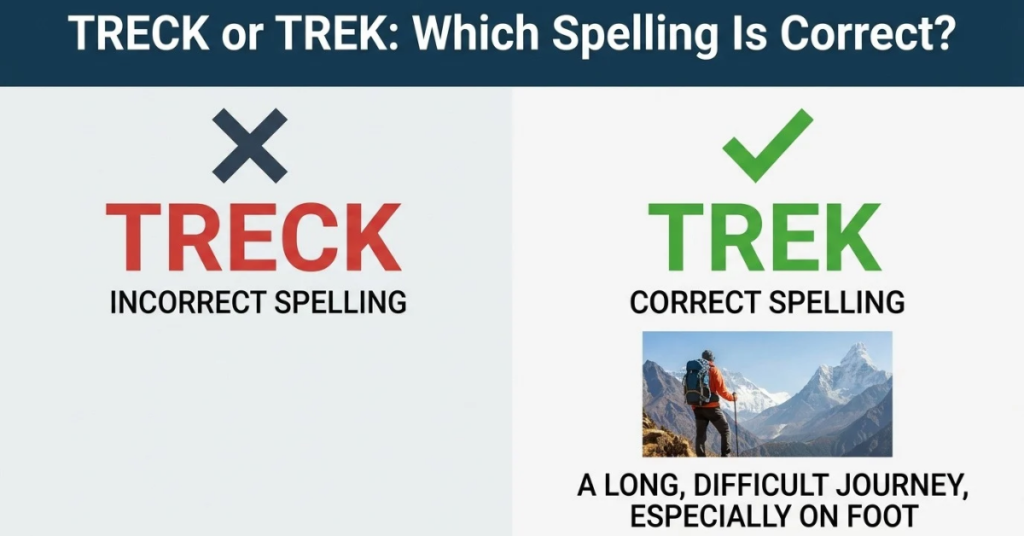
Have you ever typed treck or trek and wondered which spelling is right? You are not alone. These two words look almost identical, but only one is the standard spelling of the English word used to describe a long, challenging journey.
The correct spelling is trek, not treck. Whether you are talking about hiking through mountains, travelling across a remote landscape, or planning a Halloween-themed adventure, knowing the difference can help you write more clearly and confidently.
In this guide, we will explore the meaning of trek, its synonyms, common spelling mistakes, and how the word is used in everyday conversation, travel writing, and Halloween-related searches.
Is It Treck or Trek? The Correct Spelling Explained
If you are asking, “Is it treck or trek?” the answer is straightforward: trek is the correct spelling when referring to a long or difficult journey, especially one made on foot.
Treck is generally considered a misspelling of trek in standard English. Although people sometimes type it because it sounds similar, it is not the conventional spelling of the word.
Here is a quick comparison:
| Word | Correct usage |
|---|---|
| Trek | Correct spelling for a long or challenging journey |
| Treck | Common misspelling of trek |
Examples of the correct spelling:
-
We went on a three-day trek through the mountains.
-
The hikers prepared carefully for their trek across the valley.
-
Our school organised a nature trek for the weekend.
-
She described the journey as a difficult but rewarding trek.
A useful tip is to remember that trek has only four letters. There is no need to add a second “c” before the final “k.”
What Does Trek Mean? Definition and Origin
The word trek refers to a long walk or journey that may be physically demanding, tiring, or difficult. It is often associated with hiking, mountain climbing, wilderness exploration, and outdoor adventures. However, the word can also describe an ordinary trip that takes considerable time or effort.
The origin of the word trek
The word trek has roots in South African Dutch, also known as Afrikaans, and is related to the Dutch verb trekken, meaning “to pull” or “to travel.” Historically, the term was associated with journeys made by ox wagon, particularly in southern Africa. Over time, its meaning broadened to include long or difficult journeys in general.
Trek as a noun and a verb
One helpful way to understand the meaning of trek is to look at how it works in a sentence.
As a noun: It describes the journey itself.
-
The trek to the mountain summit took six hours.
-
Our journey home turned into a long trek.
As a verb: It describes the action of making the journey.
-
We plan to trek through the forest this summer.
-
They trekked across the rocky terrain to reach the campsite.
The word can be used in both formal travel writing and casual conversation.
Trek or Treck Spelling: Why Do People Get It Wrong?
English spelling can be confusing, particularly when words contain similar sounds. The confusion between trek and treck is a good example: adding an extra letter might seem reasonable, but it does not make the spelling correct.
There are several reasons people make this mistake.
1. Similar-sounding words
The final sound in trek can make some writers assume that the word should contain a double consonant. However, the correct base word has just one “k” and no “c.”
2. Typing too quickly
People often make spelling mistakes when writing messages, captions, or search queries in a hurry. A quick spell-check can help prevent this error from appearing in published content.
3. Confusion with related word forms
Although the base word is spelled trek, its spelling changes when certain endings are added.
| Word form | Correct spelling | Example |
|---|---|---|
| Base form | Trek | We trek every summer. |
| Third-person singular | Treks | She treks regularly. |
| Past tense | Trekked | We trekked yesterday. |
| Present participle | Trekking | They are trekking today. |
| Noun, plural | Treks | The guide organises several treks. |
Easy way to remember: Trek, trekked, trekking. Start with trek and add the appropriate ending.
Trek Synonyms: What Other Words Can You Use?
If you are looking for a trek or trek synonym, the best alternative depends on the context. Some words describe outdoor adventures, while others emphasise distance, difficulty, or the experience of travelling.
Here are some useful alternatives:
| Synonym | Meaning or typical use |
|---|---|
| Hike | A walk, often outdoors, for exercise or enjoyment |
| Journey | Travel from one place to another |
| Expedition | An organised journey undertaken for exploration or a specific purpose |
| Trekking | Walking over a long distance, often through natural terrain |
| Ramble | A leisurely walk, usually without a strict destination |
| Tramp | A long walk, sometimes tiring or demanding |
| Trudge | To walk slowly and heavily, usually because of fatigue |
| Pilgrimage | A journey to a place of religious or personal significance |
| Adventure | An exciting or unusual experience, sometimes involving travel |
| March | Walking steadily, often with a deliberate pace or purpose |
These words overlap with trek, but they are not always interchangeable. For instance, a hike is often recreational, an expedition usually has a defined objective, and a trudge emphasises the difficulty of walking.
Which synonym is best for your sentence?
Consider these examples:
-
For outdoor activities: We went on a hike through the hills.
-
For a challenging journey: The expedition lasted several days.
-
For a tiring walk: Getting to the station was a real trudge.
-
For a general trip: The journey took longer than expected.
-
For a relaxed walk: We enjoyed a peaceful ramble through the countryside.
If you want to describe a long, demanding walk, trek remains an excellent choice. If you want to highlight a leisurely experience, ramble or stroll may be more appropriate.
Treck or Trek Halloween: What Does It Mean?
The search phrase treck or trek Halloween may appear when people are looking for Halloween activities, themed events, costume ideas, or a spelling clarification. However, “treck or trek Halloween” is not a standard English expression with a recognised Halloween-specific meaning.
The correct word still depends on what you want to describe.
Using trek in a Halloween context
A trek can describe a long walk during a Halloween event, particularly if the activity involves exploring a trail, visiting decorated locations, or walking through a spooky outdoor setting.
For example:
-
We went on a spooky Halloween trek through the forest.
-
The children enjoyed a Halloween night trek with their friends.
-
Our Halloween adventure included a lantern-lit trek along a nature trail.
-
The group organised a haunted forest trek for October 31.
In these examples, trek refers to the walk or journey, while Halloween describes the event’s theme.
Is “trick or treat” related to “treck or trek”?
This is an important distinction. If you encountered the phrase while searching for Halloween vocabulary, you might actually be thinking of “trick or treat.”
Trick-or-treating is the traditional Halloween activity in which children dress up in costumes, visit homes, and ask for treats, often using the familiar phrase “trick or treat.”
The expressions have different meanings:
-
Trek: A long or difficult walk or journey.
-
Trick or treat: A Halloween custom involving costumes and collecting sweets.
-
Treck: A common misspelling of trek, rather than the name of a Halloween tradition.
If your search concerns Halloween costumes, candy, or door-to-door celebrations, trick or treat is probably the phrase you need. If you mean a spooky outdoor walk, Halloween trek is appropriate.
How to Use Trek Correctly in Everyday English
Understanding a word becomes much easier when you see it in realistic situations. The following examples demonstrate how trek can be used in travel writing, everyday conversation, social media, and descriptive content.
In travel and adventure writing
A trek is commonly associated with nature, physical effort, and exploration.
Examples:
-
Our trek through the mountains offered breathtaking views.
-
The hikers began their trek before sunrise.
-
Preparing for a high-altitude trek requires careful planning.
In everyday conversation
You do not need to be an experienced hiker to use the word. It can also describe a long or inconvenient journey.
Examples:
-
“Do we really have to trek all the way across town?”
-
“The parking area is quite far away, so it will be a trek.”
-
“We trekked to the shop in the rain.”
This informal usage is particularly useful when you want to emphasise how far you had to walk or how tiring the journey felt.
In social media captions
If you are posting about an outdoor adventure, the word can make a caption short and descriptive.
Some examples include:
-
“One trail, countless memories.”
-
“A little trek, a lot of adventure.”
-
“Finding peace one step at a time.”
-
“Chasing views, one trek at a time.”
-
“Our spooky Halloween trek begins here.”
Choose a caption that matches the experience rather than adding the word simply for SEO.
Common Mistakes to Avoid When Writing Trek
Even though trek is a short word, a few related spelling and usage mistakes are worth avoiding.
-
Writing treck instead of trek. Use trek as the standard spelling.
-
Writing “I am trecking.” The correct spelling is “I am trekking.”
-
Writing “We trecked yesterday.” The correct past tense is “We trekked yesterday.”
-
Using trek for every kind of walk. A short, relaxed walk might be better described as a stroll.
-
Confusing trek with trick or treat. The latter refers to a Halloween tradition, not a journey.
A simple proofreading habit can prevent most of these errors. If you are writing an article, website page, travel guide, or social media caption, check the base spelling first and then verify the word form that fits the sentence.
Frequently Asked Questions About Treck or Trek
1. Is it treck or trek?
Trek is correct. It is the standard spelling of the word meaning a long or difficult journey, particularly on foot. Treck is generally a misspelling.
2. What is the meaning of trek?
A trek is a long walk or journey that may be tiring or challenging. The word is often used for hiking through mountains, forests, and other natural landscapes, but it can also describe a lengthy everyday trip.
3. What is the plural of trek?
The plural is treks. For example: “The company offers guided treks through the mountains.”
4. What is the past tense of trek?
The past tense is trekked. For example: “We trekked through the forest yesterday.”
5. Is trekking spelled with one K or two?
The correct spelling is trekking, with two Ks. The base word is trek, but the final consonant is doubled when adding the -ing ending.
6. What is a synonym for trek?
Common synonyms include hike, journey, expedition, tramp, and trudge. The best choice depends on the context and whether you want to emphasise distance, exploration, or difficulty.
7. What does trek mean in Halloween searches?
In a Halloween context, trek usually means a walk or journey connected with a themed event, such as a spooky forest walk. It is different from trick or treat, which refers to the Halloween custom of collecting sweets.
8. Is trek a noun or a verb?
It can be both. As a noun, it describes a journey: “The trek was exhausting.” As a verb, it describes the action of travelling: “We trek through the hills.”
9. How do you pronounce trek?
Trek is pronounced /trek/, with a short “e” sound, similar to the vowel in “check.” It is a one-syllable word.
10. What is the origin of the word trek?
The word comes from South African Dutch and is related to the Dutch verb trekken, meaning “to pull” or “to travel.” Its historical use was associated with travel by ox wagon, and its modern meaning includes long or difficult journeys.
Conclusion: Remember, Trek Is the Correct Spelling
When choosing between treck or trek, remember that trek is the correct standard spelling. It describes a long or challenging journey and can be used as both a noun and a verb.
The word also has several useful synonyms, including hike, journey, and expedition. Its spelling changes in related forms, so remember the correct pattern: trek, trekked, and trekking.
If you came across the phrase treck or trek Halloween, check whether you mean a spooky walk or the familiar Halloween expression trick or treat. Choosing the right phrase makes your writing clearer and helps readers find the information they need.
Whether you are writing a travel blog, preparing a Halloween caption, or simply improving your English vocabulary, getting this small spelling detail right is a useful step towards more confident writing.
