
Family relationships can get surprisingly confusing once you move beyond parents, siblings, aunts, uncles, and first cousins. You might hear someone described as your first cousin once removed and wonder how that differs from a second cousin. Both terms sound similar, but they describe two different kinds of family connections.
Understanding first cousin once removed vs. second cousin comes down to two things: how closely related your ancestors are and whether you and your relative belong to the same generation.
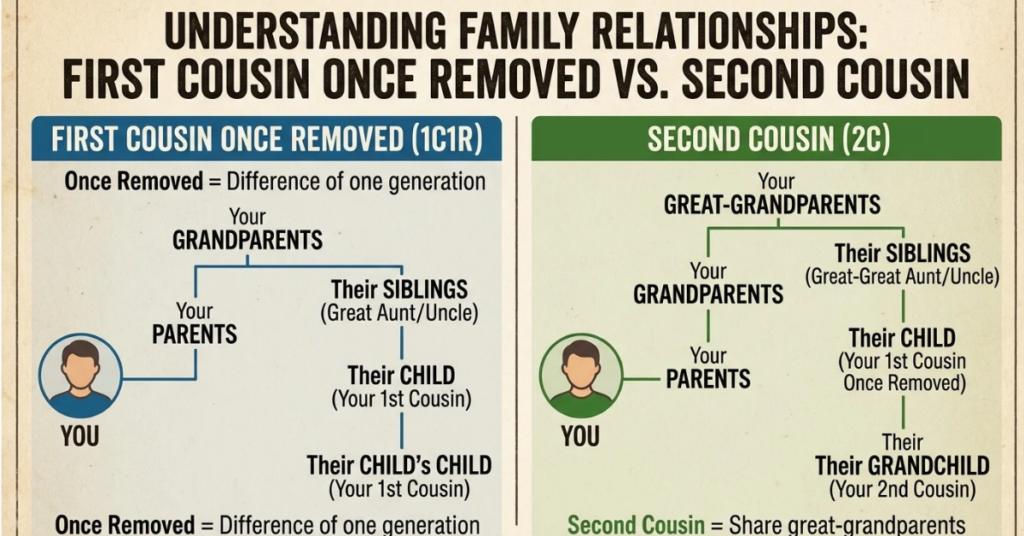
Here’s the simplest way to remember it: a first cousin once removed is one generation above or below your first cousin, while a second cousin shares the same great-grandparents as you. Once you understand that distinction, family trees become much easier to read.
Let’s break down the difference with real-life examples, a comparison chart, and straightforward answers to common genealogy questions.
What Is a First Cousin Once Removed?
A first cousin once removed is someone who is one generation above or below your first cousin. The phrase “once removed” refers to a difference of one generation, not to how distant the family connection is geographically or emotionally.
There are two common ways this relationship occurs.
Example 1: Your parent’s first cousin
Imagine your mother has a first cousin named Sarah. Your mother and Sarah share the same grandparents, making them first cousins.
You and Sarah, however, belong to different generations. Sarah is your first cousin once removed because she is your parent’s first cousin.
Example 2: Your first cousin’s child
Now imagine your first cousin David has a daughter named Emma.
You and David are first cousins because you share grandparents. But Emma is one generation below David, so Emma is your first cousin once removed.
The relationship works in both directions: your parent’s first cousin and your first cousin’s child are both your first cousins once removed.
How is the relationship calculated?
To identify a first cousin once removed, follow these steps:
- Identify your first cousin or your parent’s first cousin.
- Check whether the other person is one generation above or below you.
- If there is a one-generation difference, the relationship is first cousin once removed.
The key is that the people involved are connected through the same first-cousin family line, but they are not in the same generation.
What Is a Second Cousin?
A second cousin is someone who shares the same great-grandparents as you, but whose grandparents are siblings.
For example, imagine your grandmother and another person’s grandmother are sisters. Your grandmother’s parents are your great-grandparents, and those same people are also the other person’s great-grandparents.
You and that person are second cousins, provided your parents belong to the corresponding cousin branches.
Unlike a first cousin once removed, a second cousin is generally in your generation. You are both great-grandchildren of the same ancestors, although you may have different grandparents and parents.
A simple second-cousin example
Suppose your great-grandparents had two children: a son named Ahmed and a daughter named Ayesha.
- Ahmed had a child, Bilal.
- Ayesha had a child, Sana.
- Bilal had a child, Ali.
- Sana had a child, Zara.
Ali and Zara are second cousins because their grandparents, Bilal and Sana, are first cousins. Their shared ancestors are Ahmed and Ayesha’s parents, who are Ali’s and Zara’s great-grandparents.
This is why second cousins share great-grandparents rather than grandparents.
First Cousin Once Removed vs. Second Cousin: Key Differences
Now that both terms are clear, let’s compare them side by side. The biggest difference is the generation gap and the relationship between your shared ancestors.
First cousin once removed vs. second cousin chart
| Relationship detail | First cousin once removed | Second cousin |
|---|---|---|
| Generation | One generation above or below you | Usually the same generation |
| Shared ancestors | Your grandparents are their great-grandparents, or vice versa | Both share the same great-grandparents |
| Common example | Your first cousin’s child | Your parent’s cousin’s child |
| Family tree position | One generation apart | Same generation |
| Typical DNA shared | About 6.25% | About 3.125% |
| Common abbreviation | 1C1R | 2C |
Note: The DNA figures are population averages based on typical family relationships. Actual amounts can vary, and DNA alone does not always identify one exact relationship.
The easiest way to remember the difference
Think about the family tree as having different floors.
- First cousin: You and your relative are on the same floor and share grandparents.
- First cousin once removed: One of you is on the floor above or below the other.
- Second cousin: You and your relative are on the same floor but share great-grandparents instead.
The word “removed” describes a generational difference. The word “second” describes how far back your shared ancestors are.
Genealogy reference guides, including FamilySearch’s cousin relationship chart, use these same principles to identify cousin relationships.
Is Your First Cousin’s Child Your Second Cousin?
This is one of the most common family relationship questions, and the answer is no.
Your first cousin’s child is your first cousin once removed, not your second cousin.
Here’s why:
- You and your first cousin share grandparents.
- Your cousin’s child is one generation below your cousin.
- That makes the child your first cousin once removed.
However, the situation changes when you compare the children of two first cousins.
Imagine you have a first cousin named Ahmed. Ahmed has a daughter, Amina, and you have a son, Hamza.
Amina and Hamza are second cousins because their parents are first cousins and they share the same great-grandparents.
This is an important distinction: your cousin’s child is your first cousin once removed, but your child and your cousin’s child are second cousins.
How Much DNA Do First Cousins Once Removed and Second Cousins Share?
Family relationships can also be understood through genetics. Although a family tree tells you how two people are related, DNA testing can provide additional evidence of a biological connection.
According to standard genetic relationship estimates:
- First cousins once removed share approximately 6.25% of their autosomal DNA, on average.
- Second cousins share approximately 3.125% of their autosomal DNA, on average.
These percentages are estimates, not fixed amounts. People who have the same genealogical relationship can inherit different amounts of DNA from their shared ancestors.
Why do first cousins once removed typically share more DNA?
A first cousin once removed is generally closer to you through a first-cousin relationship, even though you belong to different generations.
Second cousins share a more distant ancestral connection through their great-grandparents. As a result, they typically share less DNA on average.
There is an important limitation, though: DNA percentages can overlap across different family relationships. If you’re using a consumer DNA test to identify a relative, consider the amount of shared DNA alongside ages, family history, and known ancestors rather than relying on a percentage alone.
How to Identify Your Cousin Relationship Using a Family Tree
If you’re still unsure whether someone is your first cousin once removed or second cousin, you can work it out without memorizing every family relationship.
Follow these steps.
Step 1: Find your common ancestor
Start with the oldest ancestor you know you share with the other person. This might be your grandparent, great-grandparent, or an even earlier ancestor.
Step 2: Count your generations
Count the number of generations between you and that ancestor, then do the same for your relative.
For example:
- Your grandparent is two parent-child steps away from you.
- Your great-grandparent is three parent-child steps away from you.
- Your great-great-grandparent is four parent-child steps away from you.
Step 3: Compare the two generation counts
If both of you are the same number of generations away from your shared ancestor, the relationship is not “removed.”
If one person is one generation farther away, the relationship is once removed. A difference of two generations means twice removed.
Step 4: Determine the cousin number
When both people are equally distant from their shared ancestor, the cousin number is one less than the number of parent-child steps to that ancestor.
For example, people who share great-grandparents are second cousins because their common ancestors are three generations above each of them.
If the two generation counts differ, use the smaller count to determine the cousin number and the difference between the counts to determine how many times removed the relationship is.
For more complicated family trees, the FamilySearch cousin relationship chart provides a helpful reference.
What Do People Say About First Cousin Once Removed vs. Second Cousin on Reddit?
People discussing cousin relationships on Reddit and genealogy forums often run into the same problem: everyday language doesn’t always match formal genealogy terminology.
Someone might call a first cousin’s child their second cousin because the child belongs to the next generation. That sounds reasonable in casual conversation, but genealogically, the correct term is first cousin once removed.
The confusion usually comes from treating the words “first” and “second” as a simple count of how many generations separate two relatives. In reality, the cousin number and the generation difference measure two separate things.
When looking through discussions about “first cousin once removed vs. second cousin Reddit,” keep these points in mind:
- A first cousin’s child is your first cousin once removed.
- Your parent’s first cousin is also your first cousin once removed.
- Your first cousin’s child and your child’s relationship is second cousins.
- A second cousin is generally in your generation and shares your great-grandparents.
Online discussions can be useful for seeing how people describe their own family relationships, but a family tree or a reliable genealogy chart is a better way to confirm the exact terminology.
Frequently Asked Questions
1. Is a first cousin once removed closer than a second cousin?
Genealogically, a first cousin once removed is generally a closer relationship by shared ancestry. On average, first cousins once removed share about 6.25% of their autosomal DNA, compared with about 3.125% for second cousins. Actual DNA inheritance varies.
2. What is a first cousin once removed in simple words?
A first cousin once removed is either your parent’s first cousin or your first cousin’s child. The term means there is a one-generation difference between you and the other person in the cousin relationship.
3. Are second cousins blood relatives?
Yes. Second cousins are biological relatives if the relationship comes through a shared biological family line. They share great-grandparents and, on average, approximately 3.125% of their autosomal DNA.
4. Are my parent’s cousins my first cousins once removed?
Yes. Your parent’s first cousin is your first cousin once removed. Your parent and that relative are first cousins, while you are one generation below them.
5. What is my second cousin’s child to me?
Your second cousin’s child is your second cousin once removed. The cousin number stays the same, while “once removed” indicates the one-generation difference.
6. Can a first cousin once removed be older than me?
Absolutely. Your parent’s first cousin may be much older than you, but the relationship is still first cousin once removed. The term refers to generations in the family tree, not a person’s exact age.
7. What is the difference between a first cousin once removed and a second cousin on a family tree?
A first cousin once removed belongs to a different generation from you, while a second cousin is generally in your generation. First cousins once removed are connected through the first-cousin branch, whereas second cousins share great-grandparents.
8. Is my first cousin once removed the same as my second cousin?
No. Your first cousin’s child is your first cousin once removed. Your second cousin is usually your parent’s cousin’s child. The two relationships have different generation patterns and different shared-ancestor connections.
9. What does 1C1R mean on a DNA test?
The abbreviation 1C1R means first cousin once removed. It is a genealogical relationship label sometimes used by DNA testing services, although the label is an estimate when based on shared DNA alone.
10. How can I find out exactly how someone is related to me?
Start by identifying your shared ancestors and comparing how many generations separate each of you from those ancestors. You can then use a cousin chart, a genealogy website, or a family tree to check the relationship. DNA testing may offer additional clues, but it cannot always distinguish between every possible relationship.
Conclusion: First Cousin Once Removed vs. Second Cousin Explained
The difference between a first cousin once removed and a second cousin becomes much easier once you separate two ideas: shared ancestry and generation difference.
A first cousin once removed is one generation above or below your first-cousin relationship. A second cousin generally belongs to your generation and shares your great-grandparents.
Keep these three rules in mind:
- First cousins share grandparents.
- First cousins once removed are one generation apart in a first-cousin relationship.
- Second cousins share great-grandparents and are generally in the same generation.
You don’t need to memorize an entire family tree to understand cousin relationships. Start with your common ancestors, count the generations, and the correct term will usually become clear.
If you’re researching your own family, try mapping your grandparents and great-grandparents first. A simple family tree can help you discover how different relatives connect and make even complicated cousin relationships easier to understand.
