
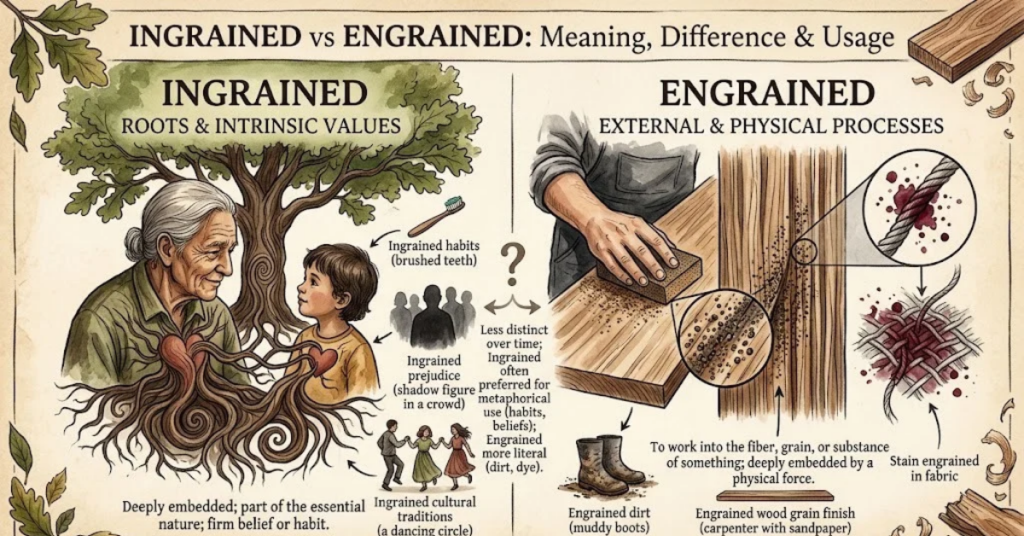
Have you ever wondered whether to write ingrained or engrained when describing a habit, belief, or behavior that is difficult to change? Both spellings look correct, and that is because they are both accepted English words. However, one spelling is much more common in everyday writing.
Understanding ingrained vs engrained can help you choose the right word for essays, professional documents, blog posts, and everyday conversations. Although the two terms generally share the same meaning, their origins and usage offer some interesting details.
In this guide, we will explain the meaning of ingrained and engrained, compare their definitions, explore British and American English usage, and provide practical examples to help you remember which spelling to use.
Ingrained vs Engrained: What Is the Difference?
The main difference between ingrained and engrained is not their meaning but their spelling and frequency of use. Both words describe something that has become deeply established, firmly fixed, or difficult to change.
Ingrained is the more common spelling in modern English, particularly when referring to habits, attitudes, beliefs, traditions, or behaviors. Engrained is also correct, but it is less frequently used in many contemporary contexts.
Here is a quick comparison:
| Feature | Ingrained | Engrained |
|---|---|---|
| Meaning | Deeply established or firmly fixed | Deeply established or firmly fixed |
| Correct spelling | Yes | Yes |
| Common usage | More widespread | Less common |
| Typical examples | Ingrained habits and beliefs | Engrained habits and beliefs |
| Best choice for general writing | Preferred | Acceptable alternative |
For most writing situations, choosing ingrained is the simplest option. It is widely recognized and generally sounds natural when discussing ideas, behaviors, and long-standing patterns.
Ingrained Meaning and Definition
The word ingrained is an adjective that describes something deeply established through repetition, experience, or long-term influence. It often refers to qualities or patterns that have become so familiar that changing them requires considerable effort.
According to its traditional meaning, something ingrained is firmly fixed in a person’s mind, character, habits, or the structure of something.
What Does Ingrained Mean in Everyday English?
In everyday language, ingrained is commonly used for things that have developed gradually and become difficult to remove or alter.
For example:
-
Ingrained habits: Behaviors repeated so often that they become automatic.
-
Ingrained beliefs: Opinions or ideas held strongly over time.
-
Ingrained prejudice: Bias that has become deeply established.
-
Ingrained traditions: Customs that have been maintained for generations.
-
Ingrained patterns: Repeated ways of thinking or acting.
Consider this sentence: “Checking her phone first thing in the morning had become an ingrained habit.”
This means the person had repeated the behavior so frequently that it had become part of her daily routine.
Example Sentences Using Ingrained
Here are some additional examples showing how the word works in different contexts:
-
His ingrained fear of failure prevented him from taking new opportunities.
-
Honesty was an ingrained value in their family.
-
Years of practice had made the technique ingrained in her memory.
-
The company needed to address its ingrained workplace culture.
-
Some ingrained habits take time and patience to change.
Notice that the word often appears before a noun, such as habit, belief, attitude, or behavior. It can also be used after linking verbs, as in “The tradition is deeply ingrained in the community.”
Engrained Meaning and Definition
Engrained is an alternative spelling of ingrained. It generally carries the same meaning: deeply embedded, firmly established, or difficult to remove.
The word is associated with the idea of something becoming fixed or embedded over time. It can be used to describe mental habits, social attitudes, and established behaviors.
For example, the sentence “His ingrained sense of responsibility made him a dependable colleague” can also be written as “His engrained sense of responsibility made him a dependable colleague.”
Both versions communicate the same idea.
Example Sentences Using Engrained
The following sentences demonstrate how engrained can be used naturally:
-
Her engrained belief in fairness influenced every decision she made.
-
The team’s engrained routines helped them work efficiently.
-
Years of repetition left the process engrained in his memory.
-
The community worked to challenge engrained social attitudes.
-
His engrained habits were difficult to change, even when he wanted to improve.
Although these sentences are grammatically understandable, many editors and writers would choose ingrained instead because it is the more familiar spelling.
Ingrained vs Engrained in UK English
One common question is whether British English prefers engrained while American English prefers ingrained. The answer is more nuanced than a simple regional division.
Both spellings are recognized in British English, and ingrained is also the usual choice in American English. There is no strict rule stating that British writers must use engrained.
In practice, ingrained is a safe choice in both UK and US English.
Which Spelling Should You Use in British English?
If you are writing for a UK audience, you can use either spelling, but ingrained is generally the more familiar choice in contemporary prose.
For example:
-
UK English: “The habit was deeply ingrained in his daily routine.”
-
US English: “The habit was deeply ingrained in his daily routine.”
The spelling remains the same even though other words in British and American English may differ.
Is Engrained More British Than Ingrained?
It is not accurate to treat engrained as exclusively British. It is an accepted variant rather than a spelling reserved for a particular country.
If you are preparing academic work, website content, business documents, or professional correspondence, consistency matters more than attempting to assign each spelling to a specific English-speaking region.
Why Are Ingrained and Engrained Both Correct?
The two spellings have overlapping histories and meanings, which helps explain why they coexist in modern English.
Ingrained is associated with the older idea of grain becoming embedded in a material, particularly in historical references to dyeing or coloring fibers. Over time, its figurative meaning developed to describe characteristics or ideas fixed deeply in a person’s mind or nature.
Engrained emerged as a spelling variant and is now used with essentially the same figurative meaning.
Today, both spellings are accepted, but their usage is not equally frequent. The widespread use of ingrained in modern writing makes it the more practical default.
It is worth remembering that a word’s historical development does not always determine how people use it today. Modern spelling conventions are also shaped by common usage, dictionaries, publishing practices, and editorial preferences.
Ingrained vs Engrained: Common Mistakes to Avoid
Although these words are easy to understand, writers sometimes make mistakes when choosing between them or using them in sentences.
1. Assuming One Spelling Is Incorrect
A common misconception is that engrained is always a spelling error. It is not. Both forms are accepted, although ingrained is more common.
2. Thinking They Have Completely Different Meanings
In ordinary modern usage, the words do not have a meaningful difference in definition. You can generally replace one with the other without changing the intended message.
3. Using the Word for Something Easily Changed
The word usually suggests that something has become deeply established. Describing a temporary preference as ingrained may exaggerate how firmly it is established.
For example, “His ingrained dislike of vegetables” suggests a long-standing attitude, whereas “He disliked vegetables yesterday” describes a temporary or specific experience.
4. Forgetting the Correct Context
Both spellings work in figurative expressions involving habits, beliefs, and attitudes. However, if you are discussing literal grain, wood grain, or another technical subject, choose terminology that accurately describes the material or process rather than assuming the figurative adjective always fits.
How to Remember Ingrained vs Engrained
If you regularly confuse the two spellings, a simple strategy can help.
Remember that ingrained is the standard choice for everyday writing. You do not need to memorize a complicated grammatical distinction because both words generally mean the same thing.
Use this quick checklist:
-
Are you describing a habit, belief, attitude, or behavior? Either spelling may work.
-
Do you want the more familiar spelling? Choose ingrained.
-
Are you following a publication’s style guide? Use the spelling required by that guide.
-
Are you editing an existing document? Keep the spelling consistent throughout.
For example, if you write “The belief was deeply ingrained in her thinking,” there is no need to replace ingrained with engrained. Your sentence is already correct and natural.
Frequently Asked Questions (FAQs)
1. Is ingrained or engrained correct?
Both ingrained and engrained are correct English spellings. They generally have the same meaning, but ingrained is more common in contemporary writing.
2. What is the meaning of ingrained vs engrained?
The meaning of ingrained vs engrained is essentially the same. Both words describe something deeply established, firmly fixed, or difficult to change, such as a habit, belief, or attitude.
3. Is engrained a real word?
Yes, engrained is a real and accepted English word. It is a variant of ingrained, although it is less commonly used in many modern contexts.
4. Is ingrained more common in British English?
Ingrained is widely used in British English, as well as American English. Although engrained is also accepted in the UK, it is not necessary to use it to make your writing sound British.
5. Is engrained British or American?
Engrained is not exclusive to either British or American English. Both varieties recognize the spelling, but ingrained is generally the more common option.
6. What does deeply ingrained mean?
Deeply ingrained means firmly established over time and often difficult to change. For instance, a deeply ingrained habit is one that has been repeated so often that it feels automatic.
7. Can I use ingrained and engrained interchangeably?
Yes. In most everyday contexts, the words are interchangeable because their meanings overlap. However, using ingrained consistently is often preferable for clarity and familiarity.
8. What is the difference between ingrained and embedded?
Both words can describe something firmly established, but they are not always interchangeable. Ingrained often refers to habits, beliefs, and attitudes, while embedded can describe something physically inserted into a material or deeply integrated into a system.
For example, “an ingrained belief” sounds natural, while “a chip embedded in a device” describes a physical component.
9. Does ingrained have a negative meaning?
No. Ingrained is a neutral word. It can describe positive qualities, such as ingrained discipline, as well as negative patterns, such as ingrained prejudice. The surrounding context determines whether the meaning is positive or negative.
10. What is the past tense of ingrain?
Ingrained is already the past-tense and past-participle form of the verb ingrain. For example, “Repeated practice ingrained the technique in her memory.” It is also used as an adjective, as in “an ingrained habit.”
Conclusion: Ingrained vs Engrained Explained
When comparing ingrained vs engrained, the most important point is that both spellings are correct and generally share the same meaning. They describe something deeply established, firmly fixed, or difficult to change, whether it is a personal habit, a long-held belief, or a social attitude.
The main distinction is frequency of use rather than definition. Ingrained is the more common spelling and is suitable for everyday writing, professional documents, academic work, and online content. Engrained remains an acceptable alternative, including in British English.
If you are unsure which version to choose, use ingrained and keep your spelling consistent. For more language guides, explore related articles on commonly confused English words, spelling variations, and word meanings to strengthen your writing and communicate with confidence.
