
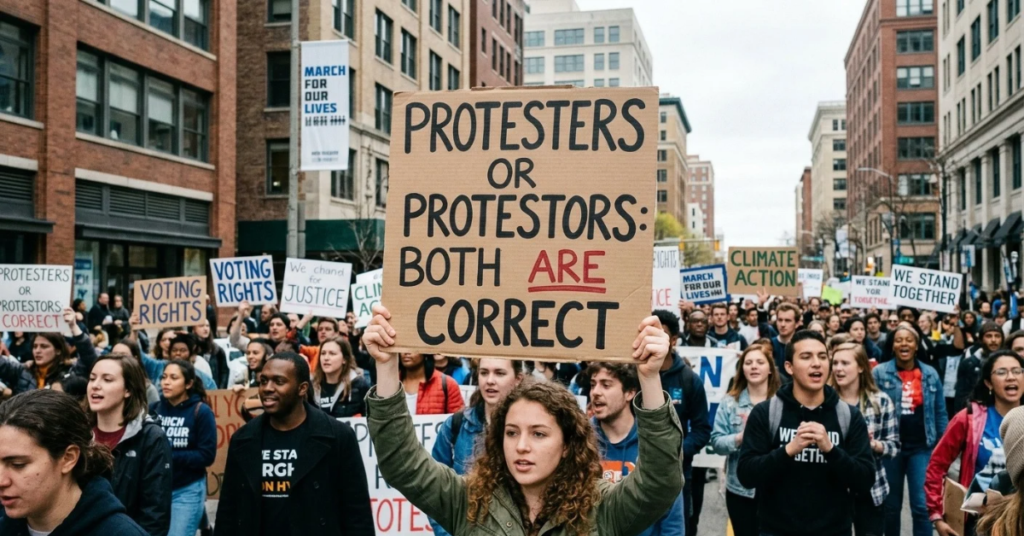
Have you ever stopped while writing to wonder whether the correct word is protestors or protesters? Both spellings appear in news reports, social media posts, academic papers, and everyday conversations. Although they look slightly different, they share the same meaning.
The good news is that both protestors and protesters are correct English spellings. However, one form is more common in modern usage, and your choice may depend on your audience, writing style, or editorial guidelines. In this guide, we’ll explain the difference, explore British and American English preferences, and clarify which spelling to use in professional writing.
Protestors or Protesters: What’s the Difference?
The words protesters and protestors refer to people who participate in a protest. A protest is an expression of disagreement, opposition, or objection to a policy, decision, action, or social issue.
For example, someone attending a public demonstration against rising prices can be described as a protester or a protestor. The meaning remains the same regardless of which spelling you choose.
The main difference is usage rather than definition.
- Protesters: The more common spelling in contemporary English, particularly in general writing and news coverage.
- Protestors: An accepted alternative spelling that also appears in journalism, publications, and other forms of writing.
If you’re unsure which one to use, protesters is generally the safer choice because it is widely recognized and commonly used.
Is It Protestors or Protesters?
If you’re asking, “Is it protestors or protesters?” the answer is that neither spelling is inherently incorrect.
Both words are formed by adding a noun ending to protest, describing a person who takes part in a protest. English sometimes allows different spellings for words that have the same pronunciation and meaning.
Consider these examples:
- Protesters gathered outside the government building to demand changes to the proposed policy.
- Protestors marched through the city center to express their opposition to the new law.
Both sentences are grammatically correct. The choice does not change the meaning or imply a different kind of demonstration.
Nevertheless, consistency matters. If you’re writing an article, report, or academic assignment, choose one spelling and use it throughout unless you are following a publication’s specific rules.
Protestors or Protesters Spelling: Why Are Both Correct?
The difference between these spellings comes down to how English words develop and how different forms become established through usage.
The word protest has Latin roots, ultimately connected to protestari, meaning to declare or testify publicly. The English noun protester follows a familiar pattern in which the suffix -er identifies a person who performs an action.
For example:
- Teach → Teacher
- Work → Worker
- Protest → Protester
The alternative spelling, protestor, uses the suffix -or, which also appears in English nouns referring to people who perform actions, such as actor and editor.
English does not apply these suffixes through one perfectly consistent rule. Both protester and protestor have become established spellings, so the difference is largely a matter of convention and editorial preference.
Which spelling is more common?
Protesters is generally the more common form in contemporary English usage. It is a particularly practical choice for online articles, educational content, and general communication.
However, frequency can vary by publication, region, and historical period. The less common spelling is still acceptable, so it should not automatically be treated as a spelling mistake.
Protestors or Protesters in UK English
When comparing protestors or protesters in UK English, both spellings are acceptable. British English does not universally require one form over the other.
British newspapers, broadcasters, and other publications may adopt their own house styles. Some use protesters as their standard spelling, while others may use protestors in particular contexts.
For writers targeting a British audience, these tips can help:
- Use protesters if you want a widely recognized, straightforward spelling.
- Follow the style guide of the British publication you’re writing for.
- Check the publication’s existing articles if its preferred spelling is unclear.
- Keep the spelling consistent throughout the text.
Remember that British English has several well-known spelling differences, such as colour instead of color. However, the distinction between protesters and protestors is not a simple UK-versus-US spelling rule.
Protestors or Protesters in American English
In American English, both spellings are also recognized. However, protesters is widely used in contemporary American news reporting and general writing.
For example, an American news article might say:
“Protesters gathered outside the courthouse to oppose the proposed legislation.”
This sentence sounds natural and follows common modern usage. Using protestors would also be understandable and acceptable, provided it does not conflict with the publication’s editorial rules.
If you’re writing for a US audience, protesters is a sensible default. It is familiar to readers and works well in news articles, blog posts, essays, and informational content.
Protestors or Protesters: What Does AP Style Say?
The Associated Press (AP) Stylebook is an influential editorial reference used by many journalists, newsrooms, and communications professionals.
When deciding between protestors and protesters in AP Style, writers should consult the current edition of the AP Stylebook or their newsroom’s official guidance rather than assume that every publication follows the same preference.
For practical writing, protesters is the recommended general-purpose choice because it is widely used in modern journalism. Still, if your employer, editor, or publication specifies protestors, follow that instruction consistently.
AP Style is especially relevant when writing:
- Newspaper and online news articles
- Press releases
- Political and social issue reports
- Editorial content
- Public relations materials
A useful rule is to prioritize your required style guide over personal preference. This keeps your writing consistent and makes editing easier.
Protesters vs. Protestors: Examples in Sentences
Seeing both spellings in context makes the difference easier to understand. Here are several examples you can use as a reference.
Examples using “protesters”
- Protesters gathered in the capital to call for political reform.
- Police closed several roads as protesters moved toward the city square.
- The protesters demanded stronger environmental protections.
- Local protesters organized a peaceful demonstration outside the factory.
- Thousands of protesters attended the march over the weekend.
Examples using “protestors”
- Protestors assembled outside the parliament building to voice their concerns.
- The protestors carried signs calling for changes to the proposed law.
- Several protestors addressed the crowd during the public demonstration.
- The authorities issued a statement after meeting with the protestors.
- Protestors gathered peacefully to oppose the construction project.
All ten examples communicate the same basic idea. The spelling alone does not indicate whether a demonstration is peaceful, disruptive, political, or focused on a particular cause.
Related Words: Protester, Protestor, Protest and Protestation
Understanding related terms can help you use the correct word in different contexts.
Protester: A person who participates in a protest or expresses opposition to something.
Protestor: An alternative spelling of protester with the same meaning.
Protest: An act of expressing disagreement, objection, or opposition. It can refer to a public demonstration or a more general expression of dissent.
Protestation: A formal or emphatic statement expressing objection, denial, or disagreement. It does not necessarily refer to someone participating in a public demonstration.
Demonstrator: A person who takes part in a public demonstration. This term often overlaps with protester, although the context may emphasize the demonstration itself.
Activist: A person who works to promote or oppose social, political, environmental, or other causes. An activist may participate in protests, but activism also includes activities such as campaigning, organizing, and advocacy.
These words are related, but they are not always interchangeable. Choose the term that most accurately describes the situation.
Common Mistakes to Avoid When Using Protesters or Protestors
Although both spellings are correct, writers can still make mistakes when using them.
1. Assuming one spelling is always wrong
Neither protesters nor protestors should automatically be marked incorrect. Both are established English forms.
2. Switching spellings unnecessarily
Using protesters in one paragraph and protestors in the next can make an article look inconsistent. Pick one form unless a quotation or official name requires otherwise.
3. Treating the spellings as British and American equivalents
Unlike some familiar regional spelling differences, this pair does not divide neatly along national lines. Both forms appear in British and American English.
4. Confusing protesters with protestations
A protester is a person, whereas a protestation is a statement or expression of objection. The words have related origins but different meanings.
5. Ignoring publication guidelines
Newsrooms, universities, businesses, and academic journals may have their own style requirements. Always check the relevant guide when producing formal content.
Frequently Asked Questions
1. Is it protestors or protesters?
Both protestors and protesters are correct spellings. They refer to people who participate in protests or publicly express opposition. Protesters is generally the more common choice in contemporary English.
2. Which spelling is correct in the UK: protestors or protesters?
Both spellings are accepted in UK English. Individual British publications may prefer one form, so follow the relevant house style when writing for a specific newspaper or organization.
3. Is it protestors or protesters in AP Style?
For professional journalism, consult the current AP Stylebook or your newsroom’s guidance for its preferred form. Protesters is a practical general-purpose choice, but writers should verify any specific AP Style requirement rather than rely on assumptions.
4. Is “protestors” a real word?
Yes. Protestors is an accepted spelling of the noun referring to people who participate in protests. It is an alternative to protesters, not an inherently incorrect word.
5. Why are there two spellings of protesters?
The two forms developed through different noun-forming patterns in English. Both the -er and -or endings occur in words describing people who perform actions, and usage has established both forms.
6. Do protestors and protesters mean the same thing?
Yes. Both words describe people who express opposition or participate in a protest. The spelling does not change the meaning.
7. Which spelling should I use in an essay?
Use protesters unless your teacher, institution, or required style guide specifies otherwise. It is widely recognized and is a straightforward choice for academic and general writing.
8. Is “protester” more common than “protestor”?
Generally, yes. Protester is widely used in contemporary English, especially in news reporting and general writing. Exact frequency can vary depending on the publication, region, and time period.
9. Is “protesters” singular or plural?
Protesters is the plural form of protester. The singular refers to one person, while the plural refers to two or more people. The same pattern applies to protestor and protestors.
10. Can I use both spellings in the same article?
You can, but it is usually better to choose one spelling and use it consistently. Exceptions may be necessary when reproducing a direct quotation or following an official name or source.
Conclusion
When deciding between protestors or protesters, remember that both spellings are correct and carry the same meaning. The main difference lies in usage, frequency, and editorial preference rather than grammar or definition.
For most blog posts, essays, and general articles, protesters is the safest default because it is widely recognized in modern English. If you’re writing for a British or American publication, follow its style guide. For journalism, check the current AP Stylebook or your newsroom’s instructions.
Ultimately, the best spelling is the one that fits your audience and remains consistent throughout your writing. If you’re interested in similar English usage questions, explore more guides on commonly confused words, spelling variations, and grammar rules to make your writing clearer and more confident.
