
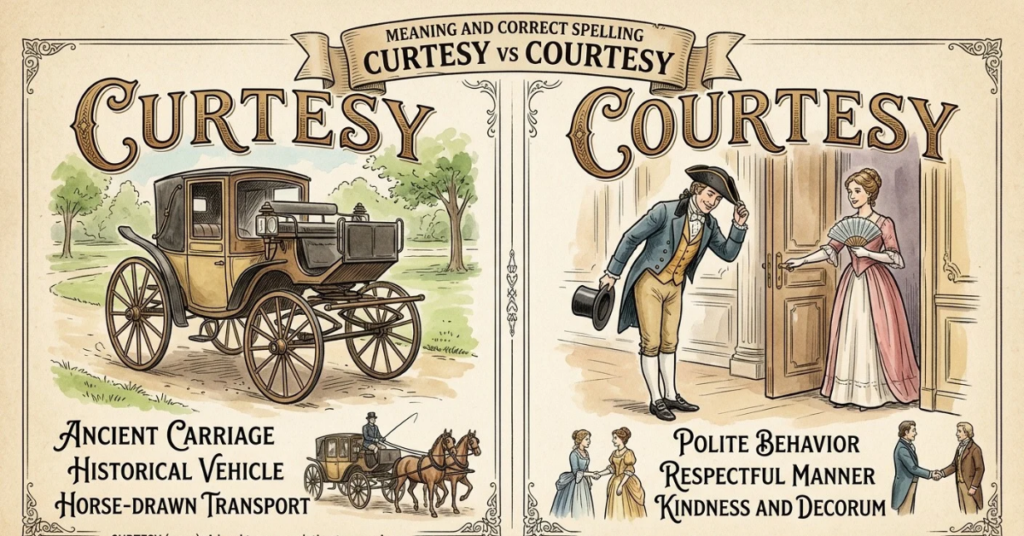
Have you ever wondered whether to write curtesy or courtesy? These two words look almost identical, but their meanings are quite different. If you want to improve your spelling, write more confidently, or understand an unfamiliar word, knowing the difference between curtesy vs courtesy will help you avoid common mistakes.
The confusion is understandable because both words are pronounced similarly in many contexts. However, courtesy is the word you will usually need when talking about politeness, respect, or good manners. Curtesy, on the other hand, is a historical legal term related to a husband’s rights in certain property inherited by his wife.
Let’s explore their definitions, spelling differences, examples, and practical usage so you can choose the right word every time.
Curtesy vs Courtesy: What Is the Difference?
The main difference between curtesy and courtesy is their meaning and context. Although they share several letters, they are not interchangeable.
- Courtesy: A noun meaning politeness, consideration, respect, or a kind and respectful act toward another person.
- Curtesy: A historical legal term, also spelled courtesy in some legal contexts, referring to a surviving husband’s traditional life interest in certain property inherited by his deceased wife.
In everyday English, courtesy is the correct choice when discussing manners, professional behavior, customer service, or considerate actions. You are unlikely to encounter curtesy unless you are reading historical legal documents or studying property law.
Quick Comparison: Curtesy vs Courtesy
| Feature | Curtesy | Courtesy |
|---|---|---|
| Meaning | Historical marital property right | Politeness, respect, or consideration |
| Common context | Historical property law | Everyday conversation and writing |
| Part of speech | Noun | Noun; also used in established expressions |
| Example | The text discussed curtesy rights under historical law. | She treated every guest with courtesy. |
| Modern usage | Rare | Very common |
Remember: If you mean good manners or respectful behavior, use courtesy. The spelling curtesy is associated with a specialized historical legal meaning.
What Does Courtesy Mean?
Courtesy means showing politeness, respect, and consideration for other people. It involves recognizing others’ feelings, respecting their time, and behaving thoughtfully in social and professional situations.
Courtesy does not necessarily require grand gestures. Simple actions, such as saying thank you, holding a door open, listening without interrupting, or responding to a message politely, can demonstrate courtesy.
Examples of Courtesy in Everyday Life
Here are some examples that show how the word is used naturally:
- Social situations: He showed courtesy by offering his seat to an elderly passenger.
- Workplace communication: Please respond to your colleagues with courtesy and respect.
- Customer service: The hotel staff treated every visitor with courtesy.
- Online communication: A courteous reply can prevent a disagreement from becoming an argument.
- Public behavior: Drivers should show courtesy to pedestrians and other road users.
In each example, courtesy describes respectful or considerate behavior.
Common Expressions Using Courtesy
The word courtesy appears in several everyday expressions. Understanding these phrases will help you recognize the correct spelling.
- Common courtesy: Basic politeness expected in ordinary interactions.
- Courtesy call: A visit or phone call made as a polite gesture rather than for a specific transaction.
- Courtesy of: Used to acknowledge who provided something or to indicate the source of a service.
- Courtesy car: A vehicle provided temporarily by a business, often while a customer’s own vehicle is being repaired.
- Courtesy notice: A reminder or notification provided as a consideration to the recipient.
For example, in the sentence “The photographs are courtesy of the event organizer,” the phrase identifies who supplied the photographs.
What Does Curtesy Mean?
Curtesy is a historical legal term associated with the traditional property rights of a husband after his wife died. Under certain common-law rules, a surviving husband could receive a life interest in qualifying real property that his deceased wife owned or inherited.
This right was traditionally subject to specific legal requirements. Depending on the applicable historical rules, these could include the couple’s marriage, the wife’s qualifying ownership of the property, and the birth of a child who could inherit from her.
The exact requirements varied by jurisdiction and period. Curtesy is now largely a historical or specialized legal term, and modern inheritance laws differ significantly across countries and regions.
An Example of Curtesy in a Sentence
Consider the following sentence:
“The historian examined the husband’s curtesy rights under the property laws of the period.”
Here, curtesy refers to a historical legal entitlement, not politeness or good manners.
Another example is:
“The legal text explained how curtesy affected the transfer of inherited land.”
Both examples use the term in the context of property and inheritance law.
Is Curtesy Still Used Today?
The term may still appear in historical legal research, older property documents, legal dictionaries, and discussions of common-law inheritance. However, it is uncommon in ordinary modern English.
If you encounter curtesy in a document, examine the surrounding text before interpreting it. It may refer to a historical marital property right, and its precise meaning depends on the relevant legal system and period.
Why Do People Confuse Curtesy and Courtesy?
There are several reasons these words are easy to mix up.
1. Their Spellings Are Almost Identical
Both words contain the letters c, u, r, t, e, and s in a similar arrangement. The main visible difference is that courtesy contains an additional o after the c.
When typing quickly, it is easy to leave out that letter or accidentally choose the less familiar spelling.
2. Their Pronunciations Can Sound Similar
In many varieties of English, the two words are pronounced similarly. Because curtesy is uncommon, writers may also assume it is simply an alternative spelling of courtesy.
However, the words have different meanings in standard usage. Their similar appearance does not make them interchangeable.
3. Spellcheck May Not Catch the Mistake
A spellchecker may recognize curtesy as a legitimate word because it exists in specialized legal vocabulary. As a result, a sentence such as “Please show curtesy to your customers” might not always be flagged.
This is why checking meaning and context is just as important as checking spelling.
How to Remember the Correct Spelling
If you frequently confuse curtesy vs courtesy, a simple memory trick can help.
Associate courtesy with consideration. Both words begin with the letter c, and courtesy is the term you need when discussing considerate behavior.
You can also remember these practical rules:
- Talking about manners? Use courtesy.
- Describing respect or politeness? Use courtesy.
- Reading about historical inheritance rights? Curtesy may be the relevant legal term.
- Unsure which word fits? Replace it mentally with politeness. If the sentence still makes sense, courtesy is probably the word you want.
For example, “She showed politeness to her neighbors” means the same thing as “She showed courtesy to her neighbors.” The substitution works because courtesy concerns respectful behavior.
Curtesy vs Courtesy: Common Mistakes to Avoid
Even experienced writers can make spelling mistakes when two words look so similar. The following examples demonstrate the difference between correct and incorrect usage.
| Sentence | Correct or Incorrect? | Explanation |
|---|---|---|
| Please show courtesy to your guests. | Correct | Courtesy means politeness. |
| Thank you for your courtesy. | Correct | The word refers to considerate behavior. |
| Please show curtesy to your guests. | Incorrect in ordinary usage | The intended word is courtesy. |
| The historian studied curtesy rights. | Potentially correct | Curtesy can refer to historical property law. |
| The manager called as a courtesy. | Correct | The call was a polite gesture. |
A useful editing habit is to read each sentence in context instead of relying exclusively on automatic spelling corrections. This is particularly helpful when writing professional emails, academic assignments, articles, or business communication.
Courtesy vs Other Similar Words
Understanding a few related terms can make your vocabulary more precise.
Courtesy vs Politeness
Courtesy and politeness are closely related. Politeness generally describes good manners and respectful behavior, while courtesy often emphasizes considerate actions toward other people.
For example, saying “please” demonstrates politeness, while offering assistance to someone who needs it can be an act of courtesy.
Courtesy vs Respect
Respect involves recognizing another person’s dignity, rights, feelings, or position. Courtesy is one way of expressing that respect through behavior.
For instance, listening carefully when someone speaks can show both respect and courtesy.
Courtesy vs Curtsy
Although the spellings are similar, curtsy is a different word altogether. A curtsy is a traditional gesture of respect in which a person bends the knees slightly, often while lowering the head.
Compare the terms:
- Courtesy: Polite or considerate behavior.
- Curtesy: A historical legal term related to marital property rights.
- Curtsy: A formal gesture of respect.
Remembering this third word can be especially helpful because all three spellings look similar.
Frequently Asked Questions
1. Is it curtesy or courtesy?
Both spellings exist, but they have different uses. Courtesy is the standard word for politeness, respect, and consideration. Curtesy is a specialized historical legal term related to a surviving husband’s rights in certain property owned by his deceased wife.
2. Is curtesy a real word?
Yes. Curtesy is a recognized legal term found in historical common-law discussions and legal references. It is not, however, the appropriate spelling when you mean ordinary politeness or good manners.
3. What does courtesy mean in simple words?
Courtesy means being polite, respectful, and considerate toward other people. Saying thank you, holding a door open, or speaking respectfully are simple examples of courtesy.
4. How do you spell courtesy correctly?
The correct spelling is courtesy, with an o immediately after the first letter c. A helpful reminder is to associate courtesy with consideration and polite behavior.
5. Is courtesy the same as a curtsy?
No. Courtesy means politeness or considerate behavior, while a curtsy is a traditional gesture involving a slight bending of the knees. Curtesy, meanwhile, is a historical legal term.
6. Can curtesy be used in modern English?
Yes, but its use is rare and generally limited to legal history, historical property discussions, and related specialist contexts. The exact legal significance depends on the jurisdiction and applicable law.
7. What is an example of courtesy in a sentence?
“She showed courtesy by thanking the staff for their help.” In this sentence, courtesy refers to respectful and appreciative behavior.
8. Why does my spellchecker accept curtesy?
Some spellcheckers recognize specialized legal terms as valid words. Since curtesy exists in legal vocabulary, a spellchecker may accept it even when you intended to write courtesy. Always consider the meaning of the sentence, not just the spelling.
Conclusion
The difference between curtesy vs courtesy becomes simple once you understand their meanings. Courtesy is the everyday word for politeness, respect, and considerate behavior, while curtesy is a rare historical legal term associated with marital property rights.
When writing emails, articles, assignments, or everyday messages, choose courtesy whenever you mean good manners. Reserve curtesy for the appropriate legal or historical context, and remember that curtsy refers to a separate gesture of respect.
To strengthen your vocabulary further, explore other commonly confused words and practice using them in sentences. A little attention to spelling and context can make your writing clearer, more accurate, and more professional.
