
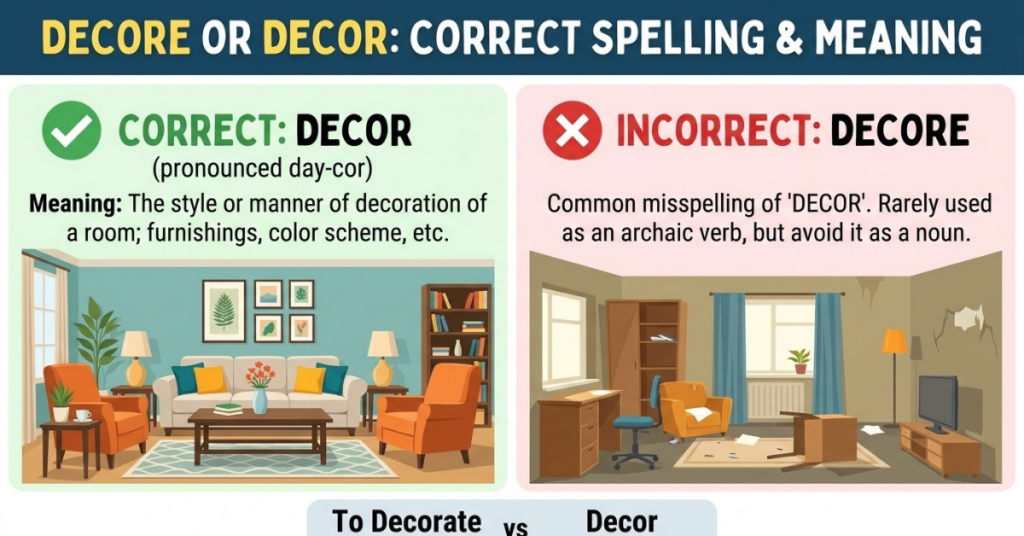
Have you ever searched for home decorating ideas and wondered whether the correct spelling is decore or decor? The two words look similar, but they are not used in the same way. If you want to write correctly about interior design, home styling, or decoration, knowing the difference can help you avoid common spelling mistakes.
The correct spelling in modern English is generally decor, although décor, with an accent over the letter “e,” is also correct. The spelling decore is not the standard choice when referring to the style or appearance of a room, home, office, or other space.
In this guide, we will explain the meaning of decor, explore the difference between decore and décor, and show you how to use the word correctly in everyday writing.
Decore or Decor: Which Is Correct?
When deciding between decore or decor, decor is the correct spelling for interior decoration and styling. You can also write it as décor, which is the traditional French-influenced spelling commonly used in English.
Here is a quick comparison:
| Word | Correct usage | Meaning |
|---|---|---|
| Decor | Yes | The style and decorative elements of a space |
| Décor | Yes | An alternative spelling of decor |
| Decore | Generally no | A nonstandard spelling when referring to interior decoration |
For example, if you are describing a beautifully furnished living room, you could write, “The decor creates a warm and welcoming atmosphere.”
Writing “The decore creates a warm and welcoming atmosphere” would be considered a spelling error in standard English.
What Does Decor Mean?
The word decor refers to the overall style, appearance, and decorative arrangement of a room, building, or other environment. It includes the objects, colors, textures, furnishings, and design details that contribute to the look and feel of a space.
Decor can be simple and minimal or detailed and luxurious. It depends on the design choices, personal preferences, and purpose of the space.
For example, a living room with neutral walls, wooden furniture, soft lighting, and a few carefully selected accessories might have a minimalist decor style. In contrast, a room with bold colors, patterned fabrics, decorative artwork, and ornate furniture might feature an eclectic or traditional decor style.
Examples of Decor in Everyday Life
You will commonly encounter the word decor in the following contexts:
- Home decor: Cushions, curtains, rugs, mirrors, wall art, and decorative accessories used at home.
- Interior decor: The furnishings, finishes, colors, and styling elements that shape an indoor space.
- Office decor: Furniture, lighting, artwork, and other details that make a workplace functional and visually appealing.
- Event decor: Flowers, table settings, backdrops, lighting, and decorations used for weddings, parties, and celebrations.
- Seasonal decor: Decorative items used during holidays, festivals, or particular seasons.
Although these categories serve different purposes, they share the same basic idea: creating a particular visual atmosphere through thoughtful decorative choices.
Decore or Décor: Understanding the Difference
The question of decore or décor often arises because the word has French origins. Understanding its spelling and pronunciation makes it easier to use correctly.
What Is the Difference Between Decor and Décor?
There is no meaningful difference in their meaning. Both decor and décor refer to the style or decorative appearance of a space.
The main difference is the accent mark. The spelling décor preserves the accent found in the French word, while decor is a widely accepted English spelling without it.
Both forms are suitable for general writing. However, consistency matters, particularly in professional documents, website content, interior design portfolios, and marketing materials.
How Do You Pronounce Decor?
In English, decor is commonly pronounced day-KOR or duh-KOR, depending on the speaker and regional accent. The second syllable receives the main emphasis.
The word décor is generally pronounced the same way in English. The accent mark does not create a different meaning or require a different pronunciation in ordinary English usage.
If you are discussing a room’s appearance, you can use either spelling without changing the meaning of your sentence.
Why Is Decore a Common Spelling Mistake?
The spelling decore can seem reasonable because English contains many words ending in “-ore” or “-core.” People may also associate it with the word decorate, which has a similar beginning.
However, decore is not the standard spelling of the noun used to describe the appearance of a room or interior space. The correct noun is decor or décor.
Another possible source of confusion is that the verb decorate describes the action of adding or arranging decorative elements. Although the words are related in meaning, they are not interchangeable.
For accurate writing, remember these distinctions:
- Decor: The style or appearance of a space.
- Décor: An alternative spelling of decor.
- Decorate: To make a place more attractive by adding or arranging decorative elements.
- Decoration: An object, feature, or arrangement used to make something more attractive.
- Decorative: Intended to improve appearance rather than serve a purely practical purpose.
Understanding these related words can improve your spelling, vocabulary, and overall writing quality.
How to Use Decor Correctly in a Sentence
The easiest way to remember the correct spelling is to practise using decor in different contexts. Here are some examples that show how the word works in everyday English.
Decor in Home Design
- The living room decor combines neutral colors with natural wood.
- I want to update my bedroom decor without spending too much money.
- Modern decor often features clean lines and simple furnishings.
- The restaurant’s decor creates a relaxed and inviting atmosphere.
Decor in Professional Writing
- Our interior design team specializes in contemporary home decor.
- The client requested elegant decor for the reception area.
- Natural materials can add warmth and character to minimalist decor.
- The event planner selected floral decor to complement the wedding theme.
Decor vs. Decorate: Example Sentences
These two words are related, but they perform different roles in a sentence.
Correct use of decor: “The decor of the apartment feels modern and comfortable.”
Correct use of decorate: “We plan to decorate the apartment with plants and artwork.”
In the first example, decor is a noun describing the apartment’s appearance. In the second, decorate is a verb describing an action.
This distinction is especially useful when writing interior design descriptions, product listings, social media captions, or articles about home styling.
Decor vs. Decoration: Are They the Same?
Although decor and decoration are closely related, they do not always mean exactly the same thing.
Decor usually describes the overall visual style of a space or setting. Decoration often refers to an individual decorative object, the process of decorating, or the act of making something more attractive.
For example, a room’s decor might include its color palette, furniture arrangement, lighting, curtains, and artwork. A decorative vase placed on a table is a decoration that contributes to that overall look.
Consider these examples:
- “The cafe has beautiful decor.” This describes the cafe’s overall appearance.
- “The handmade ornaments are beautiful decorations.” This refers to individual objects.
- “The decoration of the room took two days.” This describes the process of decorating.
Choosing the right word helps make your writing clearer and more precise.
Popular Decor Styles and Their Meanings
Now that the correct spelling is clear, it helps to understand how the term appears in interior design. Different decor styles use colors, furniture, materials, and accessories to create distinct atmospheres.
1. Modern Decor
Modern decor emphasizes clean lines, functional furniture, balanced proportions, and a carefully controlled selection of materials. Depending on the design, it may feature neutral colors, natural textures, glass, metal, or understated artwork.
2. Minimalist Decor
Minimalist decor focuses on simplicity and purpose. It typically avoids unnecessary objects and emphasizes open space, practical furniture, restrained colors, and a sense of visual calm.
3. Traditional Decor
Traditional decor draws inspiration from established design traditions. It may include classic furniture, rich wood finishes, layered textiles, detailed patterns, and symmetrical arrangements.
4. Bohemian Decor
Bohemian decor often combines natural materials, layered rugs, plants, textiles, artwork, and objects collected from different places. It tends to feel expressive, relaxed, and personal rather than strictly coordinated.
5. Scandinavian Decor
Scandinavian decor is associated with functionality, simplicity, natural materials, and light-filled interiors. Common features include pale wood, comfortable furniture, neutral colors, and carefully chosen accessories.
These examples demonstrate how the word decor describes an overall design approach rather than one specific object or product.
How to Choose the Right Decor for Your Space
Good decor does not necessarily require expensive furniture or a complete renovation. Often, a few thoughtful changes can improve the appearance and comfort of a room.
Follow these practical steps when planning your decor:
- Choose a design direction. Decide whether you prefer a modern, minimalist, traditional, or another style.
- Select a color palette. Choose a small group of complementary colors for walls, textiles, furniture, and accessories.
- Consider functionality. Make sure the room works for your daily activities before adding decorative items.
- Balance textures and materials. Combine elements such as wood, fabric, glass, metal, or natural fibers to create visual interest.
- Pay attention to lighting. Natural light, ceiling fixtures, table lamps, and accent lighting can significantly influence the atmosphere.
- Add personal details. Artwork, photographs, plants, books, and meaningful objects can make a space feel individual.
- Avoid unnecessary clutter. Give each item enough room to contribute to the design without overwhelming the space.
The most successful decor choices balance appearance, comfort, and practicality. Instead of following every trend, focus on creating a space that suits your lifestyle and personal taste.
SEO and Writing Tips for Using the Word Decor
If you create content about interiors, home styling, or decorating products, spelling and keyword selection matter. Using the correct word makes your content clearer for readers and helps align it with common search terms.
Here are a few useful writing tips:
- Use decor as your primary keyword when writing about interior styling.
- Include related phrases such as home decor ideas, modern interior decor, bedroom decor, and decorating tips where they fit naturally.
- Use décor when it suits your publication’s style, but avoid switching between spellings without a reason.
- Avoid using decore as a target spelling for standard English content about interior design.
- Write for the reader first. A clear explanation and useful examples are more valuable than repeating the same keyword excessively.
For example, an article titled “Small Bedroom Decor Ideas” is clearer and more natural than one titled “Small Bedroom Decore Ideas.”
The same principle applies to product descriptions, blog headings, portfolio projects, and social media posts. Correct spelling supports a professional impression while making your content easier to understand.
Frequently Asked Questions About Decore or Decor
1. Is it decore or decor?
Decor is the correct standard English spelling when referring to the style or appearance of a room or space. Décor is also correct, while decore is generally a misspelling in this context.
2. Is decore a real word?
The spelling decore may appear in names, specialized contexts, or nonstandard writing, but it is not the standard English noun for interior decoration. Use decor or décor when describing a room’s appearance.
3. Is decor or décor more correct?
Both spellings are correct. Decor is widely used in English, while décor retains the French accent mark. Choose one spelling and use it consistently throughout your writing.
4. What is the meaning of decor?
Decor means the style, appearance, and decorative arrangement of a room, building, or setting. It can include furniture, colors, lighting, artwork, textiles, and accessories.
5. How do you spell decor in British English?
Decor and décor are both used in British English. The unaccented spelling is common and is also widely accepted in American English.
6. How do you pronounce decor?
In English, decor is commonly pronounced day-KOR or duh-KOR, with the emphasis on the second syllable. Regional accents may affect the exact pronunciation.
7. What is the difference between decor and decoration?
Decor usually describes the overall style or appearance of a space. Decoration can refer to an individual decorative item or the process of making a place more attractive.
8. Can I use decor in formal writing?
Yes. Decor is appropriate in professional and formal writing, including interior design reports, portfolios, product descriptions, marketing materials, and academic discussions of interior environments.
9. What are some examples of decor?
Examples include furniture, rugs, curtains, cushions, artwork, mirrors, plants, lighting fixtures, and decorative accessories. Together, these elements help establish a room’s overall style and atmosphere.
10. Is home decor the same as interior design?
Not exactly. Home decor focuses mainly on the visual style and decorative elements of a home. Interior design can involve a broader range of work, including space planning, circulation, ergonomics, materials, lighting, functionality, and building-related requirements.
Conclusion: Decore or Decor?
When choosing between decore or decor, the answer is straightforward: decor is the standard spelling, and décor is an equally valid alternative. The spelling decore is generally incorrect when describing the style or appearance of an interior space.
Decor refers to the overall look and atmosphere created through furniture, colors, lighting, textures, artwork, and other decorative elements. Understanding the difference between decor, decorate, and decoration will help you write more accurately, whether you are discussing home styling, preparing an interior design portfolio, or creating SEO content.
Next time you write about interior design or home decorating, choose the correct spelling and use it consistently. If you want to explore the subject further, consider reading about modern decor styles, small-room decorating ideas, or practical ways to create a beautiful home on a budget.
