
Have you ever typed a word, looked at it twice, and wondered whether you spelled it correctly? If you’re confused about prefer or perfer, you’re not alone. Many English learners and native speakers occasionally mix up these two spellings, especially when writing quickly or relying on pronunciation.
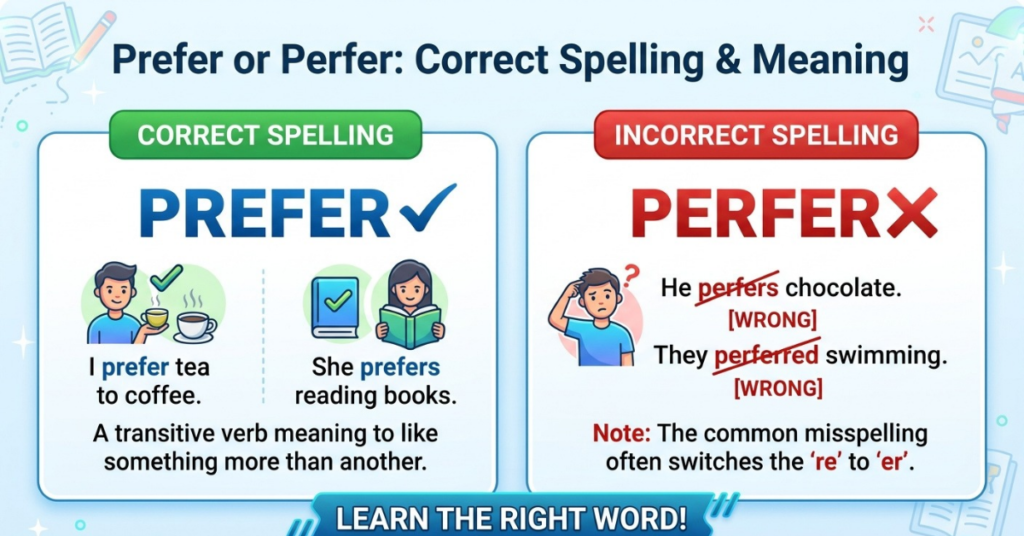
The correct spelling is prefer. The word perfer is a common spelling mistake, not a standard English word. Whether you’re writing an email, completing a school assignment, or sending a message, knowing the difference will help you communicate more clearly.
In this guide, we’ll explain the correct spelling, the meaning of prefer, how to use it in sentences, and a few simple tricks to remember it.
Is It Prefer or Perfer?
The correct spelling is prefer, with an r immediately after the first letter p and the letter e following it.
| Spelling | Correct or incorrect? | Explanation |
|---|---|---|
| Prefer | Correct | The standard English verb |
| Perfer | Incorrect | A common misspelling of prefer |
For example:
- Correct: I prefer tea over coffee.
- Incorrect: I perfer tea over coffee.
Both sentences may communicate the same intended message, but only the first uses the correct spelling.
If you’re wondering, “Is it prefer or perfer?” remember that the word always begins with pre-, not per-.
Prefer or Perfer Meaning
To understand why prefer is the correct word, it helps to know what it means.
Prefer is a verb that means to like, choose, or favor one person, thing, or option more than another. It expresses a personal choice, taste, or preference.
Here are a few everyday examples:
- I prefer reading books to watching television.
- She prefers working in the morning.
- We prefer homemade food to restaurant meals.
- He would prefer to stay at home tonight.
In each example, someone favors one option over another.
The word can describe choices about food, activities, working arrangements, travel, clothing, communication, and almost anything else involving personal preferences.
What Does Perfer Mean?
Perfer is not the standard spelling of the English verb prefer. People usually write it when they accidentally rearrange letters or misremember the correct spelling.
If you see perfer in a message or online post, the writer most likely intends to use prefer. In formal writing, professional emails, academic work, and published content, always use the correct spelling.
Why Do People Spell Prefer Incorrectly?
There are several reasons people confuse prefer and perfer. Fortunately, most are easy to correct.
1. Confusion Between Letters
When typing quickly, people sometimes place letters in the wrong order. Since prefer and perfer look similar, this small change can easily go unnoticed.
2. Pronunciation Habits
Depending on someone’s accent and speaking speed, the middle sounds in prefer may not feel especially distinct. This can make it harder to remember the exact spelling by listening alone.
3. Typing Too Quickly
Autocorrect and spell-check tools can help, but they aren’t perfect. A person may also overlook an error while proofreading a sentence they already understand.
4. Limited Spelling Practice
People who are learning English may recognize the word when reading it but struggle to reproduce the spelling from memory. Regular reading and writing can help build familiarity.
How to Remember the Correct Spelling of Prefer
If you frequently mix up prefer or perfer, a simple memory trick can make the correct version easier to recall.
Remember the Beginning: PRE
Think of the word as PRE-FER. The first three letters are P-R-E, not P-E-R.
You can practice by writing the word slowly:
P – R – E – F – E – R
Say each letter as you write it. Repeating this process a few times can help reinforce the correct sequence.
Use a Simple Example Sentence
Choose a sentence you can easily remember, such as:
“I prefer tea.”
Write it down a few times and focus on the spelling of prefer. You can also create your own examples using things you genuinely like.
Use Related Words
Learning related words can strengthen your understanding of the spelling and meaning.
- Preference: A greater liking for one option over another.
- Preferred: Chosen or liked more than another option.
- Preferring: The act of favoring one option.
- Preferable: More suitable or desirable than another option.
For example, you might say, “My preference is to work from home” or “I preferred the earlier design.”
These words share the same basic spelling pattern, making them useful for practice.
How to Use Prefer Correctly in a Sentence
Knowing the spelling is only the first step. You should also understand how to use prefer naturally in everyday English.
Prefer One Thing to Another
Use prefer A to B when comparing two choices.
Examples:
- I prefer coffee to tea.
- She prefers summer to winter.
- They prefer online classes to in-person lessons.
This structure is particularly useful when expressing a general preference.
Prefer Doing Something
You can use prefer followed by a verb ending in -ing.
Examples:
- I prefer studying in a quiet room.
- He prefers walking instead of driving.
- We prefer shopping online.
This construction works well when discussing habits and activities.
Prefer to Do Something
You can also use prefer followed by to and the base form of a verb.
Examples:
- I prefer to study in the morning.
- She prefers to travel by train.
- They prefer to eat at home.
Both prefer studying and prefer to study are grammatically correct.
Would Prefer
Use would prefer when discussing a particular choice or situation, often politely.
Examples:
- I would prefer to speak with the manager.
- We would prefer a table near the window.
- She would prefer to work from home tomorrow.
This form is especially useful in professional conversations and polite requests.
Prefer vs. Preferred vs. Preference
These words are related, but they have different grammatical roles.
| Word | Part of speech | Example |
|---|---|---|
| Prefer | Verb | I prefer simple designs. |
| Preferred | Past tense or past participle | I preferred the first option. |
| Preference | Noun | My preference is a modern interior. |
| Preferring | Present participle or gerund | She is preferring the quieter option in this comparison. |
| Preferable | Adjective | The earlier appointment is preferable. |
One important note: although preferring is grammatically possible, it is not usually the most natural choice for a general or ongoing preference. In everyday English, people typically say, “She prefers the quieter option.”
Understanding these related forms helps you avoid spelling errors while making your sentences more accurate.
Common Mistakes to Avoid When Using Prefer
Even after learning the correct spelling, you might encounter a few common grammar mistakes.
Mistake 1: Writing Perfer
Incorrect: I perfer working alone.
Correct: I prefer working alone.
The fix is simple: remember the letter sequence P-R-E at the beginning.
Mistake 2: Using Prefer Than
Incorrect: I prefer tea than coffee.
Correct: I prefer tea to coffee.
When directly comparing two things with prefer, the usual structure is prefer A to B.
Mistake 3: Confusing Prefer and Would Prefer
Both forms are correct, but they can express slightly different meanings.
- I prefer tea. — A general preference.
- I would prefer tea. — A choice in a particular situation or a more polite expression.
Choose the form that fits the context.
Mistake 4: Forgetting the Double-R Pattern in Related Words
The base word prefer contains one r at the beginning after p and another at the end. When forming preferred and preferring, the final consonant is doubled before adding the suffix.
Correct spellings include:
- Prefer
- Preferred
- Preferring
- Preference
- Preferable
Paying attention to these forms can prevent further spelling mistakes.
Quick Practice: Prefer or Perfer?
Test what you’ve learned with these examples.
- I ______ working in a peaceful environment.
- Which spelling is correct: prefer or perfer?
- She ______ tea to coffee.
- My ______ is to study in the evening.
Answers:
- Prefer
- Prefer
- Prefers
- Preference
If you answered all four correctly, you’ve understood the basic spelling and usage rules.
Frequently Asked Questions
1. Is it prefer or perfer?
Prefer is the correct spelling. Perfer is a common misspelling and is not the standard English verb.
2. Is perfer a real word?
No, perfer is not recognized as the standard spelling of the English word meaning to favor one option over another. In most cases, it is simply a misspelling of prefer.
3. What does prefer mean?
Prefer means to like, favor, or choose one thing rather than another. For example, “I prefer reading to watching television” means that reading is the favored activity.
4. How do you spell prefer correctly?
Spell it P-R-E-F-E-R. Remember that the word starts with pre, not per.
5. Why do people write perfer instead of prefer?
People may confuse the letter order, type too quickly, or misremember the spelling. Pronunciation and limited spelling practice can also contribute to the mistake.
6. Is preferred or prefered correct?
Preferred is correct. When adding -ed to prefer, the final r is doubled before the suffix.
Example: “I preferred the second option.”
7. Is preferring or prefering correct?
Preferring is correct. The final r is doubled before adding -ing.
Example: “She is preferring the quieter workspace in this comparison.”
8. Can I use prefer in formal writing?
Yes. Prefer is a standard English verb suitable for academic writing, business emails, professional communication, and everyday conversation.
9. What is the difference between prefer and preference?
Prefer is a verb that describes favoring one option over another. Preference is a noun that refers to the choice or liking itself.
For example, “I prefer modern furniture” and “Modern furniture is my preference.”
10. What is the easiest way to remember prefer or perfer?
Remember the first three letters: P-R-E. Writing and reading the example “I prefer tea” can also help you memorize the correct spelling.
Conclusion
When deciding between prefer or perfer, the answer is straightforward: prefer is the correct spelling. It means to favor or like one thing more than another, while perfer is a common spelling error.
To avoid this mistake, remember the P-R-E sequence, practice using the word in sentences, and learn related forms such as preferred, preferring, and preference. Also, remember the common grammatical structure prefer A to B when comparing two options.
The next time you write an email, complete an assignment, or share your opinion online, take a moment to check your spelling. Small improvements like this can make your English writing clearer, more confident, and more professional.
