
Have you ever paused while writing the word calf and wondered whether its plural should be calves or calfs? You are not alone. English has several unusual plural forms, and this is one of those small spelling questions that can easily cause confusion.
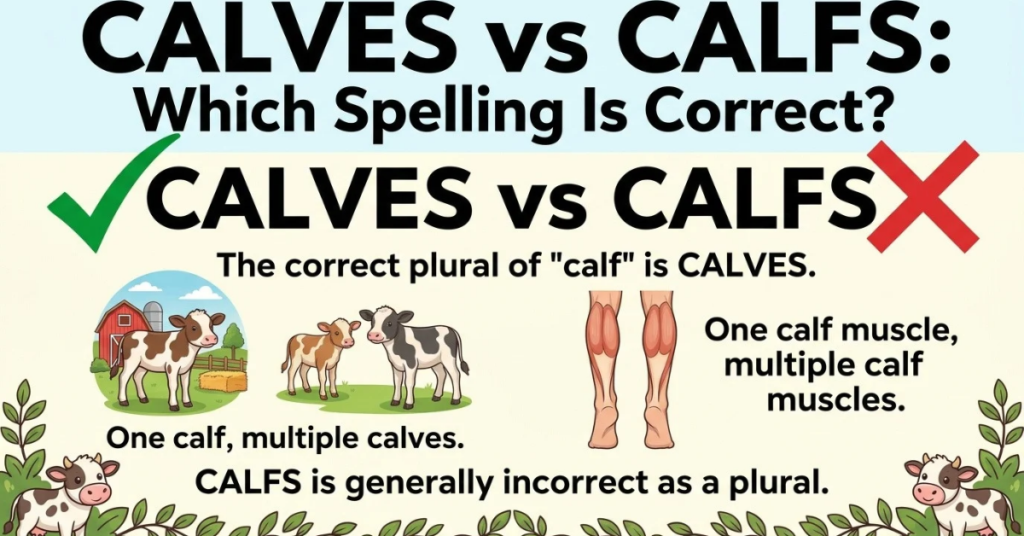
When comparing calves vs calfs, the correct spelling in standard English is calves. The word calf refers to a young animal, such as a baby cow, or the back part of the lower leg. Its plural changes from f to ves, following a common English spelling pattern.
In this guide, we will explain why calves is correct, when to use it, how the spelling rule works, and which common mistakes to avoid. You will also find practical examples and answers to frequently asked questions.
Calves vs Calfs: Which One Is Correct?
The main difference between calves and calfs is grammatical correctness. Calves is the standard plural form of calf, while calfs is generally considered incorrect when used as the ordinary plural of this word.
Here is a quick comparison:
| Word | Correct? | Meaning |
|---|---|---|
| Calf | Yes | One young animal or one lower-leg muscle area |
| Calves | Yes | More than one calf |
| Calfs | Generally no | Nonstandard spelling for the ordinary plural |
For example:
-
Correct: The farmer bought three calves.
-
Correct: She exercises her calves every morning.
-
Incorrect: The farmer bought three calfs.
-
Incorrect: My calfs hurt after running.
Whether you are writing about farm animals, fitness, anatomy, or everyday activities, calves is the spelling you should normally use.
What Does the Word Calves Mean?
The word calves has two common meanings. Its intended meaning depends on the context in which it appears.
1. Calves as Young Animals
In animal-related contexts, a calf is a young animal, particularly a young cow. However, the word also applies to the young of several other large mammals.
Examples include:
-
A cow’s baby is called a calf.
-
A young elephant is called a calf.
-
A young whale is called a calf.
-
A young giraffe is called a calf.
When referring to more than one of these young animals, the correct plural is calves.
Example: The wildlife sanctuary cares for several elephant calves.
The word is common in farming, wildlife conservation, animal science, and veterinary discussions.
2. Calves as Part of the Human Body
In anatomy, calves refers to the fleshy areas at the back of the lower legs, below the knees and above the ankles.
The calf muscles help you perform everyday movements, including walking, running, jumping, and standing on your toes. Two major muscles in this area are the gastrocnemius and soleus.
Examples:
-
My calves feel sore after a long walk.
-
Strong calves can support athletic movement.
-
Stretching may help relieve tight calf muscles.
In each sentence, calves is the correct plural form.
Why Is Calves the Correct Plural of Calf?
The reason comes down to an established English spelling pattern. Many English nouns ending in -f or -fe change that ending to -ves when they become plural.
The basic pattern looks like this:
Singular
Plural
Calf
Calves
Half
Halves
Wolf
Wolves
Leaf
Leaves
Knife
Knives
Although this pattern is useful, it does not apply to every noun ending in f. Some words simply add -s, such as roof → roofs and belief → beliefs.
That is why learning the plural form of individual words is important. In the case of calf, the standard spelling is calves.
Calf vs Calves: Singular and Plural Explained
Understanding singular and plural nouns makes it easier to choose the correct word in a sentence.
A singular noun refers to one person, animal, object, or body part. A plural noun refers to more than one.
Use calf when referring to one, and calves when referring to two or more.
| Singular sentence | Plural sentence |
|---|---|
| The calf is drinking milk. | The calves are drinking milk. |
| The calf is resting in the field. | The calves are resting in the field. |
| My left calf feels tight. | Both my calves feel tight. |
| He injured his calf muscle. | He strained both calf muscles. |
Notice that the verb often changes along with the noun. For example, we say the calf is but the calves are.
This simple distinction helps you avoid grammatical errors in school assignments, professional writing, social media captions, and everyday communication.
How to Use Calves in a Sentence
The best way to remember the correct spelling is to see it in different situations. Here are some examples from common contexts.
Everyday English Examples
-
The calves followed their mother across the field.
-
She felt a stretch in her calves after exercising.
-
The farmer checked the calves before feeding the other animals.
-
Walking uphill can make your calves work harder.
-
The young calves rested in the shade.
Calves in Fitness and Exercise
The term calves frequently appears in workout routines, fitness articles, and discussions about leg strength.
For example:
-
Calf raises help strengthen the calf muscles.
-
Running uphill can challenge your calves.
-
Stretching your calves may improve flexibility.
-
The athlete trained his calves twice a week.
Calves in Farming and Wildlife
In agriculture and wildlife writing, the word usually refers to young animals.
For example:
-
The farmer vaccinated the calves according to veterinary guidance.
-
The herd stayed close to its newborn calves.
-
Wildlife researchers observed two giraffe calves near their mothers.
Across all these examples, the spelling remains calves, regardless of the subject.
Common Mistakes When Using Calves and Calfs
Even though the rule is straightforward, people sometimes write calfs because they assume every noun forms its plural by adding -s.
Here are a few mistakes to watch out for.
Mistake 1: Adding Only -s
Incorrect: The calfs are playing outside.
Correct: The calves are playing outside.
Remember that calf follows the -f to -ves pattern.
Mistake 2: Confusing Calves With Calfs in Fitness Writing
Incorrect: My calfs hurt after leg day.
Correct: My calves hurt after leg day.
The same plural spelling applies whether you are talking about muscles or animals.
Mistake 3: Assuming Every Word Ending in F Follows the Same Rule
English plural rules have exceptions. For example:
-
Roof → roofs
-
Chief → chiefs
-
Calf → calves
-
Wolf → wolves
Avoid applying one rule to every word. When you are uncertain, check a reliable dictionary.
Mistake 4: Using Calves When You Mean One Calf
Incorrect: My calves is sore.
Correct: My calf is sore.
When discussing one leg or one young animal, use the singular calf. Use calves for more than one.
Is Calfs Ever a Correct Word?
In ordinary modern English, calfs is not the accepted plural of calf. If you are writing an essay, article, email, report, or school assignment, you should use calves.
There may be unusual contexts in which Calfs appears as a proper name, a brand name, or part of a specialized label. Such uses do not change the standard plural rule.
For everyday communication, the distinction is simple:
-
One calf.
-
Two calves.
-
Several calves.
If you see calfs used where the writer means more than one calf, it is generally a spelling mistake.
Easy Ways to Remember the Difference
If you often confuse calves and calfs, a few simple tricks can help you remember the correct form.
1. Remember the -ves pattern. Think of calf → calves, alongside half → halves and wolf → wolves.
2. Learn the word as a pair. Instead of memorizing calf alone, practice saying and writing calf, calves together.
3. Read your sentence aloud. Reading can help you spot awkward grammar, although spelling should still be checked separately.
4. Use a dictionary when unsure. Reliable dictionaries list the standard plural form and provide examples of how the word is used.
5. Practice with short sentences. Write a few examples about animals and another few about exercise. Repeating the correct form makes it easier to remember.
Frequently Asked Questions About Calves vs Calfs
1. Is it calves or calfs?
Calves is correct. It is the standard plural of calf, whether the word refers to a young animal or the back of the lower leg. Calfs is generally a misspelling when intended as the ordinary plural.
2. What is the plural of calf?
The plural of calf is calves. For example, one calf may be resting in a field, while several calves may be feeding together.
3. Why does calf become calves?
The word follows an English spelling pattern in which certain nouns ending in -f change to -ves in the plural. Similar examples include wolf → wolves and half → halves.
4. Is calves used for both animals and human legs?
Yes. Calves refers to multiple young animals, such as baby cows, and to the muscular areas at the backs of the lower legs. The meaning depends on the sentence.
5. How do you spell calf muscles in the plural?
The correct phrase is calf muscles when using calf as an adjective describing the muscles, or calves when referring to the body parts themselves.
Examples:
-
I train my calf muscles at the gym.
-
My calves feel tired after running.
Both sentences are correct.
6. Is the word calves singular or plural?
Calves is plural. The singular form is calf. For example, say, “The calf is sleeping” when referring to one animal, and “The calves are sleeping” when referring to multiple animals.
7. What is the difference between calf and calves in anatomy?
A calf is the back portion of one lower leg. Calves refers to the corresponding areas on both legs or to the lower-leg areas of multiple people.
8. Can I use calfs in formal writing?
You should not use calfs as the ordinary plural of calf in formal writing. Use calves in academic work, business communication, articles, and other standard English contexts.
9. What are some other words that change f to ves?
Common examples include:
-
Leaf → leaves
-
Knife → knives
-
Life → lives
-
Wolf → wolves
-
Half → halves
-
Shelf → shelves
However, remember that some nouns ending in f simply add -s, such as roofs and chiefs.
10. How can I check whether a plural spelling is correct?
Consult a reputable English dictionary or grammar reference. You can also look for example sentences showing the word in its plural form. This is particularly useful when a word has an irregular plural or an exception to a common spelling rule.
Conclusion: Calves vs Calfs — The Final Answer
When it comes to calves vs calfs, the correct spelling is calves. It is the standard plural form of calf, whether you are discussing young animals, human anatomy, fitness, or everyday life.
The main rule to remember is simple: calf becomes calves in the plural. Although English has exceptions to its spelling patterns, this word follows the familiar -f to -ves change.
The next time you write about calf muscles or young animals, choose calves with confidence. If you enjoy learning about commonly confused English words, explore more spelling and grammar guides to build your vocabulary and improve your writing skills.
