
Have you ever written a word that looked correct but still made you question your spelling? The confusion surrounding oversite vs oversight is a good example. Although these words look almost identical, they have different meanings, and only one is commonly used in everyday English.
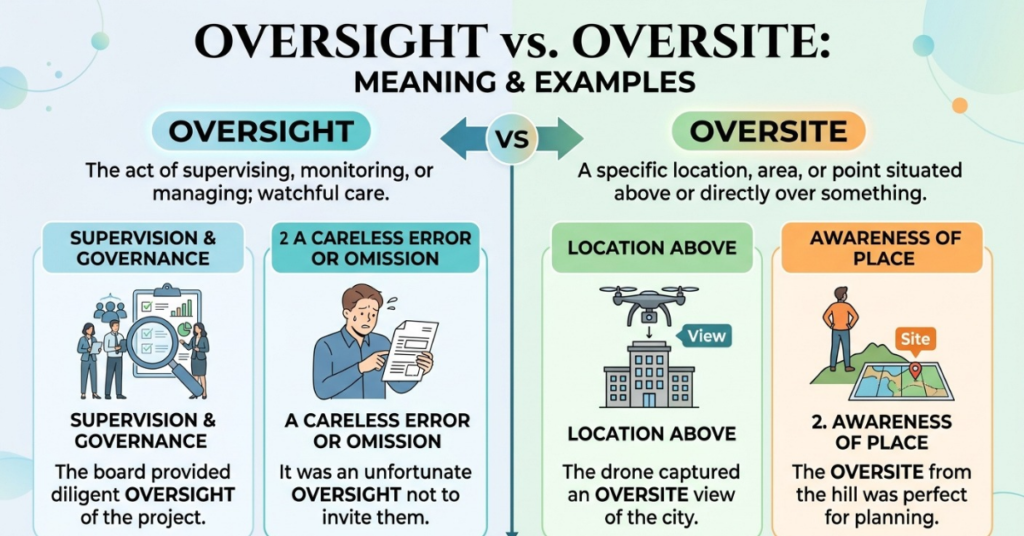
The word oversight refers to supervision, the act of overseeing something, or an unintentional mistake. On the other hand, oversite is a specialized term used mainly in construction, particularly in British English, for a concrete layer or surface beneath a floor.
Understanding the difference between oversite and oversight can help you avoid spelling mistakes, write more clearly, and choose the right word for your situation. Let’s explore their meanings, practical examples, and common uses.
Oversite vs Oversight: What Is the Difference?
The main difference between oversite and oversight is their meaning and context. While oversight is a common English word, oversite is a technical construction term.
| Feature | Oversite | Oversight |
|---|---|---|
| Meaning | A prepared surface or concrete layer beneath a floor | Supervision, monitoring, or an unintentional mistake |
| Part of speech | Noun | Noun |
| Common usage | Construction and building terminology | Everyday, professional, and academic English |
| Example | The contractor poured concrete over the oversite. | The manager discovered an oversight in the report. |
| General popularity | Limited and specialized | Widely used |
In short, use oversight when discussing supervision or a mistake. Use oversite when referring to the relevant construction feature.
What Does Oversight Mean?
Oversight is a noun with two principal meanings. It can refer to the act of supervising or monitoring a person, activity, or process. It can also describe an unintentional error or something that has been accidentally forgotten.
The intended meaning usually becomes clear from the surrounding sentence.
1. Oversight Meaning Supervision
When oversight refers to supervision, it describes the process of checking, guiding, or monitoring work to ensure that everything is completed correctly.
This meaning appears frequently in workplaces, government, education, healthcare, and project management.
Examples of oversight as supervision:
- The project requires close oversight from the construction manager.
- The school introduced new oversight procedures to improve student safety.
- The board provides financial oversight to ensure responsible spending.
- The team completed the project under the supervisor’s oversight.
In these examples, oversight means supervision, responsibility, or monitoring rather than a mistake.
2. Oversight Meaning an Unintentional Mistake
Oversight can also mean an error caused by forgetting, overlooking, or failing to notice something. It generally suggests an accidental omission rather than a deliberate action.
Examples of oversight as a mistake:
- Leaving the client’s name off the document was an unfortunate oversight.
- The missing signature was an oversight, not an intentional omission.
- Due to an oversight, the meeting invitation was never sent.
- The editor corrected an oversight in the final version of the article.
Notice how the word describes something that was missed unintentionally.
Why Does Oversight Have Two Meanings?
The word developed from the idea of looking over or supervising something. Historically, oversight could refer to watching over a person or activity, while the related idea of overlooking something gave it the meaning of an accidental omission.
Although these meanings may seem contradictory, context makes the intended meaning clear. A sentence about management usually points to supervision, while one about a missing detail generally indicates a mistake.
What Does Oversite Mean?
Oversite is a specialized construction term, particularly associated with British building terminology. It generally refers to a prepared ground surface or a concrete layer beneath a ground-floor structure.
The exact use of the term can vary by region and building specification. It is not a standard alternative spelling of oversight.
Oversite in Construction
In building work, an oversite layer may form part of the construction beneath a ground-floor slab or floor finish. Depending on the design, the underlying floor assembly may also include compacted hardcore, a damp-proof membrane, insulation, and concrete.
These materials serve different purposes, so an oversite should not be confused with the entire floor assembly.
Examples of oversite in construction:
- The builder prepared the oversite before installing the ground-floor construction.
- The contractor checked the oversite level before pouring the concrete.
- The architect specified the required oversite preparation in the building details.
- The team inspected the oversite to ensure that the surface was properly prepared.
In these sentences, oversite refers to a physical part of the building process rather than supervision or an error.
Is Oversite a Common English Word?
No. Oversite is much less common than oversight and is primarily encountered in construction documents, technical specifications, and discussions of building methods.
If you encounter it in an ordinary email, school assignment, or business report, check whether the writer actually intended to use oversight. However, in a construction document, oversite may be the correct technical term.
Oversite vs Oversight Examples
One of the easiest ways to understand the difference between oversite and oversight is to compare them in context.
Everyday English Examples
Correct: The missing attachment was an oversight.
Incorrect for this meaning: The missing attachment was an oversite.
Why? The sentence describes something accidentally forgotten, so oversight is the correct choice.
Correct: The department operates under the oversight of the director.
Incorrect for this meaning: The department operates under the oversite of the director.
Why? The sentence refers to supervision, not a construction surface.
Construction Examples
Correct: The workers prepared the oversite before proceeding with the ground-floor construction.
Incorrect for this meaning: The workers prepared the oversight before proceeding with the ground-floor construction.
Why? The sentence refers to a building component or prepared surface, making oversite appropriate.
Quick Comparison Sentences
Here are a few additional examples to help you remember the distinction:
- Oversight: The accountant identified an error that had been missed during the review.
- Oversight: The project manager provides oversight throughout the renovation.
- Oversite: The builder inspected the prepared surface beneath the proposed floor.
- Oversite: The construction specification described the required oversite preparation.
The key is to identify whether the sentence concerns a mistake, supervision, or a construction feature.
Oversite vs Oversight: Which Is Correct?
Neither spelling is universally incorrect. The right choice depends on what you want to communicate.
Choose oversight when you mean:
- Supervision or monitoring.
- Management responsibility.
- An accidental mistake or omission.
- A failure to notice a detail.
Choose oversite when you mean:
- A technical construction surface or layer.
- A building-related term used in the relevant regional terminology.
For most everyday writing, oversight is the word you need. Oversite is appropriate when you are specifically discussing construction.
If you are unsure, replace the word with a simpler alternative. For example, use supervision or mistake for oversight, and prepared ground surface for oversite when that accurately describes the construction detail.
Oversite vs Oversight Verb: How Are They Used?
Another common question concerns the verb form of oversite and oversight.
Is Oversight a Verb?
No. Oversight is a noun, not a verb. The related verb is oversee, which means to supervise, manage, or monitor something.
Examples:
- The architect will oversee the renovation.
- The supervisor oversees the installation process.
- The committee oversaw the project’s progress.
- The manager is overseeing the team’s work.
The forms of oversee are irregular: oversees, overseeing, and oversaw. Its past participle is overseen.
Is Oversite a Verb?
In standard contemporary English, oversite is principally used as a technical noun. It is not the usual verb for supervising work or overlooking a mistake.
For clarity, use oversee when describing supervision and overlook when describing a failure to notice something.
For example:
- Supervision: The engineer will oversee the installation.
- Failure to notice: The inspector overlooked a minor defect.
- Construction term: The contractor prepared the oversite.
These distinctions prevent confusion in both professional and everyday writing.
Oversight vs Oversite in Professional Writing
Choosing the correct term is particularly important in professional communication because a spelling error can change the meaning of a sentence.
In Business and Management
Use oversight to describe accountability, supervision, or an accidental omission.
Example: “The department head provides oversight of the annual budget.”
If you mean an error, you could write: “The incorrect figure was included due to an oversight.”
In Architecture and Construction
Use oversite only when the technical context supports that meaning.
Example: “The contractor must prepare the oversite according to the approved building specification.”
For technical reports, follow the terminology used in the relevant construction drawings, specification, and regional building practice. A precise description is especially important when different layers of a floor have separate requirements.
In Academic Writing
Oversight is the appropriate term when discussing supervision, governance, or an accidental omission.
Example: “The research project was conducted under the oversight of the ethics committee.”
Oversite would generally be relevant only in an academic discussion of construction or building technology.
Common Mistakes to Avoid
Even though the two words differ by only one letter, confusing them can create awkward or misleading sentences.
Watch out for these common mistakes:
- Using oversite to mean a mistake: Write “an oversight in the report,” not “an oversite in the report.”
- Using oversite to mean supervision: Write “under the oversight of the manager.”
- Using oversight for a construction layer: If the sentence refers to a technical oversite, use the construction term.
- Treating oversight as a verb: Use oversee for supervision and overlook for failing to notice something.
- Ignoring the context: Before choosing a spelling, identify whether the sentence concerns management, an accidental omission, or construction.
A quick proofreading check can help you catch these errors before submitting an assignment, publishing an article, or sending a professional email.
Frequently Asked Questions (FAQs)
1. What is the difference between oversite and oversight?
Oversight means supervision or an unintentional mistake. Oversite is a specialized construction term for a prepared surface or concrete layer beneath a ground floor. The words are not interchangeable.
2. Is oversite a real word?
Yes. Oversite is a recognized technical term used in construction, particularly in British building terminology. However, it is much less common than oversight in general English.
3. Is oversight one word or two?
Oversight is written as one word. It is a noun that can mean supervision, monitoring, or an accidental omission.
4. What is the meaning of oversight in simple words?
In simple terms, oversight means either keeping an eye on something or accidentally missing something. For example, a manager provides oversight, while forgetting to attach a file is an oversight.
5. What is an example of oversight in a sentence?
“Leaving the final page out of the report was an oversight.” Here, oversight means an accidental mistake or omission.
6. What is an example of oversite in a sentence?
“The builder prepared the oversite before continuing with the ground-floor construction.” In this sentence, oversite refers to a construction-related surface or layer.
7. What is the verb form of oversight?
The related verb is oversee, which means to supervise or manage. For example, “The architect will oversee the renovation.” If you mean failing to notice something, use overlook.
8. Does oversight always mean a mistake?
No. Oversight has two common meanings. It can refer to supervision or monitoring, as well as an unintentional error. The surrounding sentence determines which meaning applies.
9. Is oversite a spelling mistake?
Not necessarily. Oversite is correct in its specialized construction context. However, it is usually a spelling mistake when someone intends to write about supervision or an accidental omission.
10. Which word should I use in an email: oversite or oversight?
In most emails, use oversight if you mean supervision or a mistake. Use oversite only when discussing the relevant construction feature.
Conclusion
The difference between oversite vs oversight comes down to meaning and context. Oversight is the everyday word for supervision or an unintentional mistake, while oversite is a specialized construction term referring to a prepared ground surface or concrete layer beneath a floor.
Remember these simple rules:
-
Use oversight for supervision, monitoring, or an accidental omission.
-
Use oversite when discussing the relevant building or construction feature.
-
Use oversee as the verb meaning to supervise, and overlook when you mean to miss or fail to notice something.
