
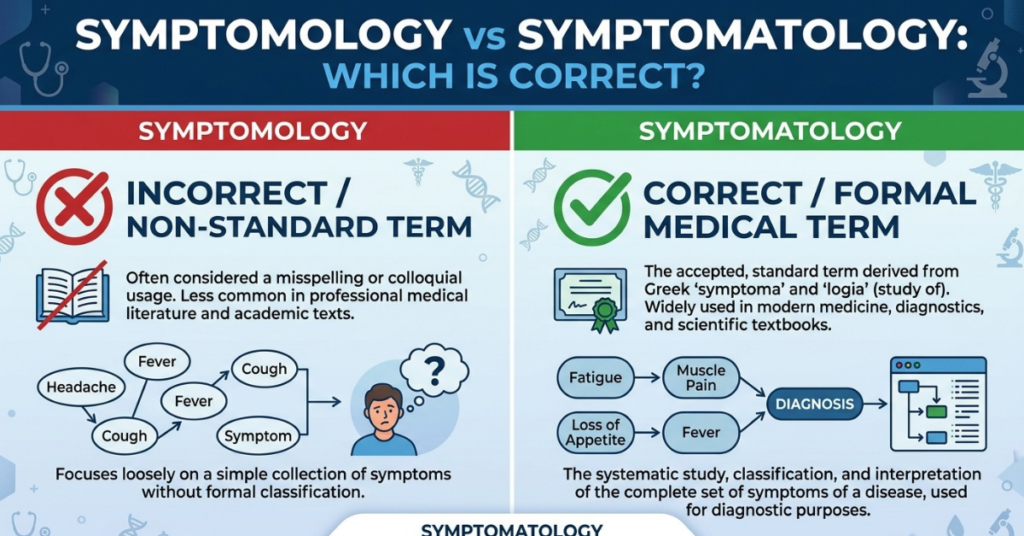
Have you ever come across the words symptomology and symptomatology and wondered whether they mean the same thing? Both terms appear in discussions about medicine, health conditions, and the study of symptoms, which makes it easy to confuse them.
When comparing symptomology vs symptomatology, the key point is that both words are used to describe the study or examination of symptoms. However, symptomatology is generally the more established and preferred term in formal medical and academic writing.
Understanding the distinction can help you choose the right word for medical reports, research papers, professional communication, and everyday writing. Let’s explore their meanings, differences, examples, and correct usage.
What Is Symptomatology?
Symptomatology is the study, description, and analysis of symptoms associated with a disease, disorder, or medical condition. It helps healthcare professionals understand how an illness presents itself and which signs or symptoms may be associated with it.
For example, a doctor evaluating a patient with a respiratory illness might examine symptoms such as coughing, shortness of breath, fever, and chest discomfort. Studying these symptoms and their patterns forms part of symptomatology.
The term is also used in psychology and psychiatry to describe the symptoms associated with mental health conditions.
Examples of symptomatology in a sentence
Here are a few examples showing how the word works in context:
- Medical research: The study examined the symptomatology of patients with chronic migraines.
- Psychology: Researchers compared the symptomatology of anxiety and depressive disorders.
- Clinical practice: The patient’s symptomatology changed over several weeks.
- Academic writing: The paper provides an overview of the symptomatology associated with the condition.
In each example, the word refers to the symptoms themselves as a pattern or to their systematic study and description.
What Is Symptomology?
Symptomology is a term used to describe the study or analysis of symptoms. It is often used interchangeably with symptomatology, particularly in general medical discussions and some professional or informal writing.
Although readers can usually understand what symptomology means, symptomatology is generally the safer choice for formal medical, scientific, and academic writing because it is the more established term.
Examples of symptomology in a sentence
Consider the following examples:
- The clinician reviewed the symptomology reported by the patient.
- The research focused on the symptomology of a particular neurological condition.
- The discussion covered the symptomology associated with seasonal allergies.
These sentences communicate the intended meaning, but in formal academic work, replacing symptomology with symptomatology may be preferable.
Symptomology vs Symptomatology: Key Differences
The two terms overlap considerably in meaning. The main distinction is their conventional usage rather than a clear difference in medical definition.
| Feature | Symptomatology | Symptomology |
|---|---|---|
| Meaning | Study and description of symptoms | Study or analysis of symptoms |
| Usage | Established in medical and academic writing | Also used, but less preferred in formal contexts |
| Medical research | Commonly suitable | May appear, depending on the author |
| Formal writing | Generally recommended | Usually worth replacing with symptomatology |
| Meaning difference | No consistent, widely accepted distinction | No consistent, widely accepted distinction |
The important takeaway is that these words do not normally describe two separate medical concepts. Their meanings overlap, and the choice often comes down to established terminology and writing style.
Which Is Correct: Symptomology or Symptomatology?
If you need to choose one word, symptomatology is generally the better option.
It is well established in clinical literature and academic discussions. Using it can also help maintain consistency with the terminology used in medical textbooks, journal articles, and professional reports.
However, symptomology is not necessarily incomprehensible or automatically incorrect in every context. If you encounter it in a published article or conversation, the intended meaning will usually be clear.
When should you use symptomatology?
Choose symptomatology when writing:
- Medical or scientific research papers
- Clinical case studies
- Healthcare reports and assessments
- Psychology and psychiatry articles
- University assignments involving medical terminology
When might symptomology appear?
You may encounter symptomology in:
- General health articles
- Informal discussions about symptoms
- Some professional publications
- Writing that uses the term interchangeably with symptomatology
For academic or professional work, follow your institution’s preferred terminology or the relevant publication’s style guide.
Symptomatology vs Symptoms: Are They the Same?
Although the terms are related, symptomatology and symptoms are not exactly the same.
A symptom is an individual experience or complaint associated with a health condition. Examples include nausea, fatigue, pain, dizziness, and shortness of breath.
Symptomatology, on the other hand, refers to the study, description, or overall pattern of symptoms associated with a condition.
For example, fatigue is a symptom. A detailed examination of fatigue alongside sleep disturbances, low energy, and difficulty concentrating may form part of the symptomatology being assessed.
This distinction is useful because a single symptom rarely provides a complete picture of a person’s health.
Why Does Symptomatology Matter in Medicine?
Understanding symptomatology helps healthcare professionals evaluate the way conditions present and how symptoms may relate to one another.
Its practical importance includes several areas:
- Clinical assessment: Healthcare professionals gather information about symptoms to understand a patient’s condition.
- Differential diagnosis: Symptom patterns can help clinicians consider and distinguish between possible explanations.
- Treatment planning: Monitoring symptoms may help assess whether a treatment is improving a patient’s condition.
- Medical research: Researchers study symptom patterns to better understand diseases and compare patient groups.
- Mental health assessment: Clinicians examine emotional, cognitive, and behavioral symptoms when assessing psychological conditions.
It is important to remember that symptomatology alone does not always establish a diagnosis. Symptoms can overlap across different conditions, so clinicians may also consider medical history, physical examinations, laboratory tests, and other relevant evidence.
Common Mistakes When Using Symptomology and Symptomatology
A few simple mistakes can make medical or academic writing less precise.
1. Treating the words as completely different concepts
There is no widely accepted general rule that gives symptomology and symptomatology separate medical meanings. Avoid claiming that one refers only to physical symptoms while the other refers only to mental health symptoms.
2. Assuming symptomology is always grammatically incorrect
Symptomology is an established variant in usage, even though symptomatology is generally preferred in formal medical writing. The context and relevant style guide should determine your choice.
3. Using either term when a simpler word would be clearer
Sometimes, the word symptoms is all you need. For example, “The patient reported three symptoms” is more direct than “The patient’s symptomatology included three complaints” when no broader clinical analysis is intended.
4. Confusing symptoms with signs
Symptoms are generally experiences reported by a patient, such as pain or nausea. Signs are observable or measurable findings, such as a rash, elevated temperature, or high blood pressure. In medical terminology, the distinction matters.
Related Style Question: Headcount or Head Count AP Style?
Another common terminology question concerns headcount vs head count. Although unrelated to medical symptomatology, it raises a similar issue: deciding which form is appropriate in professional writing.
Headcount is commonly written as one word when referring to the number of people in a group, organization, or workforce. Head count also appears as a two-word form in general English and in some editorial contexts.
For AP Style, consult the current Associated Press Stylebook entry for the exact preferred form. If you do not have access to the entry, using headcount consistently as a noun is a practical general-English choice, but it should not be presented as a verified AP Style rule without checking the current guide.
Headcount examples
- The company plans to increase its headcount next year.
- The manager completed a headcount before the event began.
- The department reviewed its current headcount during budget planning.
In professional writing, consistency is essential. If an organization or publication has its own style guide, follow that guide throughout the document.
Frequently Asked Questions
1. Is symptomology or symptomatology correct?
Both terms are used to refer to the study or analysis of symptoms. However, symptomatology is generally more established and is the preferred choice in formal medical and academic writing.
2. What is the difference between symptomology and symptomatology?
There is no consistent, widely accepted difference in their core meanings. The main distinction is conventional usage, with symptomatology generally preferred in formal contexts.
3. Is symptomology a real word?
Yes. Symptomology is used in English to refer to the study or analysis of symptoms. Nevertheless, symptomatology is usually the better choice for formal medical writing.
4. What does symptomatology mean in psychology?
In psychology, symptomatology refers to the symptoms and patterns of symptoms associated with psychological or psychiatric conditions. It can include emotional, cognitive, and behavioral experiences.
5. Is symptomatology the same as diagnosis?
No. Symptomatology describes or examines symptoms, whereas diagnosis involves identifying a condition based on relevant clinical evidence. Symptom patterns may contribute to a diagnosis, but they do not always establish one on their own.
6. What is the plural of symptomatology?
Symptomatology is generally used as an uncountable noun, so it does not usually require a plural form. Writers can use phrases such as “patterns of symptomatology” when discussing multiple patterns.
7. Is headcount one word or two words in AP Style?
Headcount is commonly written as one word in general professional English. For strict AP Style compliance, verify the current Associated Press Stylebook entry rather than assuming that general usage establishes the official rule.
8. Can I use symptomatology in an academic paper?
Yes. Symptomatology is appropriate for many academic papers involving medicine, psychology, psychiatry, and clinical research. Define the term clearly if your audience may not be familiar with it, and follow your institution’s or journal’s style requirements.
Conclusion
When comparing symptomology vs symptomatology, the most important point is that the two terms have substantially overlapping meanings. Both can refer to the study, description, or analysis of symptoms, but symptomatology is generally the more established choice for formal medical and academic writing.
If you are preparing a research paper, clinical report, or university assignment, use symptomatology unless your preferred style guide recommends otherwise. For simpler explanations, consider using symptoms when that word communicates your meaning more clearly.
Choosing precise terminology improves readability and helps readers understand your message. You can also explore related guides on medical terminology, commonly confused words, and AP Style usage to strengthen your professional writing.
