
Have you ever stopped while writing a sentence because you weren’t sure whether to spell the word pieces or peices? You’re not alone. English spelling can be confusing, especially when a word doesn’t follow the patterns we expect.
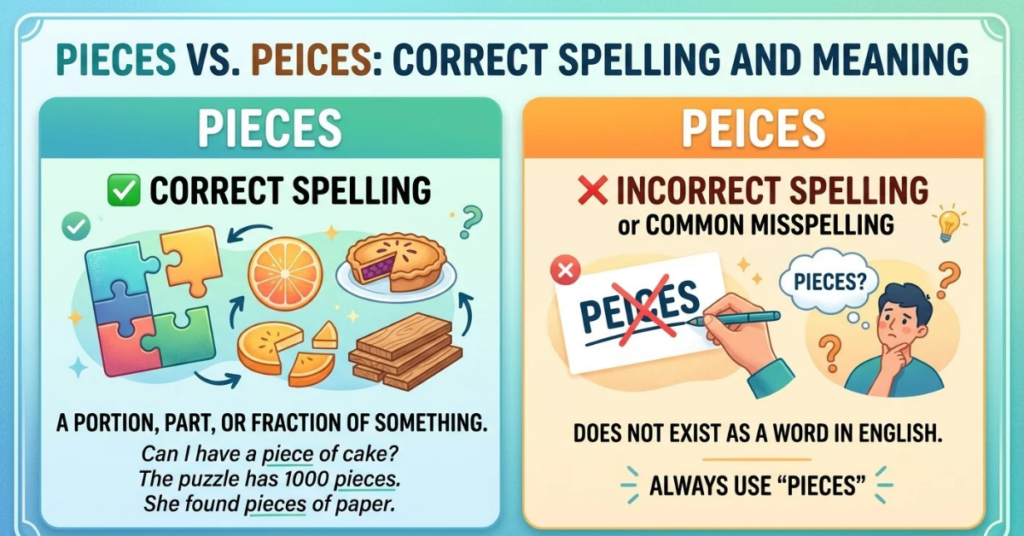
When comparing pieces vs. peices, only one spelling is correct in standard English: pieces. The word refers to parts of something, individual items, or portions of a whole. Peices is a common spelling mistake that can happen when people mix up the order of the letters.
In this guide, we’ll explain the correct spelling, its meaning, how to use it in sentences, and a few simple tricks to help you remember it.
Pieces vs. Peices: Which Is Correct?
The correct spelling is pieces, while peices is incorrect.
Although peices may look reasonable at first glance, it doesn’t follow the accepted spelling of the word. If you’re writing an email, completing a school assignment, creating website content, or preparing a professional document, always use pieces.
Here’s a quick comparison:
| Word | Correct or Incorrect? | Meaning |
|---|---|---|
| Pieces | Correct | Parts, portions, or individual items |
| Peices | Incorrect | A common misspelling of pieces |
Example:
- Correct: She cut the cake into six pieces.
- Incorrect: She cut the cake into six peices.
The difference is only the order of two letters, but that small detail matters when you’re aiming for clear, accurate writing.
What Does the Word Pieces Mean?
The word pieces is the plural form of piece. It generally describes separate parts of something or individual items that belong to a group.
Its exact meaning depends on how it’s used in a sentence.
1. Pieces as Parts of a Whole
A piece can be a section of something that has been divided, broken, or separated.
Examples:
- The glass fell and broke into several pieces.
- He divided the pizza into eight pieces.
- She used small pieces of paper to make a collage.
2. Pieces as Individual Items
The word can also describe separate objects, especially when discussing clothing, furniture, equipment, or collections.
Examples:
- I bought three pieces of furniture for my bedroom.
- The artist displayed several beautiful pieces in the gallery.
- She packed a few pieces of jewelry for her trip.
3. Pieces in Music, Art, and Writing
In creative fields, pieces can refer to individual works of art, music, or writing.
Examples:
- The pianist performed two classical pieces.
- The exhibition features pieces by local artists.
- He published several short pieces in a literary magazine.
These examples show why pieces is a useful word in everyday conversation as well as professional and academic writing.
Why Is Peices a Common Spelling Mistake?
The mistake usually happens because people remember the sound of a word more easily than its exact spelling. When writing quickly, it’s easy to place the letters i and e in the wrong order.
English has many words that contain these letters, and their spelling patterns aren’t always consistent. This can make words such as pieces confusing for students, language learners, and even experienced writers.
Here are a few reasons people misspell the word:
- Letter order confusion: Writers accidentally place the e before the i.
- Typing too quickly: A small typing error can go unnoticed.
- Incorrect visual memory: Seeing the misspelled form repeatedly can make it appear familiar.
- Limited proofreading: Spell-checking and editing are often skipped when writing informal messages.
The best solution is to learn the correct spelling and practise using it in complete sentences.
How to Remember the Correct Spelling of Pieces
If you frequently confuse pieces and peices, a simple memory trick can help.
1. Remember the Letter Sequence
The correct spelling is P-I-E-C-E-S.
Break it into smaller parts:
PIE + CES = PIECES
Think of a pie being divided into several pieces. This mental image connects the spelling with the meaning and makes the word easier to remember.
2. Use the Word in a Sentence
Writing the word in context can help reinforce the correct letter order.
Try these sentences:
- Please give me two pieces of paper.
- The puzzle has 100 pieces.
- She collected pieces of sea glass.
Repeating correct examples is often more helpful than simply memorizing a spelling rule.
3. Use a Spell Checker
Digital writing tools can identify peices as a spelling error and suggest pieces instead. However, spell-checkers aren’t perfect, so it’s still worth learning the correct form yourself.
For important documents, read the final text carefully rather than relying entirely on automated corrections.
Pieces vs. Peices: Examples in Everyday English
Understanding how a word appears in different contexts makes it easier to use correctly.
Here are some common examples:
Everyday conversation
- Can you cut the sandwich into smaller pieces?
- I found a few pieces of chocolate in the cupboard.
- The children picked up the broken pieces of the toy.
School and academic writing
- The assignment is divided into three main pieces of work.
- Students analysed different pieces of evidence.
- The puzzle consists of several interconnected pieces.
Professional and creative writing
- The designer selected individual pieces for the collection.
- The writer published several pieces about travel.
- The gallery displayed contemporary pieces from emerging artists.
Notice that the spelling remains the same regardless of the context. Whenever you mean parts, portions, or individual works, pieces is the correct choice.
Is Pieces Singular or Plural?
Pieces is a plural noun. Its singular form is piece.
Use piece when referring to one item and pieces when referring to more than one.
Examples:
- One piece of cake.
- Two pieces of cake.
- A single piece of furniture.
- Several pieces of furniture.
An important detail is that furniture is generally an uncountable noun in English. Therefore, you would normally say “three pieces of furniture,” rather than “three furnitures.”
The same structure is common with other uncountable nouns, such as advice and information, when counting individual units.
Pieces vs. Peices: Common Grammar Mistakes to Avoid
Correct spelling is only one part of using a word properly. The following tips can help you avoid related mistakes.
Mistake 1: Writing Peices Instead of Pieces
Incorrect: I need a few peices of cardboard.
Correct: I need a few pieces of cardboard.
Mistake 2: Using Piece When You Mean More Than One
Incorrect: The box contains five piece of equipment.
Correct: The box contains five pieces of equipment.
Mistake 3: Adding an Unnecessary Plural to an Uncountable Noun
Incorrect: She gave me three advices.
Correct: She gave me three pieces of advice.
Paying attention to spelling and sentence structure will make your writing more polished and easier to understand.
Frequently Asked Questions (FAQs)
1. Is it pieces or peices?
Pieces is the correct spelling in standard English. Peices is a misspelling and should be corrected to pieces.
2. Why do people spell pieces as peices?
People commonly reverse the letters i and e when writing the word. Typing quickly, relying on memory, or being unfamiliar with the correct spelling can contribute to this mistake.
3. What is the singular form of pieces?
The singular form is piece. For example, you would say “one piece of bread” and “two pieces of bread.”
4. What does pieces mean?
Pieces is the plural of piece. It can refer to parts of a whole, individual objects, portions of food, works of art, musical compositions, or written works.
5. Is peices ever an acceptable spelling?
No. Peices is not an accepted standard spelling of the English word. In formal and informal writing, use pieces.
6. What is an easy trick to remember how to spell pieces?
Remember the phrase “a PIE has PIECES.” The word pie helps you recall the correct opening letters, P-I-E, before completing the spelling with C-E-S.
7. How do you use pieces in a sentence?
Here is a simple example: “She cut the orange into small pieces and shared them with her friends.”
8. Is pieces a noun?
Yes. Pieces is a plural noun. It names multiple parts, objects, or works. In some contexts, piece can also function as a verb, but pieces is commonly used as a plural noun.
Conclusion
When comparing pieces vs. peices, the answer is straightforward: pieces is the correct spelling, and peices is a common spelling error.
The word pieces is used in many situations, from describing parts of a broken object to discussing food, furniture, artwork, and written works. Remembering the letter sequence P-I-E-C-E-S, practising with example sentences, and proofreading your work can help you avoid this mistake.
The next time you’re unsure which spelling to use, think of a pie divided into pieces. It’s a simple way to remember the correct spelling and write with greater confidence.
For more helpful English spelling guides, explore other commonly confused words and practise using them in everyday sentences.
