
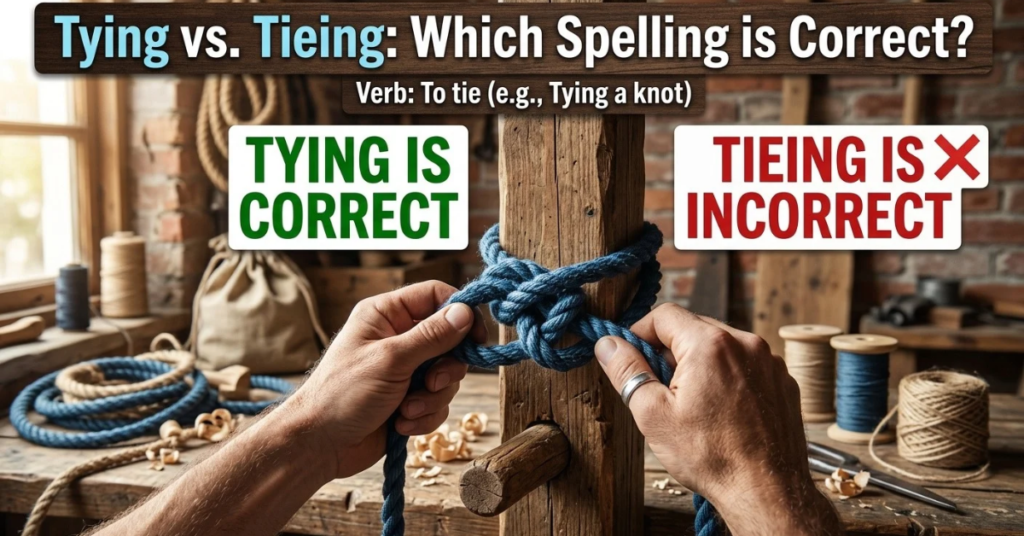
Have you ever paused while writing a sentence and wondered whether to use tying or tieing? It seems like a small spelling question, but English has plenty of words that become confusing when you add an ending. If you’re searching for tying vs tieing, the good news is that the answer is straightforward: tying is the correct spelling, while tieing is generally considered incorrect.
You might use this word when talking about tying your shoelaces, securing a package, fastening a rope, or connecting something with a knot. Understanding why the spelling changes can help you avoid the same mistake in other words.
In this guide, we’ll explain the difference between tying and tieing, explore the spelling rule behind it, and share practical examples to make the correct form easier to remember.
Tying vs Tieing: Which One Is Correct?
The correct spelling is tying. It is the present participle and gerund form of the verb tie, which means to fasten, secure, or connect something using a knot or similar method.
Although tieing might look logical at first, it is not the standard spelling used in modern English.
Here is a quick comparison:
| Word | Correctness | Explanation |
|---|---|---|
| Tying | Correct | The standard present participle of tie. |
| Tieing | Incorrect in standard usage | A nonstandard spelling that does not follow the usual spelling convention for this word. |
For example:
- Correct: She is tying her shoelaces before leaving.
- Incorrect: She is tieing her shoelaces before leaving.
The first sentence follows standard English spelling rules. Whenever you need the -ing form of tie, choose tying.
Why Is Tying Spelled With a Y Instead of IE?
The spelling of tying follows a common English spelling rule. When a verb ends in a vowel followed by the letter e, the final e is usually dropped before adding -ing.
However, the word tie is a special-looking case because removing its final e leaves the letters ti. English spelling preserves the sound of the original word by changing the ending to ty in the resulting form.
The transformation is:
Tie → Tying
This spelling preserves the pronunciation and produces the accepted form in standard English.
Consider these other examples:
- Die → Dying: The plant is dying without water.
- Lie → Lying: He is lying on the sofa.
- Vie → Vying: Several companies are vying for the contract.
These words follow the same general pattern. Recognizing it can make spelling easier, particularly when writing quickly or editing longer pieces of content.
What Does Tying Mean?
Tying refers to the act of fastening, securing, or connecting something. It can describe a physical action, but it also appears in sports, relationships, competitions, and everyday expressions.
1. Tying Something With a Knot
This is the most familiar meaning of the word. It describes securing an object with a string, rope, ribbon, or similar material.
Examples:
- She is tying a ribbon around the gift box.
- He spent a few minutes tying the rope to the post.
- The child is learning how to tie a knot.
2. Tying Shoelaces
One of the most common uses of tying appears in everyday conversation.
Examples:
- I’m tying my shoes before going for a walk.
- The teacher showed the children how to tie their shoelaces.
- He bent down while tying his sneakers.
3. Tying in Sports and Competitions
The word can also refer to making a score equal to another score.
Examples:
- The team scored a goal, tying the game at two points each.
- Her final answer succeeded in tying the competition.
- The player scored in the last minute, tying the match.
In this context, tying means bringing two competing scores to the same level.
4. Tying Things Together Figuratively
Sometimes, the word describes connecting ideas, events, or pieces of information rather than physically fastening objects.
Examples:
- The final chapter is tying together the main ideas of the book.
- Researchers are tying the new evidence to earlier findings.
- The presentation does a good job of tying the different topics together.
These examples show that tying is a versatile word that works in both literal and figurative contexts.
Tying vs Tieing in a Sentence
The easiest way to understand the spelling difference is to compare sentences.
| Incorrect spelling | Correct spelling |
|---|---|
| She is tieing her hair back. | She is tying her hair back. |
| He is tieing a knot in the rope. | He is tying a knot in the rope. |
| They are tieing the packages together. | They are tying the packages together. |
| I am tieing my shoelaces. | I am tying my shoelaces. |
| The player is tieing the score. | The player is tying the score. |
The pattern remains the same regardless of the context. Whether you’re describing a physical action or a figurative connection, tying is the standard form.
Common Spelling Mistakes Related to Tying
The confusion between tying and tieing is understandable because English does not always use one consistent method for forming words ending in -ing.
Here are a few examples that illustrate the differences.
Tie vs Tying
- Tie: The base verb.
- Tying: The present participle or gerund.
Example: I need to tie this package before I leave. I’m tying it now.
Die vs Dying
- Die: The base verb.
- Dying: The -ing form.
Example: The flowers are dying because they haven’t received enough water.
Lie vs Lying
- Lie: The base verb.
- Lying: The -ing form.
Example: She is lying on the bed and reading a book.
Dye vs Dyeing
This example is especially useful because it shows that not every verb ending in -ie changes in the same way.
- Dye: To change the color of something.
- Dyeing: The process of coloring a material.
Example: She is dyeing the fabric blue.
Unlike tieing, the spelling dyeing is correct. It retains the e to distinguish the word from dying, the -ing form of die.
This distinction is important because spelling rules depend on the individual word, not simply on how its final letters look.
How to Remember the Correct Spelling of Tying
If you frequently confuse tying with tieing, a few simple techniques can help.
- Remember the basic transformation: Tie becomes tying, not tieing.
- Compare it with dying: Just as die becomes dying, tie becomes tying.
- Read your sentences aloud: Hearing the word won’t always reveal a spelling mistake, but reading and reviewing your writing can help you spot unfamiliar forms.
- Use a spell-checker: Most modern writing tools recognize tying as the standard form and flag tieing.
- Practice with short sentences: Write examples such as “I’m tying my shoes” or “She is tying a ribbon” until the spelling feels natural.
The most useful technique is simple repetition. Once you become familiar with the word’s correct form, you’re less likely to hesitate when writing it.
Is Tying Correct in American and British English?
Yes. Tying is the standard spelling in both American English and British English.
Unlike words such as color and colour, which have accepted regional spelling differences, tying does not normally change according to the variety of English being used.
You can confidently use tying in:
- American English writing
- British English writing
- Australian English writing
- Academic assignments
- Business communication
- Blog posts and website content
If you’re writing an article, preparing a school assignment, or editing professional documents, tying is the appropriate choice.
Frequently Asked Questions
1. Is it tying or tieing?
Tying is correct. Tieing is generally considered a misspelling in standard modern English.
2. Why is tying spelled with a Y?
The spelling changes from tie to tying when the -ing ending is added. This is an established English spelling pattern also seen in die → dying and lie → lying.
3. Is tieing ever correct?
Tieing may appear in informal writing or as a spelling error, but it is not the standard spelling. Use tying in formal and informal writing.
4. What is the past tense of tie?
The past tense of tie is tied.
Examples:
- She tied the ribbon around the box.
- He tied his shoes before leaving.
- They tied the rope securely to the post.
5. What is the difference between tie, tied, and tying?
These forms serve different grammatical purposes:
- Tie: The base verb, as in “Please tie the package.”
- Tied: The simple past tense and past participle, as in “She tied the ribbon.”
- Tying: The present participle and gerund, as in “She is tying the ribbon.”
6. Is tying a verb or a noun?
Tying can function as both a verb form and a noun-like gerund.
As a verb form: “He is tying his shoes.”
As a gerund: “Tying knots takes practice.”
Its grammatical role depends on how it is used in the sentence.
7. Is tying correct in British English?
Yes. Tying is the accepted spelling in British English, just as it is in American English.
8. Is dyeing spelled the same way as tying?
No. The correct spellings are dyeing and tying. Although both words end in -ing, dyeing retains the e to distinguish it from dying, the -ing form of die.
Conclusion
When comparing tying vs tieing, the choice is simple: tying is the correct spelling in standard English, while tieing is nonstandard. The correct form is used when describing actions such as tying shoelaces, securing a rope, fastening a package, or connecting ideas.
Remember the basic pattern: tie becomes tying, just as die becomes dying and lie becomes lying. Keep these examples in mind, and you’ll find it much easier to avoid this common spelling mistake.
The next time you write about tying a knot or tying something together, you can use the correct spelling with confidence. For more practical English tips, explore other guides covering commonly confused words, spelling rules, and everyday grammar.
