
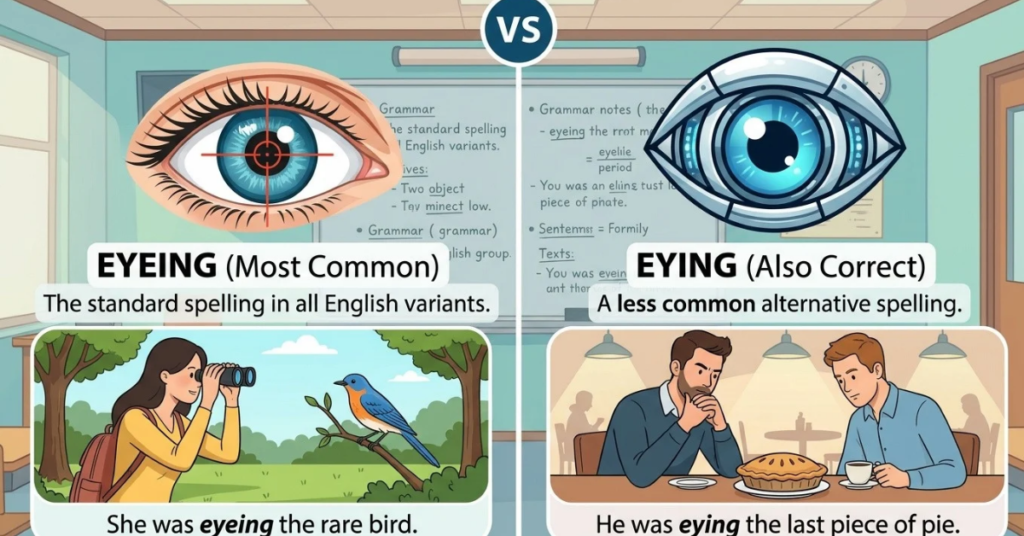
Have you ever paused while writing a sentence and wondered whether to spell it eyeing or eying? You’re not alone. The difference between these two spellings can be confusing, especially because both appear in English writing.
When comparing eyeing vs eying, the good news is that both spellings are correct. They have the same meaning, pronunciation, and grammatical function. The main difference comes down to regional spelling preferences: eyeing is more widely used, while eying is also accepted, particularly in American English.
Whether you’re writing an email, working on an article, or simply trying to improve your grammar, understanding this spelling difference can help you write with confidence. Let’s look at what each word means, when to use it, and how to choose the right spelling for your audience.
What Does Eyeing Mean?
Eyeing is the present participle of the verb eye. It means looking at someone or something closely, carefully, or with a particular intention.
The word can describe a simple glance, but it often suggests that someone is paying special attention to something because they want it, are curious about it, or are evaluating it.
For example:
- She was eyeing the last slice of chocolate cake.
- The manager was eyeing the new applicant carefully.
- He kept eyeing the watch in the shop window.
- The cat was eyeing the bird sitting on the fence.
In each sentence, the person or animal is looking at something with a particular degree of interest or attention.
The word eyeing can also be used figuratively. For instance, someone might be eyeing a promotion, a new house, or an opportunity. In these cases, the word suggests that the person is considering or hoping to obtain something.
What Does Eying Mean?
Eying is an alternative spelling of eyeing. It carries exactly the same meaning and is used in the same grammatical situations.
For example:
- She was eying the shoes on display.
- He was eying a position at the new company.
- The child was eying the cookies on the kitchen counter.
These sentences mean the same thing as their versions written with eyeing.
Although eying is a recognized spelling, it appears less frequently in general writing. Many readers and editors are more accustomed to seeing eyeing, so it is usually the safer choice when you want your writing to look familiar and consistent.
Eyeing vs Eying: Key Differences
The difference between eyeing and eying is spelling rather than meaning. Neither word describes a different action, and neither changes the pronunciation.
| Feature | Eyeing | Eying |
|---|---|---|
| Meaning | Looking at something with interest or attention | Looking at something with interest or attention |
| Pronunciation | The same | The same |
| Grammatical form | Present participle of eye | Present participle of eye |
| Correct spelling | Yes | Yes |
| General usage | More widely used | Less widely used |
| Best choice for most writing | Recommended | Acceptable alternative |
The important point is that you don’t need to learn two separate definitions. Both words express the same idea, so your choice depends mainly on convention, audience, and consistency.
Why Are Both Eyeing and Eying Correct?
English spelling can be inconsistent, particularly when words are formed by adding endings to verbs. Some words retain their original letters, while others follow different spelling patterns.
The verb eye is unusual because it ends with the letter e, yet its present participle is commonly written as eyeing, retaining the final e. The alternative form eying removes that letter before adding -ing.
Both forms have gained acceptance in English usage. Dictionaries recognize eying as a variant of eyeing, which means it is not simply a spelling mistake.
However, the fact that two spellings are accepted doesn’t mean they are equally common. In everyday writing, eyeing is generally the more familiar option.
When Should You Use Eyeing or Eying?
Choosing between the two spellings is straightforward once you consider your audience and the type of writing you’re doing.
1. Use Eyeing for General Writing
If you’re writing a blog post, school assignment, business email, or social media caption, eyeing is usually the best choice.
For example:
- I’m eyeing a new laptop for my home office.
- The customer was eyeing the latest collection.
- She is eyeing an opportunity to study abroad.
This spelling is widely recognized and is unlikely to distract readers.
2. Use Eying When Following a Style Preference
If a publication, editor, or organization prefers eying, you can use that spelling instead. It is a valid alternative, not an incorrect word.
The most important thing is to follow the spelling convention required by your project or publication.
3. Stay Consistent Throughout Your Writing
Avoid switching between eyeing and eying in the same article without a specific reason.
For example, if you begin with “She was eyeing the dress,” continue using eyeing throughout the piece. Consistent spelling makes your writing easier to read and gives it a more polished appearance.
Eyeing in a Sentence: Practical Examples
Seeing the word in different contexts is one of the easiest ways to understand its meaning.
Eyeing Something You Want
- I’m eyeing that beautiful handbag in the store.
- She has been eyeing a new phone for months.
- The children were eyeing the birthday presents.
In these examples, eyeing suggests desire or interest.
Eyeing Someone Carefully
- The security guard was eyeing the unfamiliar visitor.
- She noticed that her colleague was eyeing her suspiciously.
- The coach was eyeing the players during practice.
Here, the word suggests careful observation, suspicion, or evaluation.
Eyeing a Goal or Opportunity
- He is eyeing a promotion at work.
- The team is eyeing a place in the final.
- She is eyeing a scholarship for next year.
In these sentences, eyeing means considering or aiming for a particular goal.
Eying in a Sentence
The same examples work with the alternative spelling:
- I’m eying that beautiful handbag in the store.
- The security guard was eying the unfamiliar visitor.
- He is eying a promotion at work.
The meaning remains unchanged.
Eyeing vs Eying vs Icing: Avoid Common Confusion
Sometimes, spelling questions become more confusing when similar-looking words enter the picture. One example is icing, which has a completely different meaning.
- Eyeing: Looking at something with interest or attention.
- Eying: An alternative spelling of eyeing.
- Icing: A sweet coating used on cakes and other baked goods; it can also refer to other meanings in specific contexts.
For example:
- She was eyeing the cake. (She was looking at it.)
- She was adding icing to the cake. (She was decorating it.)
Remember that eyeing and eying are interchangeable, but icing is a different word.
Common Grammar Mistakes to Avoid
Even though both spellings are correct, a few simple mistakes are worth avoiding.
- Assuming eying is always wrong: It is an accepted alternative spelling of eyeing.
- Treating the words as having different meanings: Both forms mean the same thing.
- Confusing eyeing with looking: While eyeing involves looking, it often implies a particular interest, intention, or judgment.
- Switching spellings unnecessarily: Choose one form and use it consistently.
- Using eyeing when you mean icing: These words have different meanings and cannot be substituted for each other.
A useful tip is to remember that eyeing keeps the word eye visible in the spelling. This makes it easier to recognize the connection between the verb and the body part associated with seeing.
Frequently Asked Questions (FAQs)
1. Is eyeing or eying the correct spelling?
Both eyeing and eying are correct English spellings. However, eyeing is more widely used and is generally the preferred choice for everyday writing.
2. Is eying a real word?
Yes, eying is a recognized spelling variant of eyeing. It is not a spelling error, although it is less common in general usage.
3. Why does eyeing keep the letter E?
The verb eye commonly retains its final e when forming the present participle eyeing. English spelling does not follow one completely consistent rule for every verb, which explains why alternative forms sometimes develop.
4. Is eyeing more common in American or British English?
Eyeing is widely used in both American and British English. Eying is also accepted, particularly in American usage, but it is less common overall. If you need a familiar spelling for an international audience, choose eyeing.
5. What is the past tense of eye?
The simple past tense is eyed.
For example:
- She eyed the painting carefully.
- He eyed the unfamiliar package with suspicion.
The past participle is also eyed, as in “She had eyed the painting for several minutes.”
6. What is the difference between eyeing and looking?
Looking is a general term for directing your eyes toward something. Eyeing often suggests that you are watching, examining, evaluating, or wanting something with particular interest.
For example, “She was looking at the shoes” is neutral, while “She was eyeing the shoes” may suggest that she was thinking about buying them.
7. Can I use eying in formal writing?
Yes. Eying is an accepted spelling, so it can be used in formal writing. However, eyeing is generally the safer option because it is more familiar to readers and commonly used in published material.
8. Does eyeing mean staring?
Not necessarily. Eyeing can involve a brief or prolonged look, depending on the context. It often implies attention or intention, whereas staring usually describes looking for an extended period.
Conclusion: Eyeing vs Eying at a Glance
When it comes to eyeing vs eying, there is no difference in meaning. Both spellings describe looking at someone or something with interest, attention, curiosity, or a particular intention.
The main distinction is frequency of use. Eyeing is more common and is the best default choice for most writing, while eying remains an acceptable alternative.
To make the right choice, keep these three points in mind:
- Both spellings are correct.
- Both have the same meaning and pronunciation.
- Eyeing is generally preferable for clear, consistent writing.
The next time you encounter this spelling dilemma, you can confidently choose eyeing without worrying that you’re making a mistake. If you’re interested in improving your English further, explore other commonly confused words and spelling differences to make your writing clearer and more effective.
