
Have you ever stopped while writing a sentence and wondered whether the correct spelling is trek or treck? It is an easy mistake to make, especially because both words look similar and sound almost identical. However, when it comes to standard English, there is a clear answer.
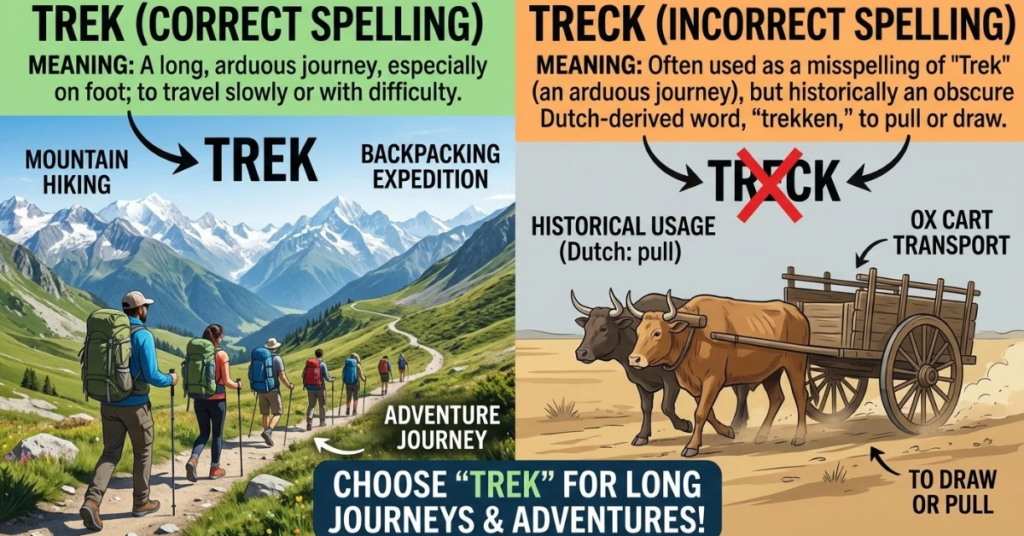
In the trek vs treck debate, trek is the correct spelling of the word used to describe a long, difficult journey, particularly one made on foot. Treck is generally considered a misspelling when used with this meaning.
Whether you are writing a travel blog, describing a hiking adventure, or improving your English vocabulary, understanding the difference will help you communicate more clearly. Let’s explore the meaning, correct usage, examples, and common questions surrounding these two spellings.
Trek vs Treck: What Is the Difference?
The main difference between trek and treck is spelling. In standard English, trek is the accepted word, while treck is usually an incorrect spelling of the same term.
Here is a quick comparison:
| Feature | Trek | Treck |
|---|---|---|
| Correct spelling | Yes | Generally no |
| Standard English word | Yes | Not standard for this meaning |
| Meaning | A long or difficult journey | Usually a misspelling of trek |
| Common context | Hiking, travel, exploration | Usually a spelling error |
| Example | We went on a mountain trek. | We went on a mountain treck. |
If you are referring to a challenging walk, a journey through the wilderness, or an extended trip across difficult terrain, use trek.
What Does Trek Mean?
The word trek is a noun and a verb. It commonly describes a long, tiring, or challenging journey, especially one undertaken on foot.
The word has historical roots in Afrikaans, where trek relates to pulling, moving, or travelling. English adopted the term, and it became widely associated with long journeys and exploration.
Trek as a Noun
When used as a noun, trek refers to a journey or trip that may require considerable time and effort.
Examples:
- The trek to the mountain summit took six hours.
- Our family planned a weekend trek through the hills.
- Reaching the remote village involved a difficult trek across rocky terrain.
- The journey to the campsite was a long trek through the forest.
In these examples, the word describes the journey itself rather than simply the act of walking.
Trek as a Verb
Trek can also describe the action of travelling over a considerable distance, particularly when the journey is demanding.
Examples:
- We trekked through the mountains for three days.
- They trekked across the desert in search of water.
- She trekked uphill to reach the viewpoint.
- The hikers trekked through the forest before sunset.
Notice how the verb changes to trekked in the past tense and trekking in the continuous form.
Why Do People Spell Trek as Treck?
There are several reasons people mistakenly write treck instead of trek. Most often, the error comes from pronunciation, spelling habits, or confusion about English spelling patterns.
1. Similar Pronunciation
In ordinary English pronunciation, trek and the intended misspelling treck would usually be pronounced the same way. Because the extra letter does not change the expected sound, it can be difficult to identify the spelling mistake by listening alone.
2. Confusion With Other English Words
English contains words such as check, deck, and neck, which end in “-eck.” Writers may unconsciously apply the same pattern to trek, even though its accepted spelling ends in “-ek.”
3. Typing Errors and Autocorrect
People often type quickly, particularly when writing social media captions, travel descriptions, or informal messages. An accidental extra letter can easily go unnoticed, especially when the writer does not proofread the text.
4. Limited Familiarity With the Word
Someone who rarely writes about hiking, outdoor activities, or long-distance journeys may not have encountered trek often enough to remember its spelling. Learning the word through examples can make it easier to use correctly.
Trek vs Treck in Sentences
The easiest way to remember the correct spelling is to compare examples of proper usage with common mistakes.
Correct Usage: Trek
- We completed a challenging trek through the mountains.
- The trek to the waterfall was worth the effort.
- They are planning a trekking holiday next summer.
- It was a long trek from the hotel to the railway station.
Incorrect Usage: Treck
- We completed a challenging treck through the mountains.
- The treck to the waterfall was worth the effort.
- They are planning a trecking holiday next summer.
- It was a long treck from the hotel to the railway station.
In these examples, replace treck with trek and use the related forms trekking and trekked where appropriate.
Trek, Trekking, and Trekked: Understanding the Word Forms
Learning the different forms of trek can help you avoid spelling mistakes in everyday writing.
| Word form | Usage | Example |
|---|---|---|
| Trek | Base form or noun | We plan to trek tomorrow. |
| Treks | Present-tense verb or plural noun | She treks every summer. |
| Trekking | Present participle or activity noun | They enjoy trekking in the hills. |
| Trekked | Past-tense verb | We trekked for hours. |
An important spelling rule appears in trekking and trekked: the final consonant is doubled before adding the suffix. This preserves the short vowel sound in the original word.
For example:
- Correct: trekking
- Incorrect: trecking
- Correct: trekked
- Incorrect: trecked
Remembering these forms is particularly helpful when writing travel articles, hiking guides, outdoor activity descriptions, or personal adventure stories.
Trek vs Hike: Are They the Same?
Although trek and hike are closely related, they do not always communicate exactly the same idea.
A hike is generally a walk in the countryside, hills, forests, or mountains, often undertaken for recreation or exercise. A trek often suggests a longer, more demanding journey or travel across challenging terrain.
For example, a short afternoon walk along a marked woodland trail would usually be called a hike. A multi-day journey through a remote mountain region might be described as a trek.
However, the terms overlap in everyday English. A difficult mountain hike can also be described as a trek, depending on the distance, conditions, and context.
How to Remember the Correct Spelling
If you regularly confuse trek and treck, try these simple techniques:
- Remember the four-letter word: The standard spelling is T-R-E-K.
- Connect it with trekking: The correct activity word is trekking, not trecking.
- Use a memorable sentence: “We took a trek through the hills.”
- Check your writing: Search for treck before publishing an article or submitting an assignment.
- Read examples: Seeing the word used correctly in travel writing can reinforce the spelling over time.
A quick spelling check is especially useful if you publish content online, where small errors can affect readability and the overall professionalism of your writing.
Why Correct Spelling Matters for SEO Content
If you are writing website content, blog posts, travel guides, or product descriptions, spelling accuracy matters for more than appearance. Correct spelling improves readability, builds trust with readers, and helps maintain a professional tone.
For SEO, the main goal should be to answer the reader’s question clearly and naturally. If your topic is “trek vs treck,” include the phrase where it makes sense, explain which spelling is correct, and use related terms such as trekking, hiking, outdoor adventures, and long-distance journeys where relevant.
Avoid repeating the target keyword excessively. A clear explanation, helpful examples, logical headings, and concise answers to common questions will provide more value than keyword stuffing.
Frequently Asked Questions (FAQs)
1. Is it trek or treck?
Trek is the correct spelling in standard English when referring to a long or difficult journey. Treck is generally a misspelling of this word.
2. What does trek mean in simple English?
A trek is a long or challenging journey, especially one made on foot. For example, walking for several hours through the mountains to reach a remote village could be described as a trek.
3. Is treck ever a correct word?
Treck is not the standard spelling for a long journey. However, it could appear as a proper name, brand name, username, or specialized term. In ordinary writing about travel or hiking, use trek.
4. Is trekking spelled with one K or two?
Trekking is spelled with two Ks. The original word trek doubles its final consonant before the suffix -ing is added.
5. What is the past tense of trek?
The past tense of trek is trekked. For example, “We trekked through the mountains last weekend.”
6. What is the difference between trekking and hiking?
Hiking usually refers to walking on trails or in natural areas for exercise or recreation. Trekking often suggests a longer or more demanding journey, sometimes lasting several days. The terms can overlap, depending on the context.
7. How do you use trek in a sentence?
You can use trek as either a noun or a verb. For example, “The trek was exhausting” uses it as a noun, while “We trek through the hills every summer” uses it as a verb.
8. Why is trek spelled without a C?
The accepted English spelling is trek, which reflects the word’s established spelling. Although adding a C might seem reasonable because of words such as deck and check, that pattern does not apply here.
Conclusion: Trek vs Treck
When comparing trek vs treck, the answer is straightforward: trek is the correct spelling for a long or challenging journey, while treck is generally a spelling mistake when used with that meaning.
Remember the related forms as well: trek, treks, trekking, and trekked. Understanding these variations will help you write confidently about hiking, travel, outdoor adventures, and exploration.
The next time you describe a journey through the mountains or a demanding walk across unfamiliar terrain, choose trek. If you want to improve your spelling further, explore other commonly confused English words and practise using them in everyday sentences.
