
Have you ever noticed a sign that says “Drive Thru” instead of “Drive Through”? Both spellings appear in everyday life, but does that mean they are interchangeable? The answer depends on where and how you use them.
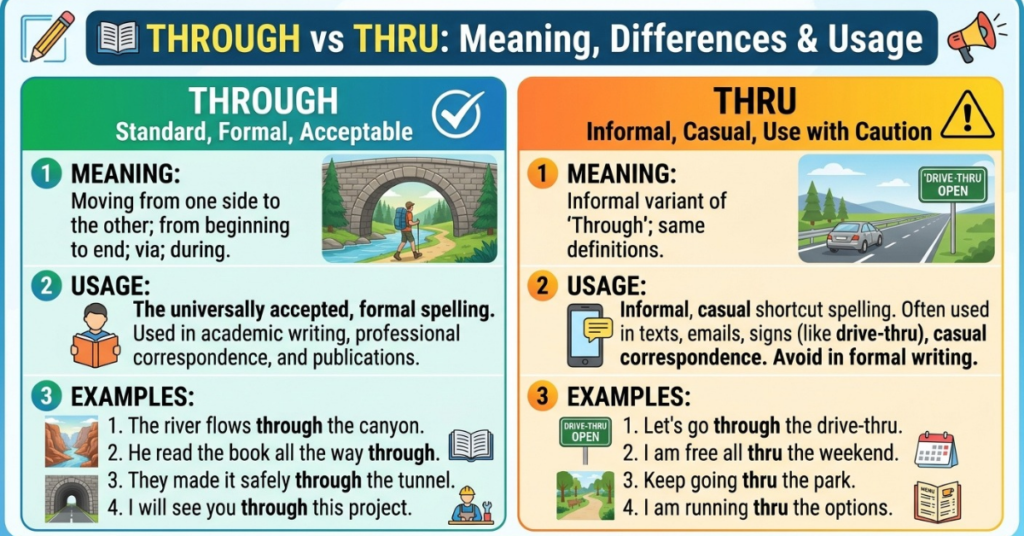
Understanding through vs thru is easier than you might think. Both words generally carry the same meaning, but they differ in spelling, formality, and common usage. “Through” is the standard spelling used in formal and informal writing, while “thru” is an informal alternative often found on signs, menus, and in advertising.
In this guide, we will explore the meaning of through vs thru, explain when to use each spelling, and clear up another common confusion: “threw” vs “through” vs “thru.”
Through vs Thru: What Is the Difference?
The main difference between “through” and “thru” is their spelling and level of formality. They are generally pronounced the same way and can express the same idea, but they are not equally suitable for every situation.
- Through: The standard English spelling, appropriate for formal writing, professional communication, academic work, and everyday sentences.
- Thru: An informal alternative, commonly used in business names, signs, menus, and short promotional messages.
For example:
- Standard spelling: “We drove through the tunnel.”
- Informal spelling: “We ordered food at the drive-thru.”
Both sentences are correct. The spelling choice simply reflects the context.
Through vs Thru Definition
Through is a preposition, adverb, and sometimes an adjective. Depending on the sentence, it can mean moving from one side of something to another, continuing from beginning to end, or completing a process.
Examples:
- “The train passed through the city.”
- “I read the entire report through.”
- “She worked through the weekend.”
Thru is a simplified spelling of “through.” It is most common in informal contexts where shorter wording is useful, particularly in American English.
Examples:
- “Drive-thru service is available.”
- “Use the thru lane to reach the exit.”
Although “thru” is widely understood, it is not the preferred spelling in formal prose.
Through vs Thru Meaning: Examples in Everyday English
To understand how these words work, it helps to look at the different meanings of “through.”
1. Moving from One Side to Another
When something enters one side of a space and exits the other, “through” describes that movement.
Examples:
- “The children ran through the garden.”
- “Sunlight came through the window.”
- “We walked through the forest.”
In casual signage, you may occasionally encounter “thru,” but “through” remains the standard spelling in a complete sentence.
2. Continuing from Beginning to End
“Through” can also describe something that continues for an entire period or covers a complete process.
Examples:
- “She stayed awake through the night.”
- “We worked through the final chapter.”
- “He listened through the entire presentation.”
In these examples, “thru” might appear in informal notes or abbreviated messages, but it is generally better to write “through” in ordinary prose.
3. Completing Something Successfully
The word “through” can describe finishing a task or reaching the end of a difficult experience.
Examples:
- “I am through with my assignment.”
- “They got through a challenging year.”
- “We finally worked through the problem.”
Here, replacing “through” with “thru” would make the writing look informal and is usually unnecessary.
When to Use Through vs Thru
Choosing the correct spelling is straightforward once you consider your audience and purpose.
Use “Through” in Formal and Standard Writing
Choose “through” for:
- Academic essays, research papers, and assignments.
- Business emails, reports, and professional documents.
- Blog posts, articles, and website content.
- Formal letters and applications.
- Everyday writing when you want to follow standard spelling conventions.
For example:
“Customers can complete their purchases through our website.”
This sentence is appropriate for a business website because it follows standard English spelling.
Use “Thru” in Informal and Commercial Contexts
“Thru” is often appropriate when brevity, familiarity, or established commercial wording matters.
Common examples include:
- Drive-thru restaurants.
- Drive-thru pharmacies.
- Signs advertising drive-thru pickup.
- Informal messages and short notes.
- Business names or branding that deliberately use the shorter spelling.
For example:
“Our drive-thru is open until midnight.”
This is a natural use of “thru” in a familiar commercial expression.
A simple rule to remember: If you are unsure which spelling to choose, use “through.” It is the standard form and works in virtually every context.
Drive Through vs Drive Thru: Which Is Correct?
One of the most frequently searched variations of this topic is “drive through vs drive thru.” Both expressions are widely understood, but “drive-thru” is especially common in restaurant and retail signage.
A drive-thru is a service that allows customers to place orders, collect purchases, or access certain services without leaving their vehicles.
Examples:
- “We stopped at a drive-thru for breakfast.”
- “The pharmacy offers drive-thru prescription pickup.”
- “You can drive through the entrance to reach the parking area.”
Notice that the final example uses “drive through” as a verb phrase. In contrast, “drive-thru” is a commonly used compound noun or adjective.
Drive-Thru vs Drive-Through: Grammar and Spelling
Both “drive-thru” and “drive-through” are accepted commercial spellings.
- Drive-thru: A shorter, informal spelling frequently used on signs and menus.
- Drive-through: A standard alternative commonly used in descriptions and general writing.
- Drive through: A verb phrase describing the action of driving through a place.
Examples:
| Expression | Example |
|---|---|
| Drive-thru | “The drive-thru closes at 11 p.m.” |
| Drive-through | “The restaurant has a drive-through service.” |
| Drive through | “Please drive through the gate slowly.” |
When writing a formal article, “drive-through” is a good choice for the service, while “drive-thru” is appropriate when referring to a business’s established wording or signage.
Threw vs Through vs Thru: Understanding the Difference
The words “threw,” “through,” and “thru” are easy to confuse because they sound alike. However, their meanings and grammatical functions are different.
What Does “Threw” Mean?
Threw is the simple past tense of the verb “throw.” It describes an action in which someone or something sent an object through the air or tossed it somewhere.
Examples:
- “She threw the ball to her brother.”
- “He threw the paper into the bin.”
- “They threw a surprise party for their friend.”
Remember that “threw” describes an action. It is not another spelling of “through.”
What Does “Through” Mean?
Through commonly refers to movement across a space, continuation over time, or completion of a process.
Examples:
- “We walked through the doorway.”
- “She studied through the night.”
- “He got through the difficult exam.”
What Does “Thru” Mean?
Thru is an informal alternative spelling of “through.” It appears most often in commercial language and abbreviated writing.
Examples:
- “The drive-thru is busy today.”
- “We picked up lunch at the drive-thru.”
Through vs Thru vs Threw: Quick Comparison
| Word | Meaning | Example |
|---|---|---|
| Through | Across, from beginning to end, or by means of | “We walked through the park.” |
| Thru | Informal spelling of “through” | “The drive-thru is open.” |
| Threw | Past tense of “throw” | “He threw the ball.” |
An Easy Trick to Remember the Difference
Ask yourself what you want to say:
- Are you describing movement, a process, or a period of time? Use through.
- Are you using a shortened spelling in a sign or familiar commercial expression? Thru may be appropriate.
- Are you describing something someone tossed or launched? Use threw.
For example, consider these three sentences:
- “She walked through the door.”
- “She ordered food at the drive-thru.”
- “She threw her keys onto the table.”
Each word serves a different purpose, even though all three sound similar.
Through vs Thru Grammar: Common Rules to Follow
Although “through” and “thru” can communicate the same basic idea, standard grammar and writing conventions favor “through” in most sentences.
Rule 1: Prefer “Through” in Formal Writing
Use “through” in professional documents, school assignments, essays, and published articles unless you are reproducing a name, sign, or quotation that uses “thru.”
Incorrect for standard formal prose:
- “The information was collected thru interviews.”
Preferred:
- “The information was collected through interviews.”
The shorter spelling is understandable, but the standard form is more appropriate for formal writing.
Rule 2: Recognize Established Compound Words
Some expressions commonly use “thru,” especially in American commercial English.
Examples:
- Drive-thru
- Drive-thru pickup
- Drive-thru banking
These expressions are widely understood and may follow the spelling chosen by a particular business or publication.
Rule 3: Do Not Confuse Pronunciation with Spelling
“Through,” “thru,” and “threw” are generally pronounced alike in standard English. This similarity does not make them interchangeable in writing.
Correct spelling depends on meaning and context, not pronunciation alone.
Rule 4: Keep Your Writing Consistent
If you are writing an article or professional document, use “through” consistently in ordinary sentences. Use “thru” when it forms part of a proper name, established expression, or intentionally informal phrase.
Consistency makes your writing easier to read and more professional.
Is “Thru” a Real Word?
Yes. “Thru” is a recognized spelling variant of “through,” and it has a long history of use in English. However, it is generally classified as informal rather than the standard spelling for ordinary prose.
It is particularly common in American English commercial contexts, including restaurant signs, roadside advertisements, and service descriptions.
For example, a restaurant might display “Drive-Thru Open” because the shorter wording is familiar and easy to read quickly. That does not mean the standard spelling “drive-through” is incorrect.
The distinction is similar to other situations in English where a shortened or simplified spelling becomes common in a particular setting. Acceptance in informal usage does not necessarily make it the best choice for every type of writing.
Through vs Thru Grammar Girl: What Should You Follow?
Readers searching for “through vs thru Grammar Girl” are generally looking for a practical explanation of the spelling difference and guidance on which form to choose.
The central usage principle is simple: “Through” is the standard spelling, while “thru” is an informal variant.
When writing for school, work, a website, or a professional audience, choose “through” unless there is a specific reason to use the alternative spelling.
For a restaurant sign, a drive-thru menu, or an established business name, “thru” may be entirely appropriate.
If you consult a particular grammar reference, follow its explanation and any relevant style-guide recommendations. The exact preferred spelling of a compound expression can depend on the publication or organization’s style conventions.
Common Mistakes When Using Through and Thru
Even confident English speakers sometimes mix up these spellings. Here are a few mistakes to avoid.
Mistake 1: Using “Thru” in Formal Essays
Informal:
- “We learned about sustainability thru research.”
Preferred:
- “We learned about sustainability through research.”
Mistake 2: Using “Threw” Instead of “Through”
Incorrect:
- “We walked threw the park.”
Correct:
- “We walked through the park.”
The sentence describes movement across a place, so “through” is the right choice.
Mistake 3: Assuming “Thru” Is Always Incorrect
It is not. “Thru” is widely used in informal and commercial settings, particularly in established expressions such as “drive-thru.”
Mistake 4: Assuming the Three Words Have the Same Meaning
“Through” and “thru” generally share a meaning, but “threw” refers to the past tense of “throw.” Understanding this difference prevents many spelling errors.
Frequently Asked Questions
1. What is the main difference between through and thru?
“Through” is the standard English spelling, while “thru” is an informal variant often used in signs, advertising, and commercial expressions such as “drive-thru.”
2. Is thru grammatically correct?
Yes, “thru” is a recognized spelling variant. However, “through” is preferred in formal writing, academic work, and most professional communication.
3. Should I write drive through or drive thru?
Both “drive-through” and “drive-thru” are widely used for vehicle-based services. “Drive-thru” is especially common on signs and menus, while “drive-through” is a suitable standard alternative in general writing.
4. What is the difference between threw and through?
“Threw” is the past tense of “throw,” meaning to toss or launch something. “Through” describes movement across something, continuation over time, or completion of a process.
Example: “He threw the ball through the window.”
5. Are through and thru pronounced the same?
Generally, yes. Both are pronounced /θruː/ in standard English, with the initial sound resembling the “th” in “think.”
6. Is thru American or British English?
“Thru” is particularly familiar in American English commercial usage. It is also understood elsewhere, but “through” remains the standard spelling in both American and British English.
7. Can I use thru in a professional email?
It is better to use “through” in a professional email. For example, write “You can contact us through our website” rather than “You can contact us thru our website.”
8. Why do businesses use thru instead of through?
Businesses often use “thru” because it is shorter, easy to recognize, and convenient for signs and menus. It can also be part of an established brand name or commercial expression.
9. What is the difference between through, thru, and threw?
“Through” is the standard spelling for movement, continuation, or completion. “Thru” is its informal alternative. “Threw” is the past tense of “throw.”
10. Which spelling should I use in an article?
Use “through” in ordinary article text. You can use “thru” when discussing the spelling itself, reproducing a business name, or referring to a conventional term such as “drive-thru.”
Conclusion
Understanding through vs thru comes down to recognizing the difference between standard spelling and informal usage. Both forms generally communicate the same meaning, but “through” is the safer choice for essays, professional documents, emails, and articles.
“Thru” is useful in familiar commercial expressions such as “drive-thru,” where shorter wording is common. Meanwhile, “threw” has a completely different meaning because it is the past tense of “throw.”
Keep these three words in mind, and choosing the right spelling becomes much easier. If you want to improve your everyday English, explore more guides on commonly confused words, spelling differences, and practical grammar rules to build confidence in your writing.
