
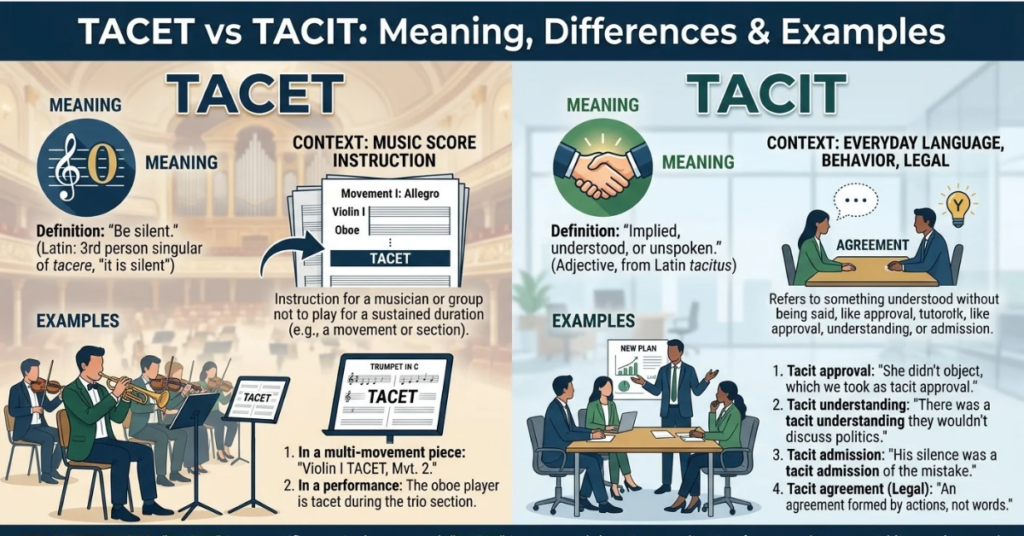
Have you ever come across the words tacet and tacit and wondered whether they mean the same thing? They look almost identical, and both have a connection to silence. However, the difference between tacet vs tacit becomes clear when you understand how each word is used.
Tacet is primarily a musical term that tells a performer not to play or sing during a particular section. Tacit, on the other hand, describes something understood, accepted, or communicated without being directly expressed in words.
Although both words are associated with the idea of silence, they belong to different contexts. This guide explains their meanings, pronunciation, origins, and practical examples so you can use each term confidently.
What Is the Difference Between Tacet and Tacit?
The main difference between tacet and tacit is their meaning and grammatical use. One is associated with musical performance, while the other describes something implied or understood without being explicitly stated.
| Feature | Tacet | Tacit |
|---|---|---|
| Meaning | A performer remains silent or does not play | Understood without being directly expressed |
| Part of speech | Musical direction | Adjective |
| Common context | Music and musical scores | Communication, agreements, and social behavior |
| Example | The flute part is marked tacet. | They reached a tacit agreement. |
| Main idea | Not playing or singing | Unspoken understanding |
In simple terms, tacet means “do not play,” while tacit means “understood without being said.” Remembering this distinction makes it much easier to choose the correct word.
Tacet Meaning: What Does Tacet Mean?
Tacet is a musical term derived from Latin. It means “it is silent” or “it is silent” in the sense that a particular instrument or voice does not perform during a specified section of music.
Musicians encounter this term in sheet music, orchestral scores, and ensemble arrangements. When a part is marked tacet, the performer is instructed to remain silent for the indicated passage, movement, or other specified portion.
How Is Tacet Used in Music?
The word tacet helps composers communicate when a musician should not play. Rather than writing detailed instructions about resting, a composer can use this established musical direction.
For example:
- The trumpet is marked tacet in the second movement. The trumpet player does not play during that movement.
- The singer’s part says tacet. The singer remains silent for the designated section.
- The percussion section is tacet during the opening passage. The percussionists wait until their parts begin.
The exact duration depends on the score. A tacet marking may apply to a movement or another clearly defined section, so performers should always check the musical context.
Tacet in Musical Scores
In an orchestral score, different instruments often enter and leave the music at different times. A violin might play continuously while a trumpet rests for an entire movement.
A tacet marking makes this arrangement clear. It does not necessarily mean that the instrument is unavailable for the entire composition; it means the performer should remain silent during the designated portion.
Example sentence: “The clarinet player noticed that the part was marked tacet for the entire third movement.”
Here, tacet is correct because the sentence refers to a musical instruction.
Tacit Meaning: What Does Tacit Mean?
Tacit is an adjective that describes something understood, accepted, or communicated without being openly expressed. It often refers to an assumption, agreement, expectation, or form of understanding that exists without a direct verbal statement.
Unlike tacet, tacit is widely used in everyday English, business, law, and social situations.
For instance, if two colleagues consistently cover each other’s responsibilities without formally agreeing to do so, they may have a tacit understanding.
Common Uses of Tacit
The word tacit appears in several common expressions.
- Tacit agreement: An agreement understood through actions or circumstances rather than stated directly.
- Tacit approval: Acceptance or support communicated indirectly.
- Tacit understanding: A shared understanding that does not require explicit discussion.
- Tacit consent: Consent inferred from circumstances or conduct, where that inference is appropriate under the relevant rules.
These expressions describe situations in which something is implied rather than clearly announced.
Tacit in Everyday Conversations
People often communicate without saying everything directly. Facial expressions, repeated behavior, and shared expectations can sometimes convey meaning without spoken words.
Consider these examples:
- They had a tacit agreement to keep the discussion private. They understood the expectation without formally stating it.
- Her silence was interpreted as tacit approval. Others took her lack of objection as a sign of acceptance, although silence alone does not always establish agreement.
- The team developed a tacit understanding of each person’s responsibilities. Everyone understood their roles without needing constant explanations.
In each example, tacit describes an unspoken understanding or an interpretation of someone’s behavior.
Tacet vs Tacit: Pronunciation Differences
Although the words look similar, their pronunciation differs slightly.
- Tacet: Commonly pronounced TAY-set in English-language musical usage.
- Tacit: Commonly pronounced TASS-it.
The second word has a short vowel sound in its first syllable, while the first is commonly pronounced with a long A sound.
A useful memory trick is to associate tacet with a musical setting and tacit with an idea that remains unspoken.
Tacet vs Tacit: Etymology and Word Origins
Understanding the origins of these words can make their meanings easier to remember.
Origin of Tacet
Tacet comes from the Latin verb tacēre, meaning “to be silent” or “to keep silent.” In musical notation, it developed into a conventional direction indicating that a performer or part remains silent.
The term is still used in classical music and other musical settings where written instructions guide performers.
Origin of Tacit
Tacit also comes from Latin, through tacitus, meaning “silent” or “not spoken.” Over time, English adopted the adjective to describe things understood or implied without being directly stated.
The shared Latin root explains why both words relate to silence. However, their modern meanings have developed differently: tacet directs musical silence, while tacit describes unspoken meaning or understanding.
When Should You Use Tacet or Tacit?
Choosing the correct word becomes straightforward when you focus on the context.
Use Tacet When Discussing Music
Choose tacet when referring to a musical score, an instrument, a singer, or a section during which a performer does not play or sing.
Examples:
- “The oboe is tacet during the final movement.”
- “The conductor checked which instruments were tacet.”
- “The bassoon part is marked tacet in this section.”
Use Tacit When Discussing Unspoken Ideas
Choose tacit when describing something implied, understood, or accepted without direct verbal expression.
Examples:
- “There was a tacit understanding between the roommates.”
- “The manager gave tacit approval to the proposal.”
- “Their cooperation depended on a tacit agreement.”
A Simple Test to Remember the Difference
Ask yourself what the sentence is describing:
- Is it about a musician remaining silent? Use tacet.
- Is it about an unspoken understanding or implied meaning? Use tacit.
This simple test works for most everyday writing situations.
Common Mistakes When Using Tacet and Tacit
Because the two words look and sound similar, confusing them is easy. However, a few common mistakes are worth avoiding.
1. Using Tacet to Mean an Unspoken Agreement
Incorrect: “They reached a tacet agreement.”
Correct: “They reached a tacit agreement.”
An agreement that is understood without being explicitly stated is tacit, not tacet.
2. Using Tacit as a Musical Direction
Incorrect: “The violin section is tacit for the second movement.”
Correct: “The violin section is tacet for the second movement.”
The musical instruction requires tacet.
3. Assuming Silence Always Means Consent
A person’s silence does not automatically demonstrate approval or agreement. Although tacit approval is a common expression, the meaning depends on the circumstances.
This distinction is especially important in legal, professional, and personal situations where consent may require an explicit statement or action.
4. Confusing Similar Spellings With Identical Meanings
The words share a Latin connection, but they are not interchangeable. Always consider whether you are describing musical silence or an unspoken idea before selecting one.
Quick Comparison: Tacet vs Tacit Examples
Here are a few additional examples to reinforce the distinction.
| Sentence | Correct word | Why? |
|---|---|---|
| The flute is ___ during the introduction. | Tacet | It describes a musical rest. |
| They formed a ___ agreement. | Tacit | The agreement is unspoken. |
| The singer’s score says ___. | Tacet | It is a musical direction. |
| Her actions showed ___ support. | Tacit | The support was communicated indirectly. |
| The orchestra marked the horns ___. | Tacet | The horns do not play during the designated section. |
| Everyone seemed to share a ___ understanding. | Tacit | The understanding was not explicitly stated. |
Frequently Asked Questions About Tacet vs Tacit
1. What is the main difference between tacet and tacit?
Tacet is a musical direction telling a performer not to play or sing during a designated section. Tacit is an adjective describing something understood or implied without being directly expressed.
2. Does tacit mean silent?
Not exactly. Tacit refers to something unspoken or implied rather than silence itself. For example, a tacit agreement is an understanding that exists without an explicit verbal agreement.
3. What does tacet mean in music?
In music, tacet instructs a performer or instrument to remain silent during a specified passage, movement, or other section of a composition.
4. How do you pronounce tacet and tacit?
Tacet is commonly pronounced TAY-set, while tacit is pronounced TASS-it. Their similar spellings can make them confusing, but their vowel sounds and meanings differ.
5. Is tacit agreement the correct phrase?
Yes. A tacit agreement is an agreement understood or inferred without being directly expressed. However, whether someone’s conduct establishes an actual agreement depends on the circumstances and, where relevant, applicable law.
6. Can tacet and tacit be used interchangeably?
No. Although both words share a Latin connection to silence, they serve different purposes. Use tacet for musical instructions and tacit for unspoken understanding, implied approval, or similar concepts.
7. What is an example of tacit in a sentence?
“Without discussing it formally, the colleagues developed a tacit understanding about how to divide their work.”
The word tacit indicates that the arrangement was understood without an explicit conversation.
8. What is an example of tacet in a sentence?
“The trumpet section is marked tacet during the opening movement.”
This sentence uses tacet correctly because it describes a musical instruction for performers.
Conclusion
Understanding tacet vs tacit comes down to one important distinction: musical silence versus unspoken understanding. Tacet is a musical direction that tells a performer to remain silent during a specified section, while tacit describes something understood or implied without being directly stated.
Remember these two examples: “The flute is tacet” and “They reached a tacit agreement.” The first concerns a musical performance, whereas the second describes an unspoken understanding.
Whenever you are unsure which word to use, consider the context rather than relying on their similar spelling. You can also explore other commonly confused English words to strengthen your vocabulary and make your writing clearer and more precise.
