
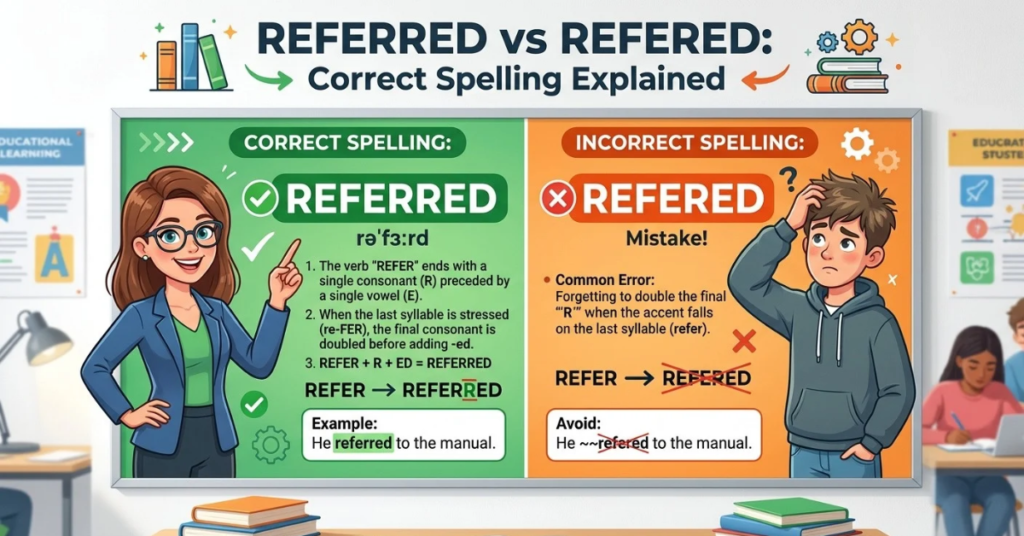
Have you ever typed refered into a message, email, or assignment and wondered whether it looked right? You’re not alone. The confusion between referred vs refered is common, especially because English spelling rules can be tricky when a word ends in a single consonant.
The good news is that there is a simple answer: referred is the correct spelling, while refered is a misspelling. Both forms might look similar, but only one follows standard English spelling rules.
In this article, we’ll explain why referred is correct, how to use it in everyday sentences, and what grammar rule helps you remember the spelling for good.
Referred vs Refered: The Main Difference
The difference between referred and refered comes down to one extra letter: r.
- Referred: The correct past tense and past participle of the verb refer.
- Refered: An incorrect spelling that does not follow standard English spelling conventions.
When someone mentions a person, directs someone to a source, or talks about something that happened in the past, the correct word is referred.
Examples:
- Correct: The manager referred me to the human resources department.
- Incorrect: The manager refered me to the human resources department.
- Correct: She referred to the report during her presentation.
- Incorrect: She refered to the report during her presentation.
Although refered may appear in informal writing or online searches, that doesn’t make it correct. In professional emails, academic assignments, blog posts, and other formal writing, always use referred.
Why Is Referred Spelled With Double R?
To understand why referred has two r’s before -ed, it helps to look at the original verb: refer.
English has a spelling rule that often requires the final consonant of a word to be doubled before adding a suffix beginning with a vowel, such as -ed or -ing. This usually happens when the word ends in a consonant-vowel-consonant pattern and the final syllable is stressed.
The word refer follows this rule because its final syllable, fer, receives the stress.
Therefore:
- Refer + ed = referred
- Refer + ing = referring
The final r is doubled before the suffix is added.
The Spelling Rule Behind Referred
Consider the following examples to see how the rule works:
| Base verb | Past tense | Present participle |
|---|---|---|
| Refer | Referred | Referring |
| Prefer | Preferred | Preferring |
| Transfer | Transferred | Transferring |
| Admit | Admitted | Admitting |
| Commit | Committed | Committing |
These examples show a similar spelling pattern. However, English has exceptions, so it’s always helpful to check a dictionary if you’re unsure about a particular word.
Why Isn’t It Written as Refered?
Writing refered may seem logical if you think of adding -ed directly to the verb. However, English spelling conventions require the final consonant to be doubled in this case.
The correct construction is:
Refer → Referred
Not:
Refer → Refered
Remembering the double-r rule can help you avoid this mistake in other words, too.
What Does Referred Mean?
The word referred is the past tense and past participle of refer. Its meaning depends on the context, but it generally describes mentioning something, directing someone to a person or resource, or sending someone to another professional for assistance.
Here are three common meanings.
1. Referred Means Mentioned or Talked About
You can use referred to when someone mentions a subject, person, document, or event.
Examples:
- The teacher referred to the previous lesson.
- He referred to several studies in his research paper.
- During the meeting, the director referred to the company’s new policy.
In these sentences, the word indicates that someone mentioned or discussed something.
2. Referred Means Directed Someone to Another Person or Place
The word is also used when someone recommends contacting another person or directs someone toward a particular source.
Examples:
- My colleague referred me to a reliable interior designer.
- The customer service representative referred the customer to the technical support team.
- She referred me to a website with useful information.
In each case, someone is being directed toward another person, department, or resource.
3. Referred Means Sent to a Specialist or Professional
In professional and medical settings, referred often describes sending someone to another professional for further assistance or evaluation.
Examples:
- The doctor referred the patient to a specialist.
- The university referred the student to an academic adviser.
- The company referred the applicant to its recruitment department.
This usage is common in healthcare, education, recruitment, and customer service.
Referred vs Refered in Everyday Writing
Knowing the correct spelling is useful, but understanding how to use the word naturally is equally important.
Here are some everyday situations in which referred is commonly used.
In Emails and Professional Communication
When writing workplace emails, the correct spelling helps your message look polished and professional.
Examples:
- As referred to in our previous conversation, the meeting will take place on Monday.
- I was referred to your department for further information.
- Thank you for referring me to the appropriate contact.
A small spelling mistake may not change the meaning of a message, but correct spelling improves clarity and credibility.
In Academic Writing
Students and researchers often use referred when discussing sources, previous studies, or information mentioned in their work.
Examples:
- The researcher referred to several published articles.
- The lecturer referred to the textbook during the session.
- The author referred to earlier findings in the conclusion.
If you’re writing an essay, thesis, or research paper, use referred rather than refered.
In Job Applications and Recruitment
The word also appears frequently in job searches and recruitment processes.
Examples:
- I was referred to this position by a former colleague.
- The candidate was referred to the hiring manager.
- She referred a qualified applicant to the recruitment team.
In these examples, referred describes directing an applicant or candidate toward a job opportunity or hiring professional.
Referred vs Referring vs Refer: What’s the Difference?
These three forms come from the same verb, but they serve different grammatical purposes.
| Word | Usage | Example |
|---|---|---|
| Refer | Base form or present tense | I refer clients to trusted professionals. |
| Referred | Past tense or past participle | She referred me to a specialist. |
| Referring | Present participle or gerund | He is referring to the earlier discussion. |
When to Use Refer
Use refer when talking about an action in the present, giving instructions, or using the base form after words such as to and will.
Examples:
- I will refer you to the relevant department.
- Please refer to the instructions before starting.
- We often refer customers to our support team.
When to Use Referred
Use referred for completed past actions or as a past participle with helping verbs.
Examples:
- She referred me to a specialist yesterday.
- The application was referred to the admissions committee.
- They have referred several clients to our company.
When to Use Referring
Use referring for ongoing actions or when the verb functions as a noun.
Examples:
- I am referring to the latest report.
- Referring customers to the correct department is part of her job.
- The doctor is referring the patient for further assessment.
Notice that referring, like referred, uses a double r.
Common Spelling Mistakes Related to Referred
The confusion between referred and refered is part of a broader pattern of English spelling mistakes. Some words require doubled consonants when suffixes are added, while others do not.
Here are a few useful examples:
| Incorrect spelling | Correct spelling |
|---|---|
| Refered | Referred |
| Refering | Referring |
| Prefered | Preferred |
| Transfered | Transferred |
| Occured | Occurred |
| Begining | Beginning |
Learning these patterns can improve your spelling and help you write with greater confidence.
However, don’t assume that every word ending in a consonant should have that consonant doubled. The rule depends on factors such as the word’s spelling pattern, syllable stress, and suffix.
How to Remember the Correct Spelling of Referred
If you frequently mix up referred and refered, try these simple techniques.
- Remember the original verb: Start with refer. When adding -ed, double the final r to form referred.
- Learn the word pair: Memorize refer → referred → referring as a group.
- Use a simple sentence: Write, “She referred me to the right person.” Repeating the correct spelling in context makes it easier to remember.
- Check your writing: Use your word processor’s spell-check feature, especially when preparing professional or academic documents.
- Practice similar words: Learn pairs such as prefer → preferred and transfer → transferred to reinforce the same spelling pattern.
The most useful trick is to remember that both referred and referring contain a double r.
Frequently Asked Questions About Referred vs Refered
1. Is it referred or refered?
Referred is the correct spelling. Refered is a misspelling because the final r in refer must be doubled before adding -ed.
2. Why does referred have two r’s?
The final syllable of refer is stressed. Under the relevant English spelling rule, the final consonant is doubled before adding the suffix -ed, producing referred.
3. Is refered ever correct in English?
No. Refered is not the standard spelling in contemporary English. Use referred in formal and informal writing.
4. What is the past tense of refer?
The past tense of refer is referred.
Example: “The manager referred the issue to the appropriate department.”
5. Is it referring or refering?
The correct spelling is referring, with a double r. The final consonant is doubled before adding -ing.
Example: “She is referring to the instructions.”
6. What is the difference between referred and referred to?
Referred is the past-tense or past-participle form of the verb refer. Referred to is a common phrase used when someone mentions a subject or directs someone toward a person, place, or resource.
Examples:
- The doctor referred the patient to a specialist.
- The speaker referred to an earlier presentation.
7. Is referred a British or American spelling?
Referred is the standard spelling in both British and American English. There is no difference between the two varieties in this word.
8. How do you use referred in a sentence?
You can use referred to describe mentioning something or directing someone to another person or resource.
Examples:
- My supervisor referred me to the HR department.
- The article referred to recent research.
- She was referred to a qualified specialist.
9. What are the forms of the verb refer?
The main forms are:
- Base form: refer
- Third-person singular: refers
- Past tense: referred
- Past participle: referred
- Present participle: referring
Remember that both referred and referring require a double r.
Conclusion: Referred vs Refered — Remember the Double R
When comparing referred vs refered, the answer is straightforward: referred is correct, and refered is a spelling mistake. The correct form is used when describing something mentioned in the past, a person directed to another source, or someone sent to a specialist.
The spelling follows an established English rule: double the final consonant in refer before adding -ed or -ing. That’s why we write referred and referring, not refered or refering.
The next time you write an email, prepare an assignment, or publish an article, remember the double r. For more practical English spelling and grammar tips, explore related guides on commonly confused words and everyday writing mistakes.
