
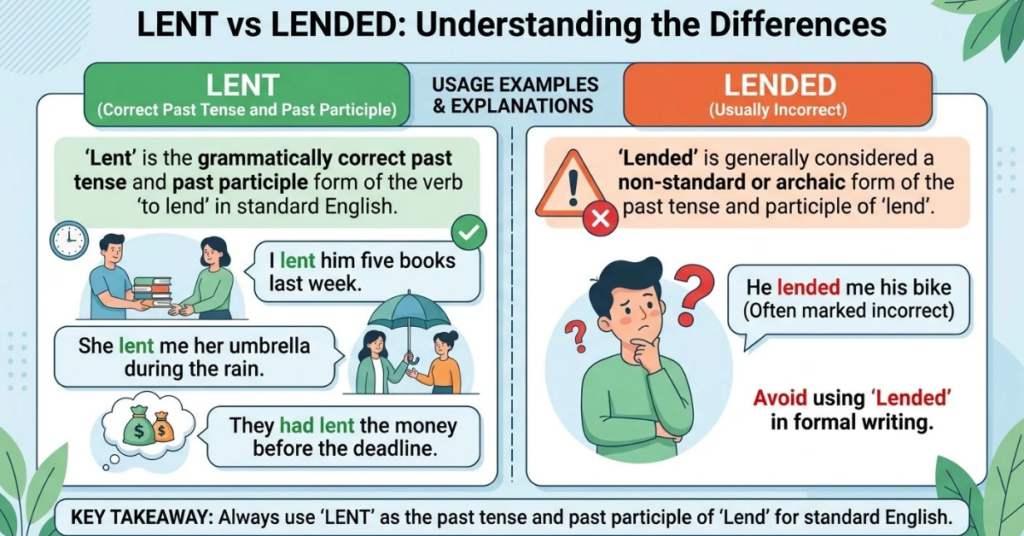
Have you ever wondered whether to write lended or lent when talking about giving someone money, a book, or another item temporarily? Although both words may sound reasonable, only one is generally accepted in standard English.
The difference between lended vs lent comes down to verb forms and correct grammar. Lent is the standard past tense and past participle of lend, while lended is considered nonstandard in modern English. Understanding this distinction can help you write clearer emails, improve your grammar, and avoid common mistakes in everyday conversations.
Let’s explore the meanings, examples, and rules that make it easy to choose the correct word.
Lended vs Lent: What Is the Difference?
The main difference is that lent is the correct standard English form, whereas lended is generally considered incorrect in formal and standard writing.
The verb lend means to give something to someone temporarily, with the expectation that it will be returned. Since lend is an irregular verb, it does not form its past tense by simply adding -ed.
Here is a quick comparison:
| Word | Correct usage | Example |
|---|---|---|
| Lend | Present tense | I lend my books to friends. |
| Lent | Past tense | I lent her my book yesterday. |
| Lent | Past participle | I have lent him some money. |
| Lended | Nonstandard form | I lended him my notes. |
In standard English, use lent when describing an action that happened in the past or when forming a perfect tense.
What Does Lent Mean?
Lent is the past tense and past participle of the verb lend. It describes giving something to another person temporarily, usually with the understanding that the person will return it.
The item can be money, clothing, books, tools, or even assistance in certain expressions.
Examples of Lent in Sentences
Here are some everyday examples:
-
I lent my sister my favorite jacket.
-
She lent me $50 to pay for groceries.
-
He lent his neighbor a ladder.
-
We lent our books to the students.
-
They have lent their support to the project.
-
My friend had lent me her laptop before the meeting.
Each sentence uses lent correctly because the action involves providing something temporarily.
How to Use Lent in Different Tenses
Although lent is associated with the past, it also appears in several verb constructions.
Simple past tense
Use lent for an action completed in the past.
Example: I lent him my calculator last week.
Present perfect tense
Use has lent or have lent when connecting a past action to the present.
Example: She has lent me her notes several times.
Past perfect tense
Use had lent when one past action occurred before another past event.
Example: He had lent me the book before I bought my own copy.
Remember that lent remains the same in these constructions. You do not need to change it to lended.
What Does Lended Mean?
Lended is a form that some English speakers use by applying the regular past-tense pattern of adding -ed to a verb. However, lend is an irregular verb, so this pattern does not apply.
In standard modern English, lended is not the accepted past tense or past participle of lend. You may encounter it in informal speech, learner writing, or nonstandard usage, but it is best avoided in professional documents, academic assignments, and published content.
Examples of Incorrect and Correct Usage
Consider these examples:
-
Incorrect: I lended him my phone yesterday.
-
Correct: I lent him my phone yesterday.
-
Incorrect: She has lended me her notes.
-
Correct: She has lent me her notes.
-
Incorrect: They lended us their car for the weekend.
-
Correct: They lent us their car for the weekend.
The meaning remains understandable in the incorrect examples, but the verb form does not follow standard English grammar.
Why Is Lent Correct Instead of Lended?
The reason is that lend belongs to a group of English verbs known as irregular verbs. Unlike regular verbs, which usually form their past tense by adding -ed, irregular verbs change in different ways.
For example:
| Present tense | Past tense | Past participle |
|---|---|---|
| Lend | Lent | Lent |
| Send | Sent | Sent |
| Spend | Spent | Spent |
| Build | Built | Built |
| Keep | Kept | Kept |
| Feel | Felt | Felt |
Notice the pattern in lend, send, and spend. Their past-tense forms change rather than taking the usual -ed ending.
Therefore, learning the three forms together is a practical way to avoid mistakes.
Lend → Lent → Lent
This pattern applies whether you are speaking about lending money, sharing belongings temporarily, or providing something that should eventually be returned.
Lended vs Lent: Common Grammar Mistakes
Even though lent is the standard form, people sometimes make mistakes when using it in sentences. Understanding these errors can help you use the verb naturally.
1. Adding -ed to Lend
Because many English verbs form their past tense with -ed, it may seem logical to write lended. However, irregular verbs do not always follow this rule.
Incorrect: I lended my friend a pen.
Correct: I lent my friend a pen.
2. Using Lend Instead of Lent
Another common mistake is using the present-tense form when describing a completed past action.
Incorrect: Yesterday, I lend him my headphones.
Correct: Yesterday, I lent him my headphones.
The word yesterday clearly places the action in the past, so lent is required.
3. Using Lended With Has, Have, or Had
Perfect tenses require the past participle of the verb. Since the past participle of lend is lent, it should follow has, have, or had.
Incorrect: I have lended her my notes.
Correct: I have lent her my notes.
4. Confusing Lend and Borrow
Although these verbs are related, they describe opposite perspectives.
-
Lend: Give something temporarily to another person.
-
Borrow: Receive something temporarily from another person.
For example, if you give your friend a book, you lend it to them. If your friend takes the book from you temporarily, they borrow it from you.
Keeping this distinction in mind helps you choose the right verb for the situation.
Lend vs Lent vs Borrowed: Understanding the Difference
The words lend, lent, and borrowed are connected, but they do not have the same grammatical role or meaning.
| Word | Meaning | Example |
|---|---|---|
| Lend | Present-tense action of giving temporarily | I lend books to my classmates. |
| Lent | Past-tense action of giving temporarily | I lent him a book yesterday. |
| Borrowed | Past-tense action of receiving temporarily | I borrowed a book from him. |
For instance, imagine that Sara gives Ali a pen for the day.
-
Sara lends Ali the pen.
-
Sara lent Ali the pen yesterday.
-
Ali borrows the pen.
-
Ali borrowed the pen yesterday.
The correct verb depends on who is giving the item and when the action occurs.
Easy Ways to Remember Lent
If you regularly confuse lended and lent, a few simple strategies can make the correct form easier to remember.
Learn the Three Verb Forms
Memorize this sequence:
Lend – Lent – Lent
Say it aloud a few times and use it when practicing sentences. Learning the present tense, past tense, and past participle together helps you recognize the correct form more quickly.
Compare It With Send and Sent
The verb send becomes sent in the past tense. Similarly, lend becomes lent.
For example:
-
I send an email today.
-
I sent an email yesterday.
-
I lend a book today.
-
I lent a book yesterday.
These similar patterns can help reinforce the correct spelling.
Look for Time Clues
Words such as yesterday, last week, earlier, and in 2024 often indicate that a sentence needs a past-tense verb.
For example:
-
Present: I lend my notes to classmates.
-
Past: I lent my notes to a classmate yesterday.
-
Present perfect: I have lent my notes to several classmates.
Checking the time reference in a sentence is a simple way to catch verb errors.
Frequently Asked Questions About Lended vs Lent
1. Is lended a real word?
Lended occurs in some nonstandard English usage, but it is not the accepted past tense or past participle of lend in standard modern English. For correct grammar, use lent.
2. Is lent the past tense of lend?
Yes. Lent is both the simple past tense and the past participle of lend.
Examples:
-
I lent her my umbrella.
-
I have lent her my umbrella.
Both sentences use the correct form.
3. Should I say “I lent him money” or “I lended him money”?
The correct standard English sentence is “I lent him money.” The verb lend is irregular, so its past tense is lent, not lended.
4. Is “I have lent” grammatically correct?
Yes. “I have lent” is grammatically correct because the present perfect tense uses have followed by the past participle. Since the past participle of lend is lent, this construction is correct.
5. What is the difference between lent and borrowed?
Lent describes giving something temporarily, while borrowed describes receiving something temporarily.
For example, “I lent her my book” means you gave her the book. “I borrowed her book” means you received the book from her.
6. Why do people say lended instead of lent?
Some people apply the regular English rule of adding -ed to form the past tense. However, lend is irregular, so its standard past-tense form is lent.
7. Is lent used in British and American English?
Yes. Both British and American English use lent as the standard past tense and past participle of lend. The correct form does not change between these varieties of English.
8. Which sentence is correct: “She lent me her car” or “She has lent me her car”?
Both sentences are correct, but they use different tenses.
-
“She lent me her car” uses the simple past tense.
-
“She has lent me her car” uses the present perfect tense.
Choose the sentence that best fits the timing and context of your message.
Conclusion
When comparing lended vs lent, the rule is straightforward: lent is the correct standard English form, while lended should generally be avoided in formal and everyday standard writing.
Remember the three forms of the verb: lend, lent, lent. Use lend for the present tense and lent for the simple past and past participle. Also, keep in mind that lend means to give something temporarily, whereas borrow means to receive something temporarily.
With a little practice, choosing between these words becomes much easier. If you want to strengthen your English grammar further, explore related guides on irregular verbs, past-tense forms, and commonly confused English words.
