
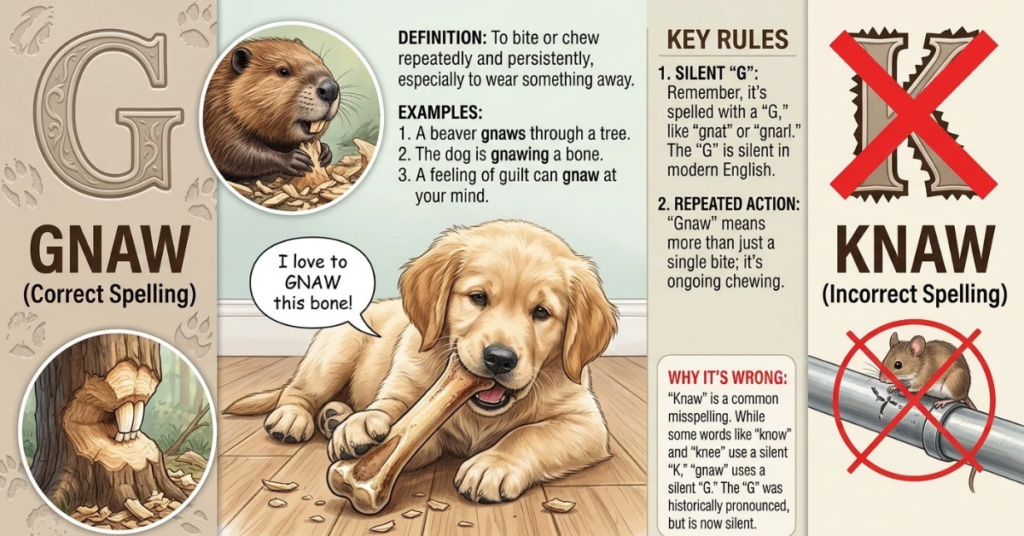
Have you ever wondered whether to write knaw or gnaw when describing someone biting or chewing something repeatedly? These words sound similar when spoken, so it is easy to see why people confuse them. However, only one is the standard spelling in modern English.
The correct spelling is gnaw, which means to bite, chew, or wear away something gradually with the teeth. Although “knaw” may appear in online searches, casual messages, or spelling mistakes, it is not the standard spelling of this word. Understanding the difference will help you write more accurately and use the word with confidence.
Knaw or Gnaw: Which One Is Correct?
When comparing knaw or gnaw, gnaw is the correct spelling in standard English. The word is commonly used when animals chew on bones, rodents bite through materials, or a person experiences a persistent feeling of worry.
“Knaw” is generally a misspelling of “gnaw” when someone intends to describe biting or chewing. It is best to use “gnaw” in school assignments, professional writing, articles, emails, and everyday communication.
Here is a quick comparison:
| Word | Meaning or usage | Correct? |
|---|---|---|
| Gnaw | To bite or chew repeatedly | Yes |
| Knaw | Usually a misspelling of gnaw | No, not for this meaning |
For example, you should write, “The puppy likes to gnaw on its toy,” rather than “The puppy likes to knaw on its toy.”
What Is the Meaning of Gnaw?
The word gnaw means to bite or chew something repeatedly, often using the back teeth. It can also describe something gradually wearing away a material or a feeling that continues to trouble someone mentally or emotionally.
The meaning depends on how the word appears in a sentence. There are three common ways to use it.
1. Gnaw Meaning in Physical Chewing
The most direct meaning of gnaw is to chew or bite something persistently. Animals such as mice, rabbits, dogs, and squirrels often gnaw on objects to explore them, maintain their teeth, or access food.
Examples include:
-
The mouse began to gnaw through the cardboard box.
-
The dog likes to gnaw on a rubber chew toy.
-
The rabbit continued to gnaw on a piece of carrot.
In each example, the word describes repeated biting or chewing rather than simply taking one bite.
2. Gnaw Meaning in Emotional Situations
Gnaw can also describe a feeling that continues to bother someone. In this context, it often appears in expressions such as “gnawing worry,” “gnawing guilt,” or “a gnawing sense of doubt.”
For instance:
-
A feeling of guilt continued to gnaw at him.
-
She had a gnawing worry about her upcoming examination.
-
Doubts began to gnaw at her confidence.
These sentences do not describe literal chewing. Instead, they use the word figuratively to explain how a thought or emotion repeatedly troubles someone.
3. Gnaw Meaning in Gradual Damage
The word can describe something slowly wearing away or damaging a surface. This use is especially common when talking about rodents, insects, or other causes of gradual deterioration.
Examples:
-
Rats can gnaw through certain types of packaging.
-
The animal gnawed at the wooden fence.
-
Moisture and neglect gradually damaged the structure, while pests continued to gnaw at its wooden components.
This meaning emphasizes repeated action over time rather than sudden damage.
How to Pronounce Gnaw Correctly
One reason people search for “knaw or gnaw” is that the spelling does not match the way the word sounds.
The word gnaw is pronounced “naw.” The letter “g” is silent, so you pronounce only the “n” sound at the beginning. According to the Cambridge Dictionary, the pronunciation is /nɔː/ in British English and /nɑː/ in American English.
Here is a simple pronunciation guide:
-
Gnaw: Sounds like “naw.”
-
G is silent: Do not pronounce it as “g-naw.”
-
Knaw: Although it may look like a possible spelling based on its sound, it is not the standard spelling for this meaning.
The silent “g” is similar to the silent “k” in words such as “knee” and “knife.” English spelling preserves several older letter patterns even when the letters are no longer pronounced.
Why Do People Confuse Knaw and Gnaw?
The confusion between knaw and gnaw mainly comes from pronunciation. Since the “g” in “gnaw” is silent, people may try to spell the word using the letters that seem most natural to them.
There are a few common reasons for this mistake:
-
Silent letters: Many English words contain letters that are written but not spoken.
-
Phonetic spelling: People sometimes spell words according to how they hear them.
-
Autocorrect and typing habits: Repeated spelling mistakes can become familiar, especially in informal messages.
-
Limited vocabulary exposure: Someone who has heard “gnaw” but rarely seen it written may not recognize its correct spelling.
The easiest way to avoid the error is to remember that the standard word begins with gn, even though the “g” is silent.
What Is the Difference Between Gnaw, Chew, and Bite?
Gnaw, chew, and bite have related meanings, but they are not always interchangeable. Knowing the difference helps you choose the most appropriate word.
| Word | Meaning | Example |
|---|---|---|
| Gnaw | To bite repeatedly, often wearing something away | The mouse gnawed through the material. |
| Chew | To work food or another object between the teeth | She chewed her food slowly. |
| Bite | To close the teeth on something, often once | The dog tried to bite the ball. |
| Nibble | To take small, gentle bites | The rabbit nibbled on a leaf. |
| Munch | To chew food steadily, often noisily | He munched on a biscuit. |
The main distinction is that gnaw often suggests persistent biting or chewing, sometimes with the aim or result of gradually wearing something away. It can also describe an ongoing emotional struggle.
Common Forms of the Word Gnaw
Like other English verbs, “gnaw” changes form depending on the tense and grammatical context.
| Word form | Usage | Example |
|---|---|---|
| Gnaw | Present tense | Dogs sometimes gnaw on toys. |
| Gnaws | Present tense with he, she, or it | The mouse gnaws at the wood. |
| Gnawed | Past tense | The puppy gnawed the old shoe. |
| Gnawing | Continuous tense or adjective | She felt a gnawing sense of doubt. |
| Gnawed | Past participle | The cable had been gnawed by rodents. |
These forms are useful in everyday writing. Remember that the past tense is generally gnawed, not “knawed.”
Synonyms and Related Words for Gnaw
If you want to improve your vocabulary or avoid repeating the same word in an article, several alternatives may fit, depending on the context.
-
Chew: To crush or work something between the teeth.
-
Bite: To grip or cut into something with the teeth.
-
Nibble: To take small bites.
-
Nip: To make a small, quick bite.
-
Wear away: To gradually reduce or damage a surface.
-
Trouble: To cause ongoing concern or distress.
-
Torment: To cause persistent mental or emotional suffering.
For example, you could replace “The dog gnawed on its bone” with “The dog chewed on its bone.” However, if you are describing persistent anxiety, “gnawing at her conscience” may express the feeling more vividly than simply saying “bothering her.”
The Origin of the Word Gnaw
The word “gnaw” has a long history in the English language. It comes from the Old English verb gnagan, meaning to gnaw or bite away little by little. Related words also appear in other Germanic languages, including German nagen.
Over time, the word developed both literal and figurative meanings. It still describes physical chewing, but it can also express how persistent worry, guilt, or doubt gradually affects a person.
This history helps explain why the spelling contains a silent “g.” Although modern speakers do not pronounce that letter, it remains part of the established spelling.
Common Mistakes to Avoid When Using Gnaw
Even after learning the correct spelling, it is useful to understand a few common errors.
-
Writing “knaw” instead of “gnaw.” Use “gnaw” when you mean repeated biting or chewing.
-
Pronouncing the silent letter. Say “naw,” not “g-naw.”
-
Using “gnawed” incorrectly. The standard past-tense form is “gnawed.”
-
Confusing literal and figurative meanings. A dog may gnaw a bone, while a worry may gnaw at someone’s mind.
-
Using the word when a simpler alternative is clearer. For ordinary eating, “chew” may be more natural than “gnaw.”
A quick spelling check before publishing an article, sending a message, or submitting an assignment can help prevent these mistakes.
Frequently Asked Questions
1. Is it knaw or gnaw?
Gnaw is correct when referring to repeated biting or chewing. “Knaw” is generally a misspelling of the word in this context.
2. What does gnaw mean in simple English?
Gnaw means to keep biting or chewing something, often little by little. It can also mean that a thought or feeling continues to worry someone.
3. How do you pronounce gnaw?
Gnaw is pronounced “naw.” The initial “g” is silent, which is why the word can be confusing when you first encounter it.
4. Is the G silent in gnaw?
Yes. The “g” is silent, and the word begins with an “n” sound. This spelling pattern is also found in some other English words that begin with “gn.”
5. What is the past tense of gnaw?
The standard past tense is gnawed. For example, “The puppy gnawed on its toy for several minutes.”
6. What does gnawing mean in a sentence?
Gnawing can describe repeated chewing or a persistent feeling of worry. For example, “The rabbit was gnawing on a branch” describes physical chewing, while “A gnawing doubt remained” describes emotional uncertainty.
7. Is gnaw a real English word?
Yes. Gnaw is a standard English verb listed in major dictionaries, including the Oxford and Cambridge dictionaries. It has both literal and figurative meanings.
8. What are some synonyms for gnaw?
Depending on the sentence, synonyms include chew, nibble, bite, munch, wear away, and trouble. The best alternative depends on whether you mean physical chewing or emotional distress.
9. Can gnaw be used to describe anxiety?
Yes. The word can describe persistent anxiety, guilt, or doubt. For example, “The uncertainty continued to gnaw at him” means that the uncertainty kept troubling him.
10. Why is gnaw spelled with a G if the letter is silent?
The spelling reflects the word’s historical development in English. Although the “g” is no longer pronounced, it remains part of the standard spelling inherited from older forms of the language.
Conclusion
When deciding between knaw or gnaw, remember that gnaw is the correct standard spelling. It means to bite or chew something repeatedly, gradually wear something away, or experience a persistent feeling of worry.
The silent “g” may make the word difficult to spell at first, but remembering its pronunciation and common examples makes it easier. Whether you are describing a dog chewing a bone or a worry that refuses to disappear, use “gnaw” to express the meaning accurately.
For more useful spelling guides, explore other commonly confused English words and learn how to use them correctly in everyday writing.
