
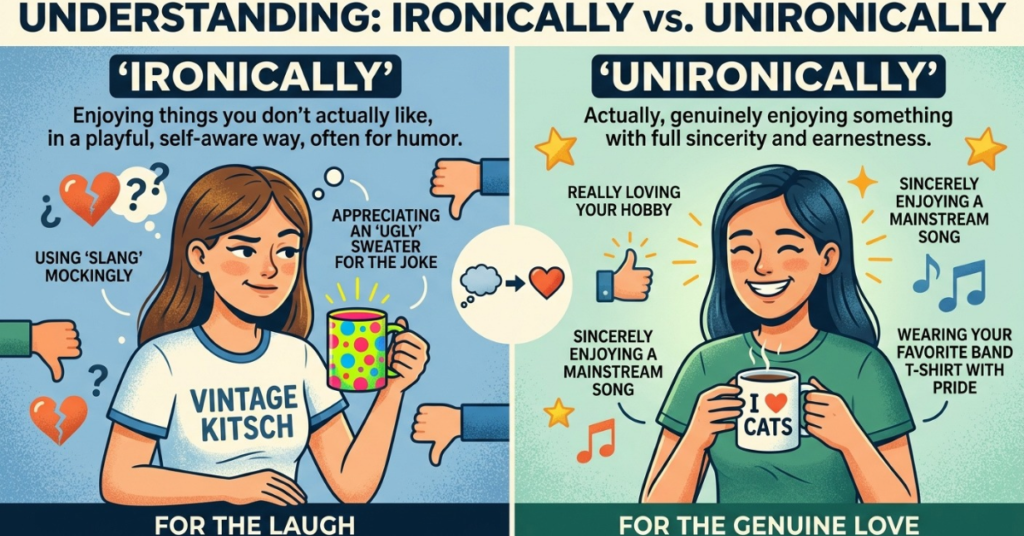
Have you ever seen someone say, “I ironically love this terrible song,” and wondered what they actually meant? Or perhaps someone posted, “I unironically think this is the best movie ever,” and you weren’t sure why they used that extra word.
Understanding ironically vs. unironically is easier than it seems. Both words describe how someone expresses an opinion, but they communicate different intentions. One often signals irony, sarcasm, or a contrast between words and meaning, while the other emphasizes that a person genuinely means what they say.
These words appear frequently in everyday conversations, social media comments, memes, and online discussions. Once you understand the difference, you’ll know exactly when to use each one and why people sometimes use them in funny or unexpected ways.
What Does Ironically Mean?
The word ironically is an adverb derived from irony. It describes a situation in which the intended meaning differs from the literal meaning, or an outcome contrasts with what someone would reasonably expect.
People also use it when making sarcastic remarks, joking about something, or expressing an opinion they don’t entirely mean literally.
Examples of Ironically in a Sentence
Here are a few examples that show how the word works:
- “I ironically listen to this awful song every day.” The speaker may be listening because the song is amusingly bad rather than because they genuinely enjoy it.
- “Ironically, the fire station caught fire.” This is ironic because a place associated with fighting fires experienced one itself.
- “I love being stuck in traffic,” she said ironically. She means the opposite of what her words suggest.
- “He bought an expensive watch to save money.” The decision contradicts the stated goal, creating an ironic situation.
However, irony does not always mean sarcasm. Sometimes, it describes an unexpected contradiction between what people anticipate and what actually happens.
For example, a person who spends years writing a book about avoiding mistakes might accidentally publish it with a major spelling error. That would be an ironic outcome, even if nobody intended to make a joke.
What Does Unironically Mean?
Unironically means sincerely, genuinely, or without irony. When someone uses this word, they want to make it clear that they actually mean what they are saying.
It often appears in conversations where a statement might otherwise sound sarcastic, exaggerated, or intentionally ridiculous.
Examples of Unironically in a Sentence
Consider these examples:
- “I unironically love this song.” The person genuinely enjoys the song, even if other people think it is bad.
- “She unironically believes that old movie is a masterpiece.” She sincerely considers the movie excellent.
- “I unironically wear socks with sandals.” The speaker likes the style and isn’t doing it as a joke.
- “He unironically thinks pineapple belongs on pizza.” He genuinely supports the combination rather than pretending to like it for humor.
The key idea is sincerity. The person isn’t hiding behind sarcasm or pretending to hold an opinion for entertainment.
Online, unironically can also suggest that someone is comfortable enjoying something that others might consider embarrassing, outdated, cheesy, or unpopular.
Ironically vs. Unironically: What’s the Difference?
The main difference between ironically and unironically is whether the statement involves irony or is meant sincerely.
| Feature | Ironically | Unironically |
|---|---|---|
| Meaning | In an ironic, often nonliteral or contrasting way | Sincerely, without irony |
| Intention | May involve sarcasm, humor, or a contrast in meaning | Expresses a genuine opinion or feeling |
| Typical use | Jokes, sarcastic remarks, unexpected outcomes | Honest preferences, beliefs, and opinions |
| Example | “I ironically love this terrible movie.” | “I unironically love this terrible movie.” |
| What it communicates | The speaker may not mean the statement literally | The speaker genuinely means the statement |
The easiest way to remember the difference is to focus on the speaker’s intention.
- Ironically: The speaker is using irony, or the situation involves an unexpected contrast.
- Unironically: The speaker means what they say without relying on irony.
One important detail is that ironically doesn’t automatically mean someone is lying. A person can use irony to make a joke while still genuinely liking something. Context determines what the speaker intends.
Ironically vs. Unironically Funny: Why Do People Use Them?
The phrases ironically funny and unironically funny are common in internet culture because humor often depends on whether someone is joking or being serious.
Something can be funny because it is ridiculous, or it can be funny because the person genuinely finds it entertaining.
What Does Ironically Funny Mean?
Something is ironically funny when its humor comes from irony, an unexpected contradiction, or a deliberately exaggerated situation.
For example, imagine a person who constantly gives advice about saving money but spends their entire paycheck on unnecessary decorations. Friends might find the contradiction ironically funny.
Another example is someone posting a picture of a motivational poster that says, “Never give up,” while joking about giving up on their unfinished projects. The humor comes from the contrast between the message and the situation.
In online conversations, people may also describe something as ironically funny when it is so awkward, exaggerated, or poorly made that it becomes entertaining.
What Does Unironically Funny Mean?
Something is unironically funny when a person genuinely finds it amusing rather than laughing at it only because it is awkward, absurd, or unintentionally ridiculous.
For instance, someone might watch a comedy film that critics dislike but genuinely laugh at every joke. They could say, “This movie is unironically funny.”
Similarly, a person might enjoy a silly meme because they think it is genuinely clever, not because it is embarrassing or bad.
The distinction is about the reason for the amusement, not necessarily how much someone laughs.
Ironically vs. Unironically in Internet Slang
Social media has made both words especially popular. On platforms such as TikTok, Instagram, Reddit, and X, people frequently use them to explain their reactions to music, fashion, movies, memes, and other trends.
1. Ironically Liking Something
Someone might say:
“I only listen to this song ironically.”
This suggests that they listen to the song as a joke, perhaps because it is cheesy, dramatic, or widely considered embarrassing.
However, the statement might not tell the whole story. They could initially have listened for fun but eventually developed a genuine appreciation for it.
2. Unironically Liking Something
Now consider this statement:
“I unironically love this song.”
Here, the person is emphasizing that their enjoyment is genuine. They may know that other people dislike the song, but they don’t feel the need to pretend their interest is a joke.
This expression is particularly common when someone admits to liking something that doesn’t fit their usual image or social circle.
3. Using Both Words for Humor
Sometimes, people use these words to make a statement funnier by highlighting the difference between pretending and being sincere.
For example:
“I started watching this show ironically, but now I unironically care about every character.”
The humor comes from the change in attitude. The person began watching the show as a joke but eventually became emotionally invested in it.
This is one reason the words work so well in online conversations: they communicate not only what someone likes but also how their feelings have changed.
How to Use Ironically and Unironically Correctly
Choosing the right word becomes simple when you consider what you want to communicate.
Follow these steps:
- Identify your intention. Are you being sarcastic, making an ironic observation, or expressing a sincere opinion?
- Consider the context. A statement may sound sarcastic on its own but be completely serious in a different conversation.
- Choose the appropriate word. Use ironically when the meaning or situation involves irony. Use unironically when you want to emphasize sincerity.
- Read the sentence again. Make sure the word communicates what you actually mean.
Common Mistakes to Avoid
Mistake 1: Assuming ironically always means sarcastically.
Irony can involve sarcasm, but it can also describe unexpected outcomes. A situation can be ironic even when nobody intends to make a joke.
Mistake 2: Thinking unironically means liking something unusual.
Not necessarily. You can unironically love a popular song, a classic film, or a widely admired book. The word simply emphasizes that your opinion is sincere.
Mistake 3: Treating the words as exact opposites in every situation.
They often contrast with each other, especially in discussions about personal preferences. However, irony can describe events and circumstances, while unironically usually emphasizes a person’s genuine meaning or attitude.
Mistake 4: Assuming an ironic statement reveals someone’s true opinion.
A person who says, “This is the best meal I’ve ever eaten,” sarcastically may dislike the food. However, the same words could be sincere in another context. Tone, facial expressions, and surrounding conversation help clarify the meaning.
Real-Life Examples of Ironically vs. Unironically
Here are some everyday situations that make the distinction easier to understand.
Example 1: Music
- Ironically: “I listen to this cheesy pop song because it’s so ridiculous.”
- Unironically: “I genuinely love this cheesy pop song.”
Example 2: Fashion
- Ironically: “I’m wearing these oversized glasses as a joke.”
- Unironically: “I love these oversized glasses and wear them because I like the style.”
Example 3: Movies
- Ironically: “This movie is so bad that watching it has become a hobby.”
- Unironically: “This movie is genuinely one of my favorites.”
Example 4: Food
- Ironically: “I ordered the strangest pizza topping just to see everyone’s reaction.”
- Unironically: “I actually enjoy this unusual pizza topping.”
Example 5: Social Media
- Ironically: Someone shares an exaggerated motivational quote to make fun of unrealistic advice.
- Unironically: Someone shares the same quote because they find it inspiring.
These examples show that the difference often lies in the speaker’s purpose. The same object, song, movie, or statement can be enjoyed ironically by one person and unironically by another.
Can You Like Something Both Ironically and Unironically?
Yes! In fact, this happens quite often.
Imagine that you start watching a low-budget television show because the acting seems exaggerated and the dialogue sounds ridiculous. At first, you watch it ironically because its flaws make you laugh.
After a few episodes, however, you begin to enjoy the characters, follow the storyline, and look forward to new episodes. Your enjoyment becomes genuine, even though you still recognize the show’s flaws.
You might describe this experience by saying:
“I started watching it ironically, but now I unironically love it.”
This sentence communicates a change in your relationship with the show. You began with an amused, somewhat mocking attitude but developed sincere affection for it.
You can also experience both reactions at the same time. You might genuinely love a movie while laughing at its awkward dialogue and questionable special effects. Human preferences are not always neatly divided into serious and joking categories.
Why Does Unironically Sometimes Sound Funny?
The word unironically can make an ordinary statement more entertaining because it signals that the speaker knows their opinion might seem unusual.
For example, saying “I love this song” is straightforward. Saying “I unironically love this song” adds another layer: the speaker anticipates that someone might assume they are joking.
That extra emphasis can make the statement humorous, especially when the subject is something considered embarrassing, outdated, or unfashionable.
This is also why unironically appears so often in memes. It lets people express sincere enthusiasm while acknowledging the possibility that others might misunderstand them.
Ultimately, the word isn’t funny by itself. Its effect depends on the contrast between what people expect someone to say and what that person genuinely believes.
Frequently Asked Questions
1. What is the difference between ironically and unironically?
Ironically describes something involving irony, such as a sarcastic statement or an unexpected contradiction. Unironically means sincerely or without irony, emphasizing that the speaker genuinely means what they say.
2. Does ironically mean you don’t like something?
No. It can suggest that someone is pretending to like something as a joke, but that isn’t always the case. People can genuinely enjoy something while making ironic comments about it.
3. What does unironically mean in slang?
In internet slang, unironically means genuinely or seriously. It is often used to clarify that someone truly likes a song, movie, meme, fashion trend, or other thing that people might assume they are mocking.
4. What does ironically funny mean?
Ironically funny generally describes humor that comes from a contradiction, unexpected outcome, or ironic situation. In casual online use, it can also describe something amusing because it is awkward or unintentionally ridiculous.
5. What does unironically funny mean?
It means something is genuinely funny to the person describing it. They aren’t laughing merely to mock it or because it is unintentionally embarrassing.
6. Is ironically the opposite of unironically?
They often function as opposites when describing how someone expresses an opinion. However, their meanings aren’t perfectly symmetrical in every context because ironically can describe situations and outcomes, while unironically usually emphasizes sincere expression.
7. Can you use ironically and unironically in the same sentence?
Yes. For example, “I bought this game ironically, but now I unironically play it every weekend.” This shows how someone’s attitude can change from joking interest to genuine enjoyment.
8. Is unironically a real word?
Yes. Unironically is a standard English adverb formed by adding the prefix un- to ironically. It is used in both informal conversation and more formal writing when the context calls for it.
9. Why do people say they unironically like something?
They often want to make it clear that their enjoyment is genuine, particularly when the subject is considered silly, unpopular, or embarrassing. The word helps distinguish sincere enthusiasm from sarcasm or playful exaggeration.
10. Is saying something ironically the same as sarcasm?
Not exactly. Sarcasm is a form of expression that often uses words to communicate criticism or the opposite of their literal meaning. Irony is broader and can include situational and dramatic irony, even when nobody is being sarcastic.
Conclusion
Understanding ironically vs. unironically comes down to recognizing intention and context. Ironically can describe sarcasm, nonliteral expression, or an unexpected contradiction, while unironically emphasizes that someone genuinely means what they say.
When someone says they ironically love a terrible movie, they may be enjoying it because it is amusingly bad. When they say they unironically love the same movie, they are emphasizing that their affection is sincere.
Both expressions are useful in everyday conversations, online slang, and discussions about humor, entertainment, and personal preferences. Pay attention to the context, and you’ll find it much easier to understand how people use these words.
Next time you come across an unusual opinion or a funny social media post, ask yourself one simple question: Is the person joking, or do they genuinely mean it? That distinction will help you understand the difference between ironically and unironically.
