
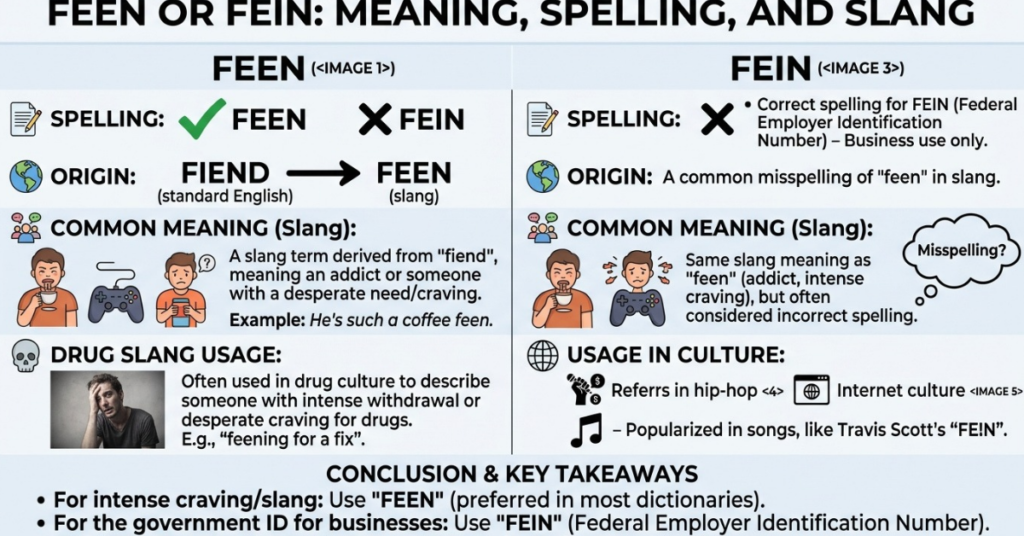
Have you seen the word feen or fein in a text message, social media comment, or song lyric and wondered which spelling is correct? These two spellings can be confusing because they sound similar and are often used in informal conversations, especially when people talk about cravings, strong desires, or drug slang.
The answer depends on the context. Feen or fein is an informal spelling question rather than a simple case of choosing between two standard English words. Both forms appear in online writing, but fiend is the established English spelling of the word commonly used to describe someone with an intense craving or an addiction. The shortened spellings feen and fein are often associated with slang and internet culture.
In this guide, you’ll learn what feen or fein means, which spelling people commonly use, how the term relates to drug slang, and how to understand it in everyday conversations.
Feen or Fein: Which One Is Correct?
If you’re asking whether to write feen or fein, neither is the standard dictionary spelling of the English word fiend. However, both variations appear in informal online communication.
The word you’re looking for is usually fiend, particularly when describing someone who strongly desires something or has a compulsive craving.
Here’s a quick comparison:
| Word | Meaning and usage |
|---|---|
| Fiend | The standard English spelling; can describe a person with an intense craving or addiction. |
| Feen | An informal slang spelling sometimes used to represent the same meaning. |
| Fein | Another nonstandard spelling found in some online conversations and slang contexts. |
For formal writing, school assignments, professional communication, and standard English, use fiend when that is the intended meaning. In casual messages, you may encounter either feen or fein.
There is no universally accepted spelling rule that makes feen or fein the correct standard form of this slang term. The spelling people choose may depend on their community, dialect, or personal preference.
Feen or Fein Meaning: What Does It Mean?
The meaning of feen or fein generally comes from the slang use of the word fiend. It describes someone who really wants something, keeps seeking it, or seems unable to get enough of it.
Although the term can refer to drug cravings, it is also used jokingly or casually for ordinary interests.
For example, someone might say they’re a coffee fiend because they drink coffee every day. Another person might describe themselves as a shopping fiend because they love buying new clothes.
In slang, the word can carry several meanings depending on the situation:
- Strong desire: Wanting something very badly.
- Craving: Feeling a powerful urge to have or do something.
- Obsessive interest: Being extremely enthusiastic about a hobby, activity, or product.
- Drug-related dependence: Describing someone who strongly craves or seeks a substance.
The surrounding words and the situation help determine which meaning is intended.
What Does Feen Mean in a Text?
In text messages, feen is generally an informal way to describe someone who is craving something or really wants it.
For example:
- “I’m feening for pizza.” This means the person really wants pizza.
- “He’s a gym fiend.” This describes someone who is very dedicated to working out.
- “She’s feening for a new phone.” This means she really wants a new phone.
These examples illustrate informal usage, not standard spelling. In the first and third examples, many writers would use fiending or rephrase the sentence as “I’m craving pizza” or “She really wants a new phone.”
On social media, spelling may vary because people often write words the way they pronounce them or follow slang used by their friends and favorite creators.
Why Is Drug Slang Associated With Feen or Fein?
The connection comes from the established word fiend and its slang verb form, fiending. Dictionary.com records the verb as slang for desiring something greatly and notes feen as an alternative form. This usage includes strong cravings for addictive substances.
Over time, informal expressions can take on broader meanings. People may use the same language to describe an intense desire for a favorite meal, a new release, or a particular experience.
However, it is important not to confuse a slang expression with a medical diagnosis. Using the word feen does not, by itself, establish that someone has a substance use disorder.
Feen or Fein in Music and Social Media
Music, memes, and social media have helped make variations of fiend more recognizable to online audiences.
One prominent example is <Entity value=”FE!N” category=”song” disambig=”2023 song by Travis Scott featuring Playboi Carti”/>, a song by Travis Scott featuring Playboi Carti. Its stylized title has introduced many listeners to the spelling FE!N, although the title’s punctuation is artistic rather than a standard English spelling rule.
On platforms such as TikTok, Instagram, and X, you may encounter variations such as:
- “I’m feening for this song.”
- “Bro is a fein for sneakers.”
- “She’s a feen for iced coffee.”
- “I’m feining for the weekend.”
These phrases generally communicate a strong desire, enthusiasm, or craving. The tone may be playful, exaggerated, serious, or suggestive, depending on the context.
Remember that popular online usage does not automatically make a spelling standard in formal English.
Feen or Fein: How to Use the Word Correctly
If you want your writing to be clear, choose the spelling according to your audience and purpose.
1. For formal and professional writing
Use standard English instead of slang whenever possible.
For example:
- Informal: “I’m feening for a vacation.”
- Standard: “I’m really looking forward to a vacation.”
Likewise, “He is a coffee fiend” is an established informal English expression, while “He really loves coffee” is a straightforward alternative.
2. For texting and social media
You may see feen, fein, feening, or fiending in casual conversations. These variations can communicate the intended meaning, but spelling preferences differ among online communities.
If you want to avoid confusion, use familiar alternatives such as “craving,” “really want,” or “obsessed with.”
3. When discussing drugs or addiction
Be mindful of the context and the people involved. Terms associated with drug cravings can sound judgmental or stigmatizing when directed at another person.
If you are discussing a real health concern, describe the behavior or symptoms clearly rather than relying on slang.
Common Mistakes When Using Feen or Fein
Several spelling and meaning mistakes can make these words confusing.
- Treating slang as standard English: Feen and fein may appear in informal writing, but fiend is the established spelling for the English noun.
- Assuming every use refers to drugs: The term can describe ordinary cravings or strong enthusiasm.
- Confusing fein with feign: These are different words. Feign means to pretend or give a false appearance, as in “She tried to feign surprise.”
- Assuming FE!N is a spelling rule: The stylized song title does not establish a standard spelling for the slang term.
- Ignoring context: A comment about craving food has a different meaning from a statement about craving an addictive substance.
Understanding these differences makes it easier to interpret the word accurately, especially when it appears in a short message without much explanation.
Frequently Asked Questions About Feen or Fein
Is it feen or fein?
Both spellings appear in informal slang, but neither replaces fiend as the standard English spelling of the noun. For formal writing, use fiend when that is the intended word.
What does feen or fein mean?
In slang, both spellings are associated with wanting something intensely, feeling a strong craving, or being unusually enthusiastic about something. The exact meaning depends on the context.
What does feen or fein mean in texting?
In a text message, the word usually describes a strong desire for something. For example, “I’m feening for pizza” means “I really want pizza.”
Is feen or fein drug slang?
It can be. The slang is associated with fiending, which can describe intense cravings for drugs or other addictive substances. However, people also use it casually to describe cravings for food, entertainment, or other things.
Is feen a real word?
Feen appears in dictionary records in specific contexts, including as a dialect noun meaning “man” and as an alternative slang form of the verb fiend. Its meaning therefore depends on how it is used.
Is fein a real English word?
In the slang context discussed here, fein is an informal spelling rather than the standard spelling of fiend. It can also appear as a proper name or in other languages, so the surrounding context matters.
What is the difference between feen, fein, and fiend?
Fiend is the established English spelling. Feen and fein are informal spellings associated with slang about craving or intense desire. Their usage is not completely standardized.
Does feen always mean addiction?
No. Someone might use the term jokingly to describe a craving for coffee or a favorite television show. When it refers to a substance-related craving, however, the context may be more serious.
What does “I’m feening” mean?
It usually means “I’m craving something badly” or “I really want something.” The object of the craving may be stated explicitly or understood from the conversation.
Should I use feen or fein in an article?
For a standard English article, use fiend where appropriate, or choose a clearer expression such as “craving” or “strong desire.” You can discuss feen or fein when explaining the slang itself.
Conclusion
So, feen or fein—which spelling should you use? Both occur in informal slang, particularly in conversations about cravings and strong desires. However, fiend remains the established English spelling when you mean a person who is intensely interested in something or someone experiencing a craving.
The phrase drug feen or fein usually points to the slang meaning associated with substance cravings, but neither spelling necessarily refers to drugs in every conversation. Context is essential to understanding the intended meaning.
When writing professionally, choose standard English for clarity. When reading texts, song lyrics, or social media posts, recognize that slang spellings can vary from one person or community to another.
If you enjoy learning about confusing English words, spelling differences, and internet slang, explore more word-meaning guides to strengthen your vocabulary and communicate with confidence.
