
Have you ever stopped while writing a sentence and wondered whether to use farther or further? You are not alone. These two words sound similar, and their meanings overlap, which makes it easy to confuse them in everyday conversation and writing.
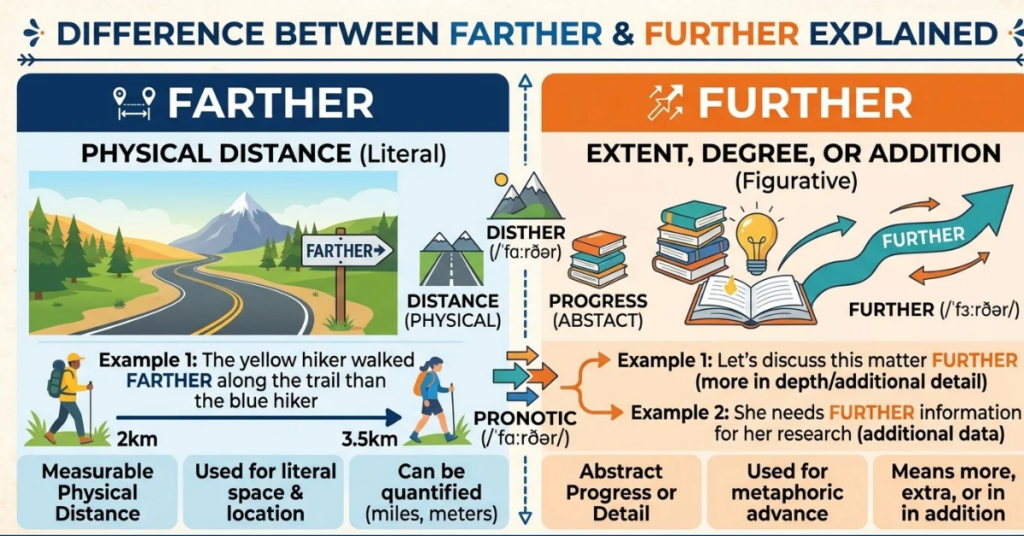
The main difference between farther and further is that farther usually refers to physical distance, while further generally refers to figurative distance, additional information, or a greater degree of something. However, English usage is not always this straightforward. Both words can sometimes describe distance, and further is widely accepted in situations where farther might also work.
Understanding their meanings, common uses, and examples will help you choose the right word with confidence.
What Is the Difference Between Farther and Further?
The simplest way to understand the difference between farther and further is to look at what each word describes.
- Farther: Usually refers to measurable physical distance between places, objects, or people.
- Further: Usually means additional, more, or to a greater extent. It is also commonly used for figurative distance and abstract ideas.
Consider these examples:
- Farther: The grocery store is farther from my house than the bakery.
- Further: We need further information before making a decision.
In the first sentence, farther describes a physical distance that can be measured. In the second, further means additional information rather than a distance between two locations.
Although this distinction is a useful guideline, it is not an absolute rule. In modern English, further can also refer to physical distance, especially in British English and in many general writing contexts.
Farther Meaning and Usage
The word farther is the comparative form of far. It generally describes something located at a greater physical distance or a movement that continues over a longer distance.
It is particularly useful when you can imagine measuring the distance in miles, kilometers, feet, or another unit.
When to Use Farther
Use farther when talking about:
- Physical distance between two locations.
- How far someone travels or moves.
- The relative distance between objects or places.
- A measurable difference in location.
Farther Examples in Sentences
Here are some everyday examples that show how to use farther correctly.
- My school is farther from home than yours. The sentence compares the physical distance between two schools and their respective homes.
- We walked farther than we planned. This means the walk covered a greater physical distance than expected.
- The next petrol station is farther down the road. The petrol station is located at a greater distance along the road.
- Can you throw the ball farther? This asks whether someone can throw the ball over a greater distance.
- The mountains looked farther away in the evening light. The sentence describes the apparent physical distance between the observer and the mountains.
In each example, farther refers to a physical location, movement, or distance.
Further Meaning and Usage
The word further can mean additional, more, or to a greater extent. It is commonly used for ideas, discussions, education, research, progress, and other situations that do not involve a straightforward physical measurement.
It can also function as a verb meaning to advance or promote something.
When to Use Further
Use further when referring to:
- Additional information or details.
- More discussion, research, or investigation.
- Progress toward a goal.
- A greater degree or extent.
- Advancing a cause, career, or plan.
Further Examples in Sentences
The following examples demonstrate the different meanings of further.
- Please contact us if you need further assistance. Here, further means additional help.
- We need to conduct further research before publishing the report. It refers to more research.
- She wants to further her education by pursuing a master’s degree. In this sentence, further is a verb meaning to advance or develop.
- The manager asked for further clarification. This means the manager needs more explanation.
- Let’s discuss this matter further tomorrow. The sentence means the discussion should continue in greater depth.
- The new policy could further improve workplace safety. Here, further means to advance or improve something.
Notice that none of these sentences requires a measurable physical distance. Instead, further expresses the idea of more, continued progress, or a greater extent.
Farther vs. Further: A Quick Comparison
The following table summarizes the main differences between the two words.
| Feature | Farther | Further |
|---|---|---|
| Main meaning | Greater physical distance | Additional, more, or greater extent |
| Common use | Travel, locations, measurable distance | Research, discussion, information, progress |
| Part of speech | Adverb or adjective | Adverb, adjective, or verb |
| Example | We drove farther today. | We need further details. |
| Can describe physical distance? | Yes | Yes |
| Can mean additional? | Not usually | Yes |
The most important thing to remember is that farther is the more specific choice for physical distance, whereas further has a broader range of meanings.
Difference Between Farther and Further Usage in Everyday English
Knowing the definitions is helpful, but the real challenge often comes when both words seem to fit a sentence. In these situations, consider the meaning you want to communicate.
1. Talking About Physical Distance
When you are comparing measurable distances, farther is usually the clearest choice.
Example: The airport is farther from the city center than the railway station.
You could also hear, “The airport is further from the city center than the railway station.” This is also accepted in English. However, if you want to follow the traditional distinction, choose farther for physical distance.
2. Asking for More Information
When you need additional details, use further.
Example: Please provide further information about the application process.
Using farther information would sound unnatural because information is not a physical distance.
3. Discussing Progress or Development
Use further when describing progress, improvement, or advancement.
Example: The training program will further develop your communication skills.
Here, the word describes improvement rather than movement through physical space.
4. Continuing a Conversation
When you want to explore a subject in greater depth, further is generally the appropriate choice.
Example: We should investigate the issue further before reaching a conclusion.
This means continuing the investigation, not traveling a greater distance.
5. Describing Figurative Distance
Further is generally preferred when distance is metaphorical rather than physical.
Example: His actions took him further away from his original goals.
The sentence describes a growing separation from a goal, not a measurable distance between two locations.
Is There a Difference Between Farther and Further in English?
Yes, there is a difference, but the distinction is flexible.
Traditional grammar guidance often recommends farther for physical distance and further for figurative distance or additional amounts. This is a useful approach for students, professional writers, and anyone learning English.
However, dictionaries also recognize that further can refer to physical distance. For example, both “We walked farther into the forest” and “We walked further into the forest” are acceptable.
In practice, the words overlap in some contexts. The best approach is to use farther when you specifically mean physical distance and further when you mean additional information, progress, or a greater extent.
Common Expressions With Farther and Further
Some expressions are especially useful to learn because they appear frequently in everyday conversation and professional writing.
Common Expressions With Farther
- Farther away: At a greater physical distance.
- Farther down the road: At a more distant point along a road.
- Farther than expected: A greater physical distance than anticipated.
- No farther: No greater physical distance.
Example: The hotel is farther away than we thought.
Common Expressions With Further
- Further information: Additional information.
- Further details: More specific information.
- Further discussion: Additional or continued discussion.
- Further research: More research.
- Further assistance: Additional help.
- Further notice: Additional notice or information.
- Further action: Additional steps taken in response to something.
- Further development: Continued growth or improvement.
Example: Please read the instructions carefully before taking any further action.
Learning these expressions can make your English sound more natural and help you avoid common word-choice mistakes.
Farther vs. Further: Common Mistakes to Avoid
Even experienced English speakers sometimes confuse these words. Here are a few mistakes to watch for.
Mistake 1: Using Farther for Additional Information
Incorrect: Please send me farther details about the project.
Correct: Please send me further details about the project.
Why? The sentence asks for additional information, not a greater physical distance.
Mistake 2: Assuming Further Cannot Describe Physical Distance
Incorrect assumption: The word further can never describe distance.
Correct understanding: Further can describe physical distance, although farther is often preferred when the distance is measurable.
Example: We continued further along the trail.
This sentence is acceptable English.
Mistake 3: Forgetting That Further Can Be a Verb
Incorrect: She wants to farther her career.
Correct: She wants to further her career.
Why? As a verb, further means to advance or promote progress. Farther is not used this way.
Mistake 4: Treating the Rule as Absolute
It is helpful to remember the physical-versus-figurative distinction, but English usage is more flexible than a strict rule might suggest.
For example, “We traveled further than we expected” is widely accepted. You do not need to replace further with farther every time a sentence refers to travel.
Easy Trick to Remember the Difference
If you struggle to remember the difference between farther and further, use this simple technique.
Think of the letter A in farther as standing for actual distance. This is a memory aid rather than a formal grammar rule, but it can help you remember the traditional distinction.
- If you can measure the distance between two places, consider farther.
- If you mean additional information, more discussion, or progress, use further.
- If both seem possible, remember that further can also describe physical distance.
For example:
- “The library is farther away.” This describes physical distance.
- “I need further explanation.” This means additional explanation.
- “Let’s explore the subject further.” This means examining the subject in greater depth.
With practice, choosing the correct word becomes much easier.
Difference Between Farther and Further in Hindi
For Hindi speakers learning English, the distinction can be understood through the meanings of the words.
- Farther: ज़्यादा दूर (zyada door) — at a greater physical distance.
- Further: अतिरिक्त (atirikt), और अधिक (aur adhik), or आगे बढ़ाना (aage badhana), depending on the context.
Examples:
Farther: My house is farther from the market.
Hindi: मेरा घर बाज़ार से ज़्यादा दूर है।
Further: I need further information.
Hindi: मुझे अतिरिक्त जानकारी चाहिए।
Further as a verb: She wants to further her career.
Hindi: वह अपने करियर को आगे बढ़ाना चाहती है।
These translations are approximate because the best Hindi equivalent depends on how each word is used in a sentence.
Frequently Asked Questions
1. What is the main difference between farther and further?
Farther usually refers to greater physical distance, while further generally means additional, more, or to a greater extent. However, both words can describe physical distance in modern English.
2. What is the difference between farther and further with examples?
Consider these two sentences:
- “The station is farther from my house.” This refers to physical distance.
- “I need further information.” This means additional information.
The difference becomes clearer when you focus on what the word describes.
3. Is farther or further correct for distance?
Both can be correct. Farther is traditionally preferred for measurable physical distance, but further is also commonly used to describe distance.
4. Can further and farther be used interchangeably?
Sometimes, especially when referring to physical distance. However, they are not interchangeable in every situation. For example, “further research” is correct, while “farther research” is generally incorrect.
5. Is further a formal word?
Yes. Further is appropriate in formal and informal writing. Expressions such as “further information,” “further investigation,” and “further consideration” are common in professional communication.
6. Is farther an adjective or an adverb?
Farther can function as both an adjective and an adverb.
As an adjective: The farther destination requires more planning.
As an adverb: We walked farther than yesterday.
7. Can further be used as a verb?
Yes. Further can mean to advance, promote, or help something develop.
Example: The internship will further her professional development.
8. Which is correct: further away or farther away?
Both expressions are acceptable. Farther away emphasizes physical distance under the traditional distinction, while further away is also widely used.
9. What is the difference between farther and further in American English?
In American English, the traditional distinction remains useful: farther for physical distance and further for additional or figurative meanings. However, American speakers also use further for physical distance.
10. What is the difference between farther and further in British English?
British English commonly uses further for both physical distance and figurative meanings. Farther is understood and used too, particularly when emphasizing physical distance, but the distinction is generally less strict in everyday usage.
Conclusion
Understanding the difference between farther and further is easier when you focus on the meaning of the sentence. Use farther for greater physical distance and further for additional information, continued discussion, or progress. Remember, though, that further can also describe physical distance, so the traditional distinction is a helpful guideline rather than an absolute rule.
The next time you are unsure which word to choose, ask yourself whether you mean a measurable distance or something additional. This simple question will help you make a more confident choice in everyday conversations, academic assignments, and professional writing.
For more practical English grammar tips, explore related articles about commonly confused words and improve your writing one small step at a time.
