
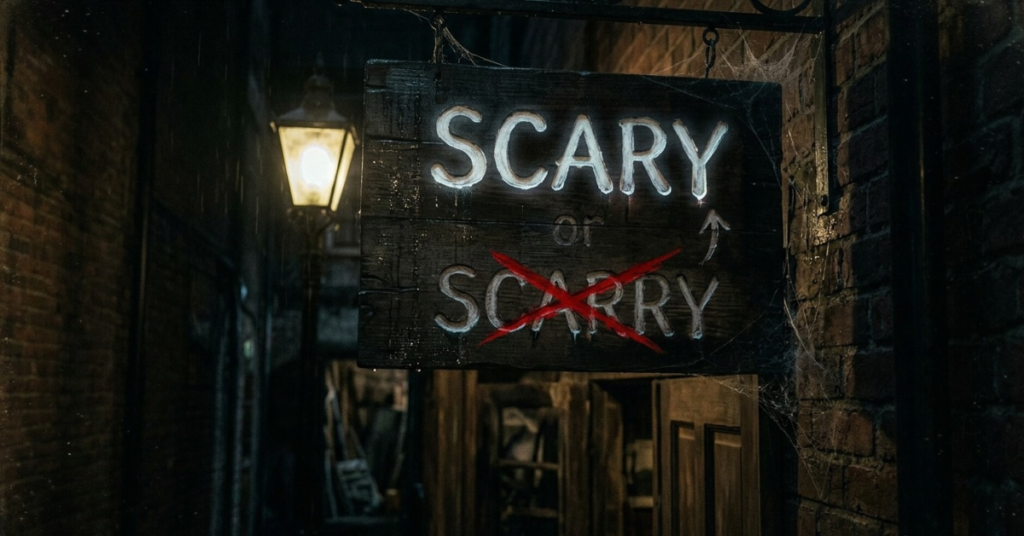
Have you ever typed “scarry” instead of “scary” and wondered whether both spellings are correct? You’re not alone. English has plenty of words that sound similar but can cause confusion when written down.
When comparing scarry or scary, the correct choice in standard English is usually scary. It describes something frightening, unsettling, or capable of causing fear. Although “Scarry” can appear as a surname or proper name, it is not the standard spelling of the adjective used to describe something frightening.
In this guide, you’ll learn the meaning of scary, why people confuse it with scarry, how to use it in everyday sentences, and how to remember the correct spelling.
Scarry or Scary: Which One Is Correct?
Scary is the correct spelling when you want to describe something that causes fear. Scarry is generally a misspelling of the adjective scary.
Here is a quick comparison:
| Word | Meaning | Correct Usage |
|---|---|---|
| Scary | Causing fear, fright, or nervousness | The movie was scary. |
| Scarry | Usually a surname or proper name | Richard Scarry was a children’s author. |
The easiest way to remember the difference is to focus on the word’s meaning. If you’re talking about a frightening movie, a creepy sound, a nightmare, or a dangerous situation, use scary.
However, if “Scarry” appears as someone’s name, it may be perfectly correct. Proper names follow their established spelling rather than ordinary spelling rules.
Scary Meaning: What Does Scary Mean?
The word scary is an adjective that describes something that makes a person feel afraid, frightened, nervous, or uneasy.
It can refer to obvious sources of fear, such as ghosts and horror films, but it also applies to real-life experiences. For example, driving through a severe storm, receiving unexpected medical news, or getting lost in an unfamiliar place can all feel scary.
Simple Definition of Scary
In simple English, scary means frightening or causing fear.
Here are a few examples:
- A scary movie can make you jump out of your seat.
- A scary dream may leave you feeling unsettled after waking up.
- A scary situation can make you feel nervous or unsafe.
- A scary noise in the middle of the night might make you check the doors and windows.
The intensity of the feeling depends on the situation. Something that seems scary to one person might not frighten another.
Synonyms of Scary
Several words have a meaning similar to scary, although each can express a slightly different kind of fear.
- Frightening: Something that causes fear.
- Terrifying: Something that causes extreme fear.
- Creepy: Something strange or unsettling.
- Spooky: Something mysterious or associated with ghosts.
- Alarming: Something that causes sudden worry or concern.
- Intimidating: Something that makes a person feel nervous or less confident.
- Eerie: Something strangely unsettling or mysterious.
For example, a haunted house might be described as spooky, while a life-threatening emergency could be called terrifying.
Why Do People Confuse Scarry and Scary?
The confusion between scarry and scary usually comes from pronunciation and spelling habits.
When people speak, the two spellings may seem similar because they are often pronounced as though they sound alike. However, standard English uses scary for the adjective meaning frightening.
There are a few common reasons for this mistake.
1. Confusion About the Letter R
Some people assume that adding another “r” makes the spelling more natural. However, the correct spelling is scary, with one “r” before the final “y”.
2. Typing Errors
When writing quickly on a phone or computer, it is easy to add an extra letter. Autocorrect may not always identify the intended word, especially when the incorrect spelling resembles a proper name.
3. Uncertainty About English Spelling
English contains many words with unusual spelling patterns. Learners may therefore rely on how a word sounds rather than how it is conventionally written.
The solution is simple: remember that the adjective meaning frightening is spelled S-C-A-R-Y.
Scary in a Sentence: Examples of Correct Usage
Understanding a word becomes easier when you see it used in everyday situations.
Here are some examples showing how to use scary correctly.
Everyday Examples
- The thunderstorm last night was really scary.
- I watched a scary movie with my friends.
- Walking alone through a dark street can feel scary.
- That was a scary experience, but thankfully everyone was safe.
- The strange noise coming from the basement sounded scary.
- It can be scary to start a new job in an unfamiliar environment.
- The roller coaster looked scary, but the ride was exciting.
- She had a scary dream about being lost in a forest.
- The sudden power outage was scary for the children.
- Sometimes, making an important decision can feel scary.
Notice that scary describes a person, place, event, object, or experience that causes fear or nervousness.
Scary vs. Scared: What Is the Difference?
Another common spelling and vocabulary question involves scary and scared. Although they are related, they have different meanings.
| Word | Meaning | Example |
|---|---|---|
| Scary | Causing fear | The story is scary. |
| Scared | Feeling fear | I am scared of spiders. |
| Scare | To frighten someone | Don’t scare your little brother. |
| Scares | Frightens someone or something | Loud noises scare the cat. |
| Scaring | Causing someone to feel afraid | You are scaring me. |
A useful way to remember the difference is that a scary thing causes fear, while a scared person experiences fear.
For instance, a horror movie can be scary, and the person watching it might feel scared.
Is Scarry Ever a Correct Word?
Yes, Scarry can be correct when it is used as a proper name, such as a surname.
One well-known example is Richard Scarry, the American children’s book author and illustrator famous for his illustrated books featuring animals and everyday life.
In this context, the spelling Scarry is intentional and correct. It should not be changed to Scary simply because the words look similar.
However, when describing something frightening in ordinary writing, use scary.
For example:
- Correct: That was a scary experience.
- Incorrect: That was a scarry experience.
- Correct: Richard Scarry wrote popular children’s books.
The meaning and context determine which spelling you should use.
How to Remember the Correct Spelling of Scary
If you frequently mix up scarry and scary, a few simple techniques can help you remember the correct form.
Use a Simple Memory Trick
Think of the word scare. The adjective scary is formed by adding “y” to the base word and dropping the final “e”.
Scare → Scary
This connection makes the spelling easier to remember.
Practice With Short Sentences
Writing a few examples can help reinforce the correct spelling.
Try these sentences:
- The dark room looked scary.
- Horror movies can be scary.
- I felt scared when I heard the noise.
Check the Context
Before using the word, ask yourself whether you are describing something frightening or referring to a person’s name.
- Describing fear? Use scary.
- Referring to Richard Scarry or another person named Scarry? Keep the proper name’s spelling.
This small habit can help you avoid the mistake in emails, social media captions, school assignments, and professional writing.
Frequently Asked Questions (FAQs)
1. Is it scarry or scary?
Scary is the correct spelling of the adjective meaning frightening or capable of causing fear. Scarry is generally a misspelling in this context, although it can be correct as a surname or proper name.
2. What is the meaning of scary?
Scary means frightening, unsettling, or causing fear. For example, a scary movie may make viewers feel nervous or frightened.
3. Is scarry a real word?
Scarry is used as a surname and in proper names. However, it is not the standard spelling of the adjective meaning frightening.
4. How do you spell scary correctly?
The correct spelling is S-C-A-R-Y. It contains one “r” and ends with “y”.
5. What is the difference between scary and scared?
Scary describes something that causes fear, whereas scared describes someone who feels fear. For example, “The film is scary” and “I am scared” are both correct.
6. What is another word for scary?
Common synonyms include frightening, terrifying, creepy, spooky, eerie, and alarming. The best alternative depends on the situation and the intensity of the fear.
7. Can I use scary in formal writing?
Yes. Scary is a standard English adjective and can be used in both casual and formal writing. In highly formal or technical contexts, words such as frightening, alarming, or intimidating may be more appropriate depending on the intended meaning.
8. Why do people write scarry instead of scary?
People may add an extra “r” because of typing mistakes, uncertainty about English spelling, or confusion about pronunciation. Remembering the connection between scare and scary can help prevent this error.
Conclusion
When deciding between scarry or scary, the correct spelling for something that causes fear is scary. It is an adjective used to describe frightening movies, unsettling experiences, strange noises, and situations that make people feel nervous or afraid.
Although Scarry can be correct as a surname or proper name, it should not replace scary in ordinary sentences about fear.
The easiest way to remember the spelling is to connect scary with scare. Once you understand the meaning and see the word used in context, choosing the correct spelling becomes much simpler.
If you’re working on your English vocabulary, exploring similar word comparisons—such as scared vs. scary and creepy vs. spooky—can help you communicate more clearly and confidently.
