
Have you ever finished writing a report, opened a grammar checker, and wondered whether to write appendixes or appendices? You’re not alone. Both spellings are correct, and understanding appendixes vs appendices is easier than it might seem once you know how the words are used.
The confusion comes from the word appendix, which has two common meanings. It can refer to a small organ in the human body or to a section of additional information at the end of a book, report, or academic paper. Although the plural forms may look different, both are accepted in English.
In this guide, we’ll explore the meaning of each word, explain when to use appendixes versus appendices, and share practical examples to help you choose the right spelling in everyday writing, academic assignments, and professional documents.
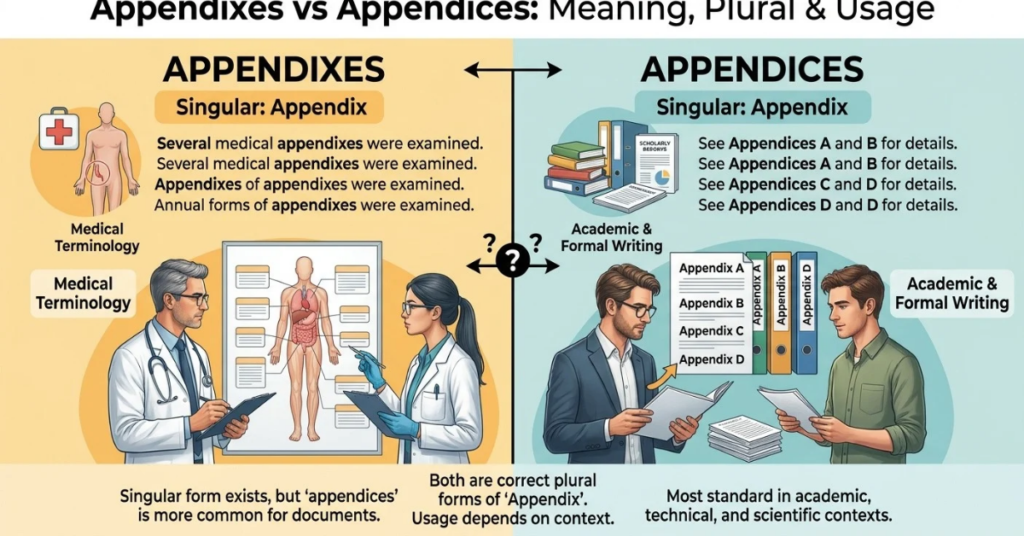
Appendixes vs Appendices: The Main Difference
The main difference between appendixes and appendices is their spelling, not their meaning. Both are plural forms of the singular noun appendix.
-
Appendixes: The regular English plural, formed by adding -es.
-
Appendices: The traditional Latin-derived plural, formed by changing -ix to -ices.
Neither form is inherently incorrect. Your choice usually depends on your writing style, the context, and any requirements set by your school, university, publisher, or workplace.
Here is a quick comparison:
| Feature | Appendixes | Appendices |
|---|---|---|
| Singular form | Appendix | Appendix |
| Plural form | Appendixes | Appendices |
| Grammatical correctness | Correct | Correct |
| Common context | General English and medical writing | Academic, scientific, and formal writing |
| Meaning | Two or more appendixes or supplementary sections | Two or more appendixes or supplementary sections |
The important point is that both spellings can refer to multiple organs or multiple supplementary sections. The context, rather than the spelling alone, tells readers which meaning you intend.
What Does Appendix Mean?
Before comparing the two plural forms in detail, it helps to understand what appendix means. The word has two main uses in English, and each one appears in a different context.
1. Appendix as a body part
In anatomy, the appendix is a small, finger-shaped pouch attached to the large intestine. The plural form generally used for this body part is appendixes.
Examples:
-
The surgeon examined the patients’ appendixes.
-
Inflammation can affect the appendix.
-
The medical report discussed complications involving the appendixes.
In medical writing, appendixes is the clearest conventional choice when referring to multiple anatomical structures.
2. Appendix as a section of a document
In books, reports, research papers, and dissertations, an appendix is a section containing additional information that supports the main text. This information might include data tables, questionnaires, technical notes, interview questions, or detailed calculations.
For this meaning, appendices is a common choice, particularly in academic and formal writing. However, appendixes is also correct.
Examples:
-
The research paper includes three appendices.
-
Please review the appendices before submitting your report.
-
The book’s appendices contain additional references and statistical tables.
If you’re writing a thesis, dissertation, business report, or research paper, appendices is a suitable default unless your institution or style guide specifies otherwise.
When Should You Use Appendixes vs Appendices?
Choosing between appendixes and appendices becomes easier when you consider the subject of your sentence and the type of writing you’re doing.
Use appendices for academic documents
When referring to supplementary sections in a thesis, dissertation, research paper, or formal report, appendices is a natural and widely recognized choice.
Example: “The appendices provide supporting data for the study.”
Use appendixes for general or medical writing
The regular plural appendixes is especially common when discussing the anatomical organ. It is also acceptable for supplementary sections in books and reports.
Example: “The medical study compared the patients’ appendixes.”
There is one important detail to remember: this is a practical usage preference, not an absolute grammatical rule. Both forms can be used for document sections, and a consistent style matters more than switching between them without a reason.
A simple rule to remember
If you’re unsure which spelling to choose, follow these steps:
-
Identify the meaning. Are you discussing a body part or supplementary material in a document?
-
Consider the audience. Academic readers often expect appendices when referring to supporting sections.
-
Check your style guide. Follow your university’s formatting instructions or publisher’s preferred spelling.
-
Stay consistent. Use the same plural form throughout your document unless there is a specific reason to distinguish the meanings.
Appendixes vs Appendices: Pronunciation Guide
Another common source of confusion is pronunciation. Although both words come from the same singular noun, their endings sound different.
| Word | Pronunciation guide |
|---|---|
| Appendix | uh-PEN-diks |
| Appendixes | uh-PEN-dik-siz |
| Appendices | uh-PEN-duh-seez |
The pronunciation of appendices reflects its traditional Latin-derived plural ending, while appendixes follows the regular English plural pattern. The pronunciations shown are approximate guides rather than phonetic transcriptions.
Here’s an easy way to practice:
-
Say “one appendix, two appendixes.”
-
Then say “one appendix, two appendices.”
Both plural forms are recognizable in standard English. Learning to pronounce them correctly can make academic presentations, classroom discussions, and professional conversations feel more comfortable.
Examples of Appendixes vs Appendices in Sentences
Seeing both spellings in context is one of the best ways to understand their usage.
Examples using appendixes
The following sentences use the regular plural form:
-
The doctors examined the patients’ appendixes during the study.
-
The textbook contains several appendixes with additional exercises.
-
Researchers reviewed the appendixes of the collected medical specimens.
-
The report includes appendixes with extra technical information.
Notice that appendixes works in both medical and document-related contexts. The spelling itself does not limit the word to anatomy.
Examples using appendices
Here are examples of the traditional plural form:
-
The dissertation contains four appendices.
-
Additional survey results are presented in the appendices.
-
The research team included two appendices with supporting evidence.
-
Readers can consult the appendices for a detailed explanation of the methodology.
These examples illustrate why appendices is particularly useful in academic writing, where supplementary material often needs to be clearly organized.
Which spelling sounds more natural?
Consider these two sentences:
-
“The thesis includes three appendixes.”
-
“The thesis includes three appendices.”
Both are grammatically acceptable. However, the second may sound more familiar in a university or research setting.
Now consider a medical context:
– “The patients’ appendixes were examined.”
This is the more conventional choice when referring to the anatomical organs. Oxford’s dictionary specifically distinguishes the usual plural forms according to these two meanings.
Why Does Appendix Have Two Plural Forms?
The reason goes back to the history of the English language. English has borrowed many words from Latin and other languages, and some borrowed nouns retain their traditional plural forms alongside regular English alternatives.
The word appendix comes from Latin appendix, associated with the verb appendere, meaning to hang or attach. Over time, English developed the regular plural appendixes while retaining the Latin-derived form appendices.
This pattern also appears in other English words, although their preferred forms can differ.
| Singular | Plural forms |
|---|---|
| Appendix | Appendixes / Appendices |
| Index | Indexes / Indices |
| Matrix | Matrixes / Matrices |
| Vertex | Vertexes / Vertices |
| Codex | Codexes / Codices |
Not every alternative is equally common in every context. For example, indices is common in mathematics, while indexes is widely used for book indexes and databases.
The broader lesson is that English sometimes allows both a regular plural and a traditional plural inherited from another language.
Common Mistakes to Avoid
Even though both appendixes and appendices are correct, a few mistakes can make your writing less clear.
1. Assuming appendices is the only correct spelling
Some writers believe that appendices is the only grammatically acceptable plural. That isn’t true. Appendixes is also a standard English plural, and dictionaries recognize both forms for supplementary sections.
2. Assuming appendixes is only for body parts
While appendixes is generally preferred for anatomical references, it can also refer to additional sections in books and reports. The word is not restricted to medical contexts.
3. Mixing the two forms without a reason
Using both spellings interchangeably within the same report can distract readers. Choose a preferred form and use it consistently, following any applicable editorial guidelines.
4. Confusing the plural with a possessive
Remember that these forms serve different grammatical purposes:
-
Appendices: More than one supplementary section.
-
Appendix’s: Something belonging to one appendix.
-
Appendices’: Something belonging to multiple appendices.
For example, “The appendix’s final table contains the results” uses a singular possessive. “The appendices’ tables contain the results” uses a plural possessive.
How to Use Appendices in a Thesis or Research Paper
If you’re preparing an academic assignment, knowing how to pluralize appendix is only one part of presenting your work professionally.
An appendix usually contains supporting information that is useful to readers but too detailed or lengthy to include in the main body of the paper.
Common examples include:
-
Survey questionnaires and interview questions.
-
Detailed calculations and supplementary data.
-
Additional charts, figures, and tables.
-
Research instruments and technical documentation.
-
Supporting documents that help explain your methodology.
How to label multiple appendices
If you choose appendices, you can label individual sections clearly, for example:
-
Appendix A: Research Questionnaire
-
Appendix B: Interview Responses
-
Appendix C: Supplementary Data
You can then refer to these sections in the main text, such as: “See Appendix B for the complete interview questions.”
Some institutions use numbered appendices instead of letters. Always check your department’s requirements before finalizing your formatting.
Frequently Asked Questions
1. Is it appendixes or appendices?
Both are correct plural forms of appendix. Appendixes is generally preferred for the anatomical organ, while appendices is commonly used for supplementary sections in academic and professional documents.
2. Is appendices grammatically correct?
Yes. Appendices is a standard plural form, particularly in formal and academic writing. It is not a misspelling or an outdated grammatical error.
3. What is the plural of appendix in medical terminology?
The usual plural is appendixes when referring to the anatomical organ. For example: “The researchers examined the patients’ appendixes.”
4. Should I use appendixes or appendices in a dissertation?
Appendices is a good default for a dissertation containing multiple supplementary sections. However, your university’s thesis guidelines take priority if they specify a particular spelling or labeling convention.
5. Can I use appendixes in an academic paper?
Yes. Appendixes is grammatically correct for supplementary sections in an academic paper. Nevertheless, appendices may be more familiar to readers in formal academic settings.
6. What is the singular of appendices?
The singular form is appendix. For example, “The report includes one appendix” and “The report includes three appendices.”
7. How do you pronounce appendices?
Appendices is pronounced approximately “uh-PEN-duh-seez.” The regular plural appendixes is pronounced “uh-PEN-dik-siz.”
8. Is appendices British English and appendixes American English?
Not exactly. Both forms are recognized in British and American English. The preferred form depends more on the meaning, writing context, and editorial conventions than on a strict difference between national varieties.
9. What is the difference between an appendix and an addendum?
An appendix is a supplementary section that provides additional information alongside a main document. An addendum is additional material added to a document, often after the original content has been completed or published. Their uses can overlap, but they are not always interchangeable.
10. Which plural should I use in everyday writing?
For everyday writing, either form can be correct when referring to supplementary sections. Choose the form that sounds natural in context, and follow the relevant style guide if one applies.
Conclusion: Appendixes vs Appendices
The difference between appendixes vs appendices is simpler than it first appears. Both words are correct plural forms of appendix, but they have slightly different usage preferences.
Remember these key points:
-
Appendixes is generally preferred when discussing anatomical organs.
-
Appendices is common in academic papers, books, reports, and dissertations.
-
Both forms are acceptable for supplementary document sections.
-
Consistency and your institution’s style guidelines should guide your final choice.
The next time you’re writing a report, preparing a thesis, or editing an article, you won’t need to second-guess this grammar question. Choose the spelling that fits your context, keep it consistent, and focus on making your writing clear and useful for your readers.
For more practical grammar guidance, explore related articles on irregular plurals, commonly confused words, and academic writing conventions. These small details can make a meaningful difference in the clarity and professionalism of your work.
