
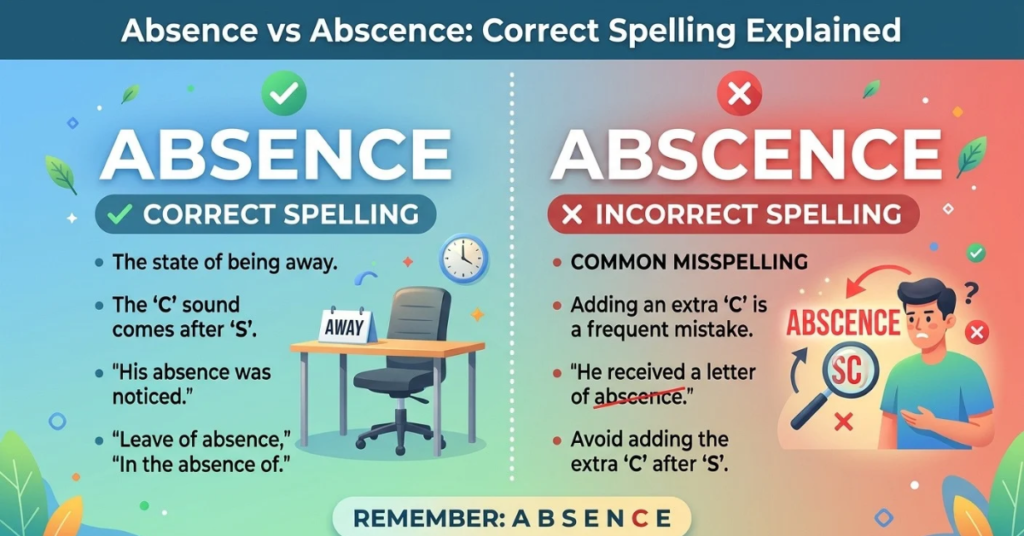
Have you ever typed a word, looked at it twice, and wondered whether you spelled it correctly? The words absence and abscence are a good example of this common spelling confusion. They look similar at first glance, but only one is accepted as the correct spelling in standard English.
When comparing absence vs abscence, the answer is simple: absence is correct, while abscence is a misspelling. Although the incorrect version appears in online searches and everyday writing, it is not a recognized standard spelling of the word.
In this guide, we will explore the correct spelling, its meaning, pronunciation, practical examples, and a few easy ways to remember it.
Absence vs Abscence: Which Is Correct?
The correct spelling is absence. The word refers to the state of being away from a place, not being present, or the lack of something that is expected or needed.
On the other hand, abscence is a spelling mistake. It may happen when someone accidentally switches letters or assumes the word contains a “sc” combination.
Here is a quick comparison:
| Word | Correct or Incorrect? | Meaning |
|---|---|---|
| Absence | Correct | The state of not being present or the lack of something |
| Abscence | Incorrect | A misspelling of absence |
For example:
- Correct: Her absence from the meeting was noticed by everyone.
- Incorrect: Her abscence from the meeting was noticed by everyone.
The difference is only one letter, but using the correct spelling makes your writing clearer and more professional.
What Does Absence Mean?
The noun absence describes a situation in which a person is not present somewhere or something is missing.
It can be used in several contexts, including education, workplaces, personal relationships, and general conversation.
1. Absence From School or Work
This is one of the most common uses of the word. It describes a situation in which someone does not attend a class, office, meeting, or other scheduled activity.
Examples:
- The teacher asked about his absence from school.
- Please inform your manager if you need to take a day of absence.
- Her frequent absences affected her attendance record.
2. Absence as a Lack of Something
The word can also describe the lack of a particular quality, feature, or object.
Examples:
- The absence of natural light made the room feel dark.
- The report highlighted the absence of reliable evidence.
- In the absence of clear instructions, the team made its own decision.
3. Absence in Personal Relationships
In everyday conversation, absence can describe the feeling or effect of someone not being around.
Examples:
- His absence was felt throughout the family.
- Distance made her appreciate his presence even more.
- The absence of close friends made the first few weeks difficult.
As these examples show, the word has several meanings depending on the situation, but its spelling remains the same.
Why Do People Confuse Absence and Abscence?
Spelling mistakes often happen because English words do not always follow predictable patterns. In this case, the confusion comes from the arrangement of the letters.
The correct spelling is a-b-s-e-n-c-e. People sometimes write abscence because they mistakenly place the letter “c” before the “e” in the middle of the word.
A few factors can contribute to this error:
- Letter order: The middle letters can be easy to mix up when typing quickly.
- Pronunciation: The word’s pronunciation does not make every letter sequence obvious.
- Typing habits: Repeated spelling mistakes can become familiar through frequent use.
- Lack of proofreading: Small errors can go unnoticed, especially in longer sentences.
The best approach is to remember the correct letter sequence and use a spell-checking tool when necessary.
How to Spell Absence Correctly
If you regularly confuse these spellings, a simple memory trick can help.
Remember the Letter Sequence
Break the word into smaller parts:
AB + SEN + CE = ABSENCE
Focus on the middle letters: S-E-N, not S-C-E-N.
Another useful reminder is to connect absence with absent. Both words share the same opening letters and relate to the idea of not being present.
- Absent — an adjective describing someone who is not present.
- Absence — a noun describing the state of not being present.
For example, you might say, “Ali is absent today because of his illness,” or “Ali’s absence was recorded by the teacher.”
Practicing these related words together can make the correct spelling easier to remember.
Absence vs Absent: Understanding the Difference
Although absence and absent are related, they serve different grammatical purposes.
| Word | Part of Speech | Example |
|---|---|---|
| Absence | Noun | Her absence was unexpected. |
| Absent | Adjective | She was absent yesterday. |
Use absence when referring to the situation or state of not being present. Use absent when describing a person who is not present.
Understanding this distinction can help you avoid grammatical mistakes as well as spelling errors.
Common Synonyms for Absence
Depending on the context, several words can express a similar meaning to absence. However, not every synonym works in every sentence.
Common alternatives include:
- Nonattendance: Failure to attend a class, meeting, or event.
- Unavailability: The state of not being available.
- Lack: The absence of something necessary or desirable.
- Shortage: An insufficient amount of something.
- Nonexistence: The state of not existing.
- Departure: The act of leaving a place, although it does not always mean absence.
For example, “the absence of food” could be rewritten as “the lack of food.” However, “her absence from school” is more naturally expressed as “her nonattendance at school” than as “her departure from school.”
Choosing the right alternative depends on the sentence and the meaning you want to communicate.
Examples of Absence in Everyday Sentences
Here are additional examples to help you understand how to use the word correctly.
- The principal requested an explanation for the student’s absence.
- His absence from the family gathering surprised everyone.
- The company introduced a policy to manage employee absences.
- The absence of fresh air made the room uncomfortable.
- In the absence of further information, we decided to wait.
- Her long absence from social media raised questions among her followers.
- The doctor explained that the absence of symptoms did not necessarily mean the problem had disappeared.
- Please submit an absence note if you miss a scheduled class.
Notice that absence can refer to a person’s physical nonattendance or to something that is missing. The surrounding words usually make the intended meaning clear.
How to Avoid Common English Spelling Mistakes
Confusing absence with abscence is a small error, but learning to recognize such mistakes can improve your writing over time.
Try these practical habits:
- Read your writing aloud: This can help you notice awkward phrasing, although it will not always reveal spelling mistakes.
- Use spell-checking tools: Most word processors and browsers can flag common misspellings.
- Learn related words: Practicing absent and absence together reinforces their spelling and meaning.
- Proofread slowly: Give unfamiliar or frequently misspelled words extra attention.
- Keep a personal word list: Write down words you commonly misspell and review them occasionally.
You do not need to memorize every English spelling rule. Learning frequently confused words one at a time is a practical way to build confidence.
Frequently Asked Questions (FAQs)
1. Is it absence or abscence?
Absence is the correct spelling. Abscence is a misspelling and should not be used in standard English writing.
2. What does absence mean?
Absence means the state of not being present in a particular place or the lack of something. For example, “His absence from work was unexpected.”
3. Why is abscence incorrect?
The spelling abscence contains the letters in the wrong order. The standard spelling is absence, with the sequence S-E-N-C-E after the initial “ab.”
4. How do you pronounce absence?
Absence is commonly pronounced AB-suhns, with the stress on the first syllable. The final “e” is silent.
5. What is the difference between absence and absent?
Absence is a noun, while absent is an adjective. For example, “Her absence was noticed” and “She was absent yesterday.”
6. Can absence refer to something other than a person?
Yes. The word can describe the lack of a quality, object, condition, or piece of information. For example, “the absence of evidence” refers to a lack of evidence.
7. Is absence used in formal writing?
Yes. Absence is appropriate in academic assignments, workplace emails, attendance records, official letters, and other formal documents.
8. What is the plural of absence?
The plural is absences. For example, “The school contacted the parents about the student’s repeated absences.”
Conclusion
When it comes to absence vs abscence, there is no complicated rule to learn: absence is the correct spelling, and abscence is a common spelling mistake.
Remember that absence can refer to someone not being present or to the lack of something. It is widely used in school, work, academic writing, and everyday communication. Connecting it with the related word absent can also make it easier to remember.
The next time you write an email, complete an assignment, or prepare a professional document, take a moment to check the spelling. Small improvements like this can make your writing more accurate, polished, and confident.
