
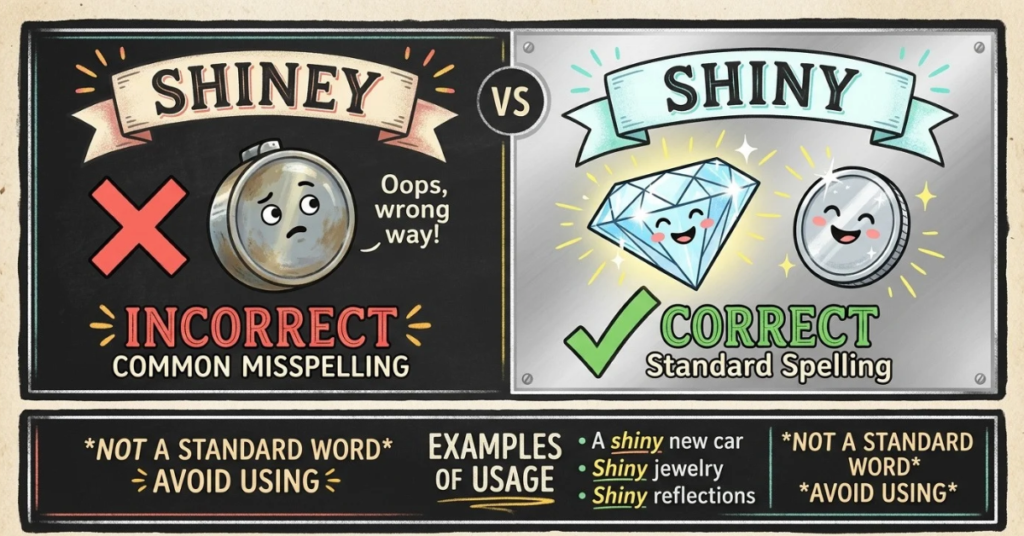
Have you ever wanted to describe a polished car, sparkling jewelry, or freshly cleaned shoes but paused to wonder whether shiney or shiny is the correct spelling? It is an easy mistake to make because the word shine naturally makes you think that adding a y should produce shiney.
However, shiny is the correct spelling in standard English. The word describes something that reflects light, looks glossy, or has a bright appearance. Shiney is generally considered a misspelling, even though people sometimes use it in informal writing.
In this guide, we’ll explain the difference between shiney and shiny, explore their meanings, look at British and Australian English, and explain why the spelling shiny is especially familiar to Pokémon fans.
Shiney or Shiny: Which Spelling Is Correct?
The correct spelling is shiny, with no letter e between the n and the y. It is a standard English adjective used to describe objects or surfaces that reflect light or have a bright, glossy appearance.
By comparison, shiney is a common spelling error. Although it may appear in online conversations, social media posts, or search queries, it is not the standard spelling you should use in formal or everyday writing.
Here is a quick comparison:
| Word | Correct spelling? | Explanation |
|---|---|---|
| Shiny | Yes | Standard adjective meaning bright or glossy |
| Shiney | No, in standard usage | Common misspelling of shiny |
| Shine | Yes | Verb or noun related to giving off or reflecting light |
| Shining | Yes | The present participle of shine, also used as an adjective |
| Shinier | Yes | Comparative form of shiny |
| Shiniest | Yes | Superlative form of shiny |
Example:
- Correct: Her new shoes look shiny.
- Incorrect: Her new shoes look shiney.
If you remember just one thing, remember that shiny is spelled without the extra e.
Shiney or Shiny Meaning: What Does Shiny Mean?
The word shiny describes something that reflects light or has a bright, smooth, or glossy appearance. It can refer to physical objects, materials, surfaces, and even certain figurative ideas.
For example, a polished silver ring may look shiny because it reflects light from its surface. Similarly, freshly washed hair can appear shiny when light reflects off its smooth strands.
Examples of Shiny in Everyday Life
Here are some common examples that show how the word is used:
- Shiny shoes: Shoes that have a polished or glossy surface.
- Shiny hair: Hair that looks smooth and reflects light.
- Shiny metal: Metal with a bright, reflective finish.
- Shiny jewelry: Rings, necklaces, or bracelets that reflect light.
- Shiny floors: Clean or polished floors with a noticeable sheen.
- Shiny new car: A new or well-maintained vehicle with a glossy exterior.
The word can also describe something that appears attractive because it is new or impressive. For example, the phrase “a shiny new opportunity” uses shiny figuratively rather than referring to literal light reflection.
Why Is Shiny Spelled Without an E?
One reason people write shiney is that they assume the word follows the spelling pattern of shine. However, English spelling does not always work by simply adding y to the end of a word.
The adjective shiny follows a common word-forming pattern in which the ending -y is added to a base form with a slight spelling change. The final silent e in shine is dropped before adding the suffix.
Compare these examples:
- Shine → shiny
- Smoke → smoky
- Ice → icy
- Noise → noisy
- Grease → greasy
These examples illustrate a familiar spelling pattern, although English has exceptions and not every word follows the same rule.
A useful way to remember the correct form is to associate shiny with smoky and icy. None of these adjectives retains the final e of its base word.
Shiney or Shiny in UK English
If you use British English, you might wonder whether the spelling changes in the United Kingdom. The answer is no: shiny is the correct spelling in British English, just as it is in American English.
British English has several spelling conventions that differ from American English, such as colour versus color and centre versus center. However, shiny is not one of those differences.
Examples in British English include:
- The kitchen floor looks shiny after cleaning.
- She wore shiny black shoes to the event.
- The old coin had a shiny surface.
- His hair looked shiny in the sunlight.
You should use shiny in school assignments, workplace documents, articles, and everyday messages in the UK.
Shiney or Shiny in Australian English
Australian English also uses shiny as the standard spelling. The word is not spelled differently in Australia, so there is no need to add an e when writing for an Australian audience.
For example:
- The car looked shiny after being washed.
- She bought a shiny new handbag.
- The sunlight reflected off the shiny water.
- His boots were clean and shiny.
Australian English shares many spelling conventions with British English, but in this case, both follow the same spelling used in American English.
Whether you are writing in Australia, the UK, the United States, or another English-speaking country, shiny is the appropriate choice.
Shiney or Shiny Pokémon: Which Spelling Is Correct?
If you play Pokémon games or follow the Pokémon community, you have probably seen the term Shiny Pokémon. In this context, the correct spelling is also shiny, not shiney.
A Shiny Pokémon is a special variation of a Pokémon that differs from its usual appearance, often through a different color scheme. These Pokémon are generally uncommon, and finding one can be an exciting moment for players.
For example:
- I finally caught a shiny Pokémon after several attempts.
- She is looking for a shiny Eevee.
- Finding a shiny legendary Pokémon can be a memorable experience.
- He spent hours searching for a shiny version of his favorite Pokémon.
In Pokémon discussions, shiny is often capitalized when it forms part of an official name, title, or heading. In ordinary sentences, it is commonly written in lowercase unless a particular style calls for capitalization.
The spelling remains the same regardless of the Pokémon game, species, or online community.
Shiny vs. Shine: Understanding the Difference
Although shiny and shine are related, they do not perform exactly the same grammatical role.
Shine can function as a verb or a noun, while shiny is an adjective.
| Word | Part of speech | Example |
|---|---|---|
| Shine | Verb | The stars shine at night. |
| Shine | Noun | The polish gives the shoes a beautiful shine. |
| Shiny | Adjective | The shoes have a shiny finish. |
| Shining | Verb form or adjective | The shining sun warmed the garden. |
| Shinier | Comparative adjective | This surface is shinier than the other one. |
| Shiniest | Superlative adjective | That is the shiniest object in the display. |
Understanding the difference can help you choose the right word when constructing a sentence.
For instance, you would say, “The floor has a shine” or “The floor looks shiny.” Both sentences are correct, but they use the related words differently.
Synonyms of Shiny
If you want to avoid repeating shiny throughout an article or conversation, you can use other words that describe brightness or reflectiveness. The best synonym depends on the appearance you want to convey.
| Synonym | Meaning | Example |
|---|---|---|
| Glossy | Smooth and reflective | The magazine has a glossy cover. |
| Polished | Made smooth or bright through rubbing or finishing | He wore polished shoes. |
| Lustrous | Having a soft, rich shine | The fabric had a lustrous finish. |
| Gleaming | Shining brightly or cleanly | The kitchen counters were gleaming. |
| Sparkling | Giving off bright flashes of light | The water looked sparkling in the sun. |
| Glimmering | Shining faintly or intermittently | A glimmering light appeared in the distance. |
| Reflective | Able to reflect light | The material has a reflective surface. |
These words have slightly different meanings. For example, glossy often describes a smooth surface, while sparkling suggests small, bright points of light.
Common Mistakes When Spelling Shiny
Even a familiar word can be misspelled when you rely on pronunciation or assume that the spelling follows a different pattern.
Here are some common mistakes to avoid.
1. Adding an Extra E
Incorrect: The table has a shiney finish.
Correct: The table has a shiny finish.
2. Confusing Shiny With Shining
Both words are correct, but they are used differently.
- Shiny: The shiny metal reflected the light.
- Shining: The metal was shining in the sunlight.
The first describes the metal, while the second describes what it was doing.
3. Using Shiney in Professional Writing
Although readers will usually understand what you mean, using shiney in a professional article, report, or email can make the writing look less polished. Use shiny to follow standard spelling conventions.
4. Assuming the UK Uses a Different Spelling
Unlike words such as colour and color, the spelling of shiny does not change between British, American, and Australian English.
5. Forgetting the Comparative Forms
The correct forms are shiny, shinier, and shiniest.
For example:
- This surface is shiny.
- That surface is shinier.
- This is the shiniest surface of all.
Learning these forms will help you use the adjective naturally.
Frequently Asked Questions
1. Is it shiney or shiny?
Shiny is correct. It is the standard English spelling of the adjective used to describe something that reflects light or has a glossy appearance. Shiney is generally a misspelling.
2. How do you spell shiney or shiny?
The correct spelling is S-H-I-N-Y. The final e in shine is dropped when forming the adjective shiny.
3. What is the meaning of shiny?
Shiny means bright, glossy, or reflective. It can describe objects such as jewelry, shoes, metal, and hair, as well as things that appear attractive or new.
4. Is shiny correct in UK English?
Yes. Shiny is the standard spelling in British English. The spelling does not change to shiney in the United Kingdom.
5. Is shiny correct in Australian English?
Yes. Australian English uses shiny, just like British and American English. There is no regional spelling difference for this word.
6. Why do people spell shiny as shiney?
People often make this mistake because they associate the adjective with the base word shine. However, the standard spelling drops the final e before adding y.
7. Is it shiny Pokémon or shiney Pokémon?
The correct term is Shiny Pokémon. Pokémon fans use shiny to describe special Pokémon variants with different appearances from their standard forms.
8. What is the plural of shiny?
Shiny is an adjective, so it does not have a regular plural form. You can use it with plural nouns, as in “shiny shoes,” “shiny coins,” or “shiny objects.”
9. What is the comparative form of shiny?
The comparative form is shinier, and the superlative form is shiniest. For example, “This ring is shinier than that one” and “This is the shiniest ring in the shop.”
10. Is shiny a real English word?
Yes. Shiny is a standard English adjective found in dictionaries. It describes something that reflects light or has a bright, glossy appearance.
Conclusion
When deciding between shiney or shiny, remember that shiny is the correct spelling in standard English. The word describes something that reflects light, looks glossy, or appears bright, and it is used consistently in British, American, and Australian English.
Although shiney is a common spelling mistake, you can avoid it by remembering the spelling pattern used in words such as smoky and icy. The same rule applies when describing shiny shoes, polished surfaces, jewelry, or Shiny Pokémon.
Next time you write about something bright or reflective, choose shiny with confidence. If you’re interested in improving your spelling further, exploring other commonly confused English words can help you write more clearly in everyday conversations and professional content.
