
Have you ever written a word, looked at it twice, and wondered whether the letters are in the right order? Camouflage is one of those words that can cause confusion, especially because its pronunciation doesn’t make the spelling obvious.
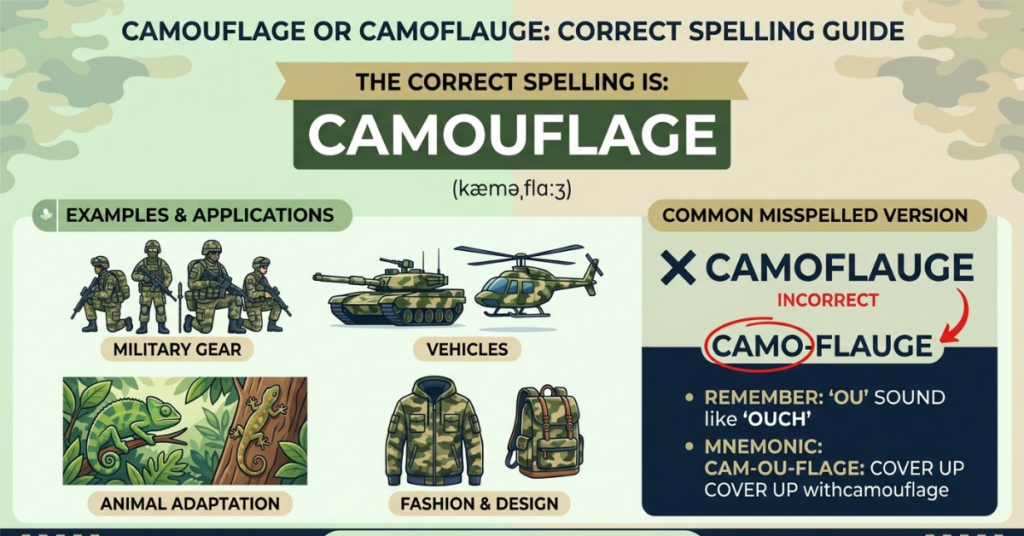
When comparing camouflage or camoflauge, only one spelling is correct in standard English: camouflage. This word describes methods people and animals use to hide or blend into their surroundings.
In this guide, we’ll explore the correct spelling, explain the meaning of camouflage, and share practical examples. You’ll also discover a few easy ways to remember the word, whether you’re writing an assignment, preparing an article, or improving your English vocabulary.
Camouflage or Camoflauge: Which Is Correct?
Camouflage is the correct spelling. People often write camoflauge by mistake because they mix up the letters in the middle of the word.
Here’s a quick comparison:
| Word | Correct spelling? | Explanation |
|---|---|---|
| Camouflage | Yes | The standard English word for hiding or disguising something |
| Camoflauge | No | A common misspelling of camouflage |
| Camouflaged | Yes | Describes something that someone has concealed or disguised |
| Camouflaging | Yes | The act of concealing or disguising something |
| Camouf lage | No | An incorrect separation of the word |
For example:
- Correct: The soldier wore camouflage clothing.
- Incorrect: The soldier wore camoflauge clothing.
To avoid this mistake, remember the correct spelling: C-A-M-O-U-F-L-A-G-E.
What Does Camouflage Mean?
Camouflage refers to a method of hiding or disguising a person, animal, object, or structure by making it less noticeable in its surroundings. It can involve colors, patterns, textures, shapes, or behaviors that help something blend into the background.
Although many people associate camouflage with military uniforms, the technique also appears throughout nature. Designers, fashion brands, and artists use camouflage patterns for practical and decorative purposes, too.
Camouflage Meaning in Simple English
In simple terms, camouflage means making something difficult to see or recognize by helping it blend into its environment.
For example:
- A green insect blends into the leaves of a plant.
- A soldier wears patterned clothing that matches the surrounding terrain.
- A snowshoe hare develops a white winter coat that helps it blend into snowy surroundings.
- A hunting tent uses colors and patterns that make it less noticeable in a forest.
In each case, camouflage reduces the chance that someone or something will notice the subject. However, the exact method depends on the environment and the purpose of concealment.
Why Is Camouflage So Difficult to Spell?
The spelling can be confusing because the word contains an unusual combination of vowels and consonants. Moreover, its pronunciation doesn’t make the letter sequence immediately obvious to every English learner.
The middle section, -ouflage, often causes the most trouble. People sometimes rearrange the letters and accidentally write camoflauge instead of camouflage.
English spelling can be unpredictable, particularly when a word contains unfamiliar letter combinations. Consequently, even people who understand the meaning may occasionally misspell camouflage.
An Easy Trick to Remember the Correct Spelling
One simple trick is to divide the word into two parts:
CAMOU + FLAGE
Pay particular attention to the final section: it contains FLAGE, not FLAUGE.
Next, practice writing a sentence such as:
“The camouflage pattern helps the animal blend into its surroundings.”
Reading the word, spelling it aloud, and using it in a sentence can strengthen your memory. With regular practice, you’ll find it easier to recognize the correct spelling.
How to Use Camouflage in a Sentence
The word camouflage functions as both a noun and a verb. Its meaning depends on how you use it in a sentence.
Camouflage as a Noun
As a noun, camouflage refers to a concealment method, pattern, or material.
Examples include:
- The jacket features a traditional camouflage pattern.
- The chameleon relies on camouflage to avoid being noticed.
- The military vehicle uses a desert camouflage design.
- The photographer wore neutral colors while observing wildlife.
- The tent’s camouflage helps it blend into the woodland.
These examples describe camouflage as a technique or feature rather than an action.
Camouflage as a Verb
As a verb, camouflage means to conceal or disguise something.
Consider these examples:
- The designers used dark colors to camouflage the equipment.
- The insect camouflages itself among the branches.
- Tall plants helped camouflage the garden shed.
- The artist used shadows to camouflage the edges of the sculpture.
- The animal camouflaged itself against the rocky surface.
Notice how the word describes an action in each sentence. Depending on the context, you can use camouflages, camouflaged, or camouflaging to express different tenses and forms.
Camouflaged and Camouflaging
Two common forms of the word are camouflaged and camouflaging.
- Camouflaged: The team camouflaged the equipment to make it less noticeable.
- Camouflaging: The insect was camouflaging itself among the leaves.
Learning these related forms will help you use the word more confidently in everyday writing.
Types of Camouflage and Their Uses
Camouflage doesn’t rely on a single color or pattern. Instead, different techniques help organisms and objects blend into particular environments.
1. Color Matching
Color matching involves using colors similar to those in the surrounding environment. For instance, a sandy-colored animal may become less noticeable in a dry, sandy habitat.
This technique helps animals survive in a range of environments, including deserts, forests, grasslands, and snowy regions.
2. Disruptive Patterns
Disruptive camouflage uses contrasting shapes, lines, or patches of color to make an object’s outline harder to recognize.
Many military uniforms use this approach. Similarly, stripes and spots in nature can make it more difficult for an observer to identify an animal’s body shape.
3. Seasonal Camouflage
Some animals change their appearance as the seasons change. For example, the Arctic fox generally develops a white winter coat that blends into snowy surroundings, while its summer coat often appears darker.
This adaptation helps the animal remain less noticeable as environmental conditions change.
4. Mimicry and Disguise
Certain organisms resemble leaves, twigs, or other features of their surroundings. Stick insects, for example, have body shapes that resemble small branches.
Although mimicry and camouflage share similarities, they are not identical. Camouflage reduces the chance of detection, whereas mimicry involves resembling another organism or object in a way that influences how an observer identifies it.
Camouflage in Fashion and Everyday Life
Camouflage has become a familiar feature of modern clothing and visual design. Originally associated with practical concealment in military and outdoor settings, it now serves as a distinctive fashion pattern.
Common examples include:
- Camouflage jackets and trousers
- Outdoor clothing and backpacks
- Hunting and wildlife photography equipment
- Military-inspired footwear
- Decorative accessories and home textiles
In fashion, people often choose camouflage for its appearance rather than its ability to hide the wearer. For example, someone wearing a camouflage-print jacket in a city may simply enjoy the pattern.
The word also has a figurative meaning. Someone might say that a design feature camouflages an unattractive surface, meaning that it makes the surface less noticeable.
Camouflage Synonyms and Related Words
Several words share a connection with camouflage, although each has a slightly different meaning.
| Word | Meaning |
|---|---|
| Conceal | To keep something hidden |
| Disguise | To change an appearance to prevent recognition |
| Hide | To place something where it is difficult to see |
| Mask | To cover or obscure something |
| Obscure | To make something unclear or difficult to see |
| Blend in | To look similar to the surrounding environment |
| Deceive | To cause someone to believe something that is not true |
For example, conceal works well when describing a hidden object. By contrast, blend in is particularly useful when explaining how an animal becomes less noticeable in its habitat.
Choosing suitable synonyms also makes your writing more varied. However, remember that these words aren’t always interchangeable, so consider the meaning of your sentence before replacing camouflage with another term.
Common Spelling Mistakes to Avoid
Understanding common spelling errors can help you recognize the correct form more quickly.
- Camoflauge: Incorrect letter order.
- Camoflage: Missing letters.
- Camoflauge pattern: Incorrect spelling in a common phrase.
- Camouflage pattern: Correct spelling.
- Camouflaged clothing: Correct past-tense or participle form.
- Camouflaging an object: Correct -ing form.
A spellchecker can identify many of these mistakes. Nevertheless, learning the correct spelling yourself remains useful, particularly when preparing professional documents, academic assignments, or published content.
Frequently Asked Questions
1. Is it camouflage or camoflauge?
Camouflage is the correct spelling in standard English. Camoflauge is a common misspelling caused by rearranging letters in the middle of the word.
2. How do you spell camouflage correctly?
The correct spelling is C-A-M-O-U-F-L-A-G-E. Remember the sequence -ouflage to avoid writing the incorrect form -oflauge.
3. What does camouflage mean?
Camouflage means concealing or disguising something by helping it blend into its surroundings. The term can describe animal adaptations, military patterns, clothing, and other concealment methods.
4. Why do people spell camouflage incorrectly?
The word contains an unusual letter sequence, and its pronunciation doesn’t make the spelling obvious to everyone. As a result, people sometimes rearrange the letters and mistakenly write camoflauge.
5. Is camouflage a noun or a verb?
It can function as both. As a noun, it describes a concealment method or pattern. As a verb, it means to conceal or disguise something.
6. What is the plural of camouflage?
When referring to the general technique, camouflage usually functions as an uncountable noun. However, writers may use camouflages when referring to distinct types or instances of camouflage.
7. What is the past tense of camouflage?
The past tense is camouflaged. For example, “The team camouflaged the equipment to make it less noticeable.”
8. What is the difference between camouflage and disguise?
Camouflage generally makes something blend into its surroundings, while disguise changes its appearance to conceal its identity or true nature. Both involve concealment, but their methods and purposes can differ.
9. Is camouflage used only in the military?
No. Camouflage also occurs naturally in animals and plants. In addition, people use camouflage patterns in outdoor clothing, fashion, wildlife photography, and design.
10. What is another word for camouflage?
Common alternatives include conceal, disguise, hide, mask, and blend in. The most suitable synonym depends on the context.
Conclusion
When choosing between camouflage or camoflauge, remember that camouflage is the correct spelling in standard English. The alternative camoflauge is a common spelling error caused by mixing up the letters in the middle of the word.
Camouflage refers to hiding or disguising something so that it becomes less noticeable. From natural adaptations and military clothing to fashion patterns and visual design, the word has several practical uses.
To remember the spelling, focus on the sequence CAMOU + FLAGE and practice using the word in everyday sentences. Finally, proofread your writing before publishing it to catch spelling mistakes and keep your content clear, accurate, and professional.
