
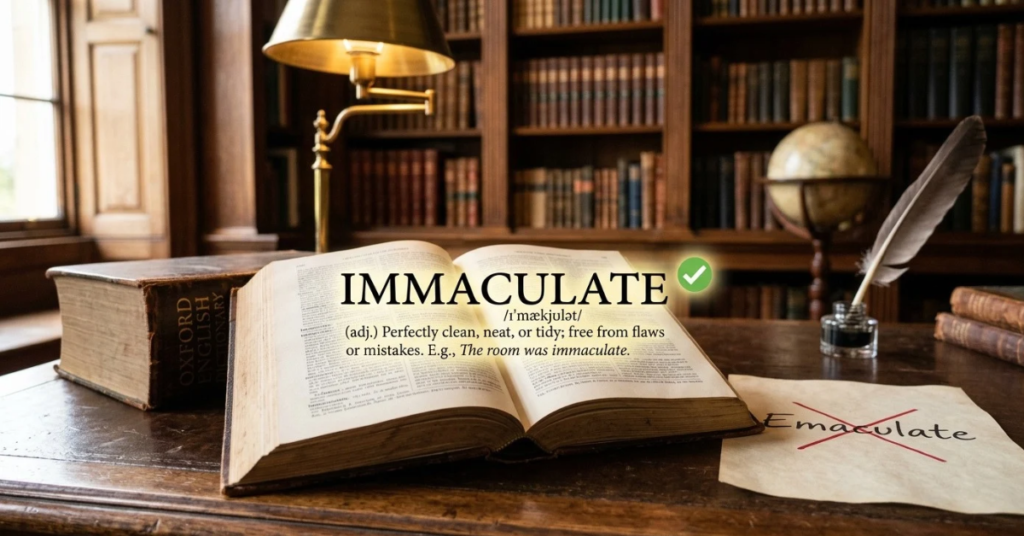
Have you ever wanted to describe something perfectly clean, beautifully arranged, or completely flawless but wondered whether to write immaculate or emaculate? This spelling confusion is more common than you might think, especially when a word sounds different from how people expect it to be written.
When comparing immaculate or emaculate, the correct spelling in standard English is immaculate. The word means perfectly clean, free from flaws, or exceptionally well-maintained. Emaculate is a common misspelling and is not the standard form of the word.
In this guide, we’ll explain the meaning of immaculate, show you how to use it correctly, explore similar words, and provide practical examples to make the spelling easier to remember.
Immaculate or Emaculate: Which Is Correct?
Immaculate is the correct spelling. It is an adjective used to describe something that is spotless, flawless, or in excellent condition.
On the other hand, emaculate is generally an incorrect spelling of immaculate. Although you may see it in online posts, messages, or informal writing, it should be avoided in professional documents, academic assignments, and published content.
Here is a quick comparison:
| Word | Meaning | Correct spelling? |
|---|---|---|
| Immaculate | Perfectly clean, flawless, or without blemishes | Yes |
| Emaculate | A common misspelling of immaculate | No, in standard English |
| Immaculately | In a perfectly clean or flawless manner | Yes |
| Immaculateness | The quality of being immaculate | Yes, though less commonly used |
For example:
- Correct: Her bedroom was immaculate.
- Incorrect: Her bedroom was emaculate.
The easiest way to remember the correct spelling is to start with imma-, not ema-.
What Does Immaculate Mean?
The word immaculate means perfectly clean, spotless, or free from visible flaws. Depending on the context, it can also describe something exceptionally well-organized, beautifully maintained, or executed with remarkable precision.
For example, an immaculate kitchen has clean surfaces and everything in its proper place. An immaculate outfit looks neat, polished, and free from noticeable imperfections.
The word can also have a figurative meaning. An immaculate performance, for instance, is one completed with almost no mistakes.
Immaculate Meaning in Simple English
In simple terms, immaculate means perfectly clean or flawless.
Here are a few everyday examples:
- An immaculate house: A home that is exceptionally clean and tidy.
- An immaculate appearance: Someone who looks neat and well-groomed.
- An immaculate record: A record without mistakes or negative incidents.
- An immaculate performance: A performance completed with outstanding precision.
- An immaculate design: A design that looks polished, refined, and carefully executed.
The exact meaning depends on what the word describes, but the central idea is the absence of flaws or imperfections.
How to Use Immaculate in a Sentence
One of the best ways to understand a new word is to see how it works in different situations. Immaculate is versatile, so you can use it when discussing cleanliness, appearance, work, design, or performance.
Examples of Immaculate in Everyday Life
- The hotel room was immaculate when we arrived.
- She keeps her workspace immaculate and organized.
- His white shoes remained immaculate despite the long walk.
- The garden looked immaculate after the gardener finished working.
- Their kitchen was immaculate, with every utensil in its proper place.
Immaculate Examples in Professional Settings
The word is also useful in professional communication when you want to describe exceptional quality or attention to detail.
- The designer presented an immaculate interior concept.
- Her presentation was immaculate, with clear visuals and accurate information.
- The team maintained an immaculate workspace throughout the project.
- The architect delivered an immaculate set of drawings.
- The restaurant is known for its immaculate service and presentation.
In these examples, the word communicates a high standard of care, precision, or presentation.
Immaculate in Fashion and Interior Design
In fashion, immaculate often describes a polished appearance, well-fitted clothing, or an outfit that looks exceptionally neat.
For example: “He arrived at the event in an immaculate black suit.”
In interior design, the word can describe a clean, carefully styled room where the furniture, lighting, finishes, and accessories work together beautifully.
For example: “The living room had an immaculate contemporary design, with balanced lighting and perfectly arranged furniture.”
However, immaculate does not necessarily mean expensive or luxurious. A simple room can look immaculate when it is clean, organized, and thoughtfully maintained.
Why Do People Confuse Immaculate and Emaculate?
The confusion often happens because people rely on pronunciation when spelling unfamiliar words. In everyday speech, the opening sound of immaculate may be less obvious than its written form.
Another reason is that people sometimes assume a word begins with e when they hear an unstressed vowel sound. Without seeing the word written down, it can be difficult to remember which letters come first.
Here are three ways to avoid the mistake:
- Remember the first letters: The correct word begins with imma-.
- Connect the word with its meaning: Think of an immaculate room as a perfectly clean room.
- Practice writing it: Use the word in a few sentences until the spelling becomes familiar.
If you frequently write articles, emails, or social media captions, adding immaculate to your vocabulary list can also help you remember its spelling.
Immaculate Synonyms: Words With Similar Meanings
Several English words have meanings similar to immaculate. However, each synonym has slightly different uses, so the best choice depends on the sentence.
| Synonym | Meaning | Example |
|---|---|---|
| Spotless | Completely clean | The bathroom was spotless. |
| Flawless | Without mistakes or imperfections | She delivered a flawless performance. |
| Pristine | In an original, fresh, or nearly untouched condition | The beach looked pristine. |
| Impeccable | Extremely good, with no noticeable faults | His manners were impeccable. |
| Unblemished | Free from marks or defects | The surface remained unblemished. |
| Perfect | Having no faults or shortcomings | The timing was perfect. |
| Neat | Tidy and well-arranged | Her desk was neat. |
Although these words overlap, they are not always interchangeable. For instance, spotless usually emphasizes cleanliness, while impeccable often describes excellent standards, behavior, or judgment.
Antonyms of Immaculate
An antonym is a word with the opposite meaning. Learning antonyms can make it easier to understand when immaculate is appropriate.
Common antonyms include:
- Dirty: Covered with dirt or unclean.
- Messy: Untidy or disorganized.
- Flawed: Containing imperfections or mistakes.
- Stained: Marked by discoloration or a substance.
- Imperfect: Not completely free from faults.
- Untidy: Not neat or properly arranged.
For example, you could say, “The room was immaculate after cleaning, but it became messy when the children started playing.”
Choosing the right antonym helps you express the difference between something well-maintained and something that needs attention.
What Is the Difference Between Immaculate and Impeccable?
Immaculate and impeccable are closely related, but they often emphasize different qualities.
Immaculate usually focuses on cleanliness, appearance, or the absence of visible flaws. Impeccable often describes something done extremely well, especially when discussing behavior, judgment, technique, or standards.
Consider these examples:
- “Her bedroom was immaculate.” This emphasizes cleanliness and tidiness.
- “Her professional manners were impeccable.” This emphasizes excellent behavior.
- “The car was immaculate.” This suggests that the car was exceptionally clean and well-maintained.
- “His timing was impeccable.” This means he acted at exactly the right moment.
Both words are positive descriptions, but understanding the distinction helps you choose the more precise word.
Is Immaculate a Positive Word?
Yes. Immaculate is generally a positive word because it communicates cleanliness, perfection, precision, or exceptional care.
People commonly use it to compliment a person’s appearance, a well-maintained property, an organized workspace, or a carefully completed task.
For example, saying “Your presentation was immaculate” is a compliment suggesting that the presentation was polished, organized, and free from noticeable mistakes.
In some religious contexts, immaculate can also have a specific spiritual meaning. For example, the phrase “Immaculate Conception” is a Catholic theological term referring to the belief that Mary was preserved from original sin from the moment of her conception. This specialized meaning is different from the everyday use of the word to describe something spotless or flawless.
Common Spelling Mistakes Related to Immaculate
Because immaculate is not always easy to spell from pronunciation alone, it helps to recognize common errors.
| Incorrect or confused form | Correct form |
|---|---|
| Emaculate | Immaculate |
| Immaculant | Immaculate |
| Imacul ate | Immaculate |
| Immaculately written as “emaculately” | Immaculately |
The correct spelling is I-M-M-A-C-U-L-A-T-E.
Notice the double m near the beginning. Remembering those two letters is one of the simplest ways to avoid the most common mistake.
Frequently Asked Questions
1. Is it immaculate or emaculate?
Immaculate is the correct standard English spelling. Emaculate is generally a misspelling of the word.
2. What is the meaning of immaculate?
Immaculate means perfectly clean, spotless, or free from flaws. It can also describe something exceptionally well-maintained or completed with great precision.
3. Is emaculate a real word?
Emaculate is not the standard English spelling of the adjective meaning spotless or flawless. In ordinary writing, use immaculate instead.
4. How do you spell immaculate correctly?
The correct spelling is immaculate: I-M-M-A-C-U-L-A-T-E. Remember that it begins with imma- and contains a double m.
5. What is an example of immaculate in a sentence?
“Her apartment was immaculate, with clean floors, organized shelves, and neatly arranged furniture.”
6. What is another word for immaculate?
Common synonyms include spotless, flawless, pristine, impeccable, unblemished, and perfect. The best synonym depends on whether you mean cleanliness, appearance, or quality.
7. Is immaculate a compliment?
Yes. Calling something immaculate is generally a compliment. It suggests that a person’s appearance, a room, a piece of work, or an object is exceptionally clean, polished, or free from flaws.
8. What is the difference between immaculate and perfect?
Immaculate often emphasizes cleanliness, presentation, or the absence of imperfections. Perfect is broader and can describe anything that meets an ideal standard or has no faults.
9. What is the opposite of immaculate?
Common opposites include dirty, messy, flawed, stained, imperfect, and untidy. The most appropriate antonym depends on the context.
10. Can you use immaculate to describe a person?
Yes. You can describe someone’s appearance, clothing, grooming, or presentation as immaculate. For example, “She looked immaculate in her formal outfit.”
Conclusion
When deciding between immaculate or emaculate, remember that immaculate is the correct spelling in standard English. It describes something that is perfectly clean, exceptionally neat, or free from noticeable flaws, while emaculate is generally a spelling mistake.
You can use immaculate to describe a spotless home, a polished appearance, an outstanding performance, or a carefully executed design. Remember the double m at the beginning, and practice using the word in everyday sentences to make the spelling stick.
If you want to strengthen your English vocabulary, learning the synonyms, antonyms, and examples of commonly confused words is a useful next step. Small improvements like these can make your writing clearer, more accurate, and more professional.
