
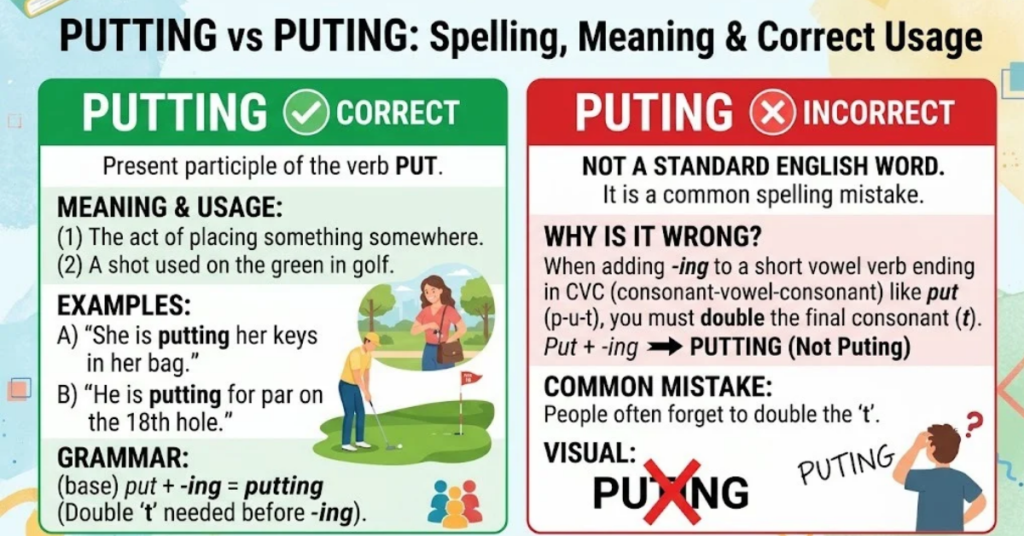
Have you ever typed a word, looked at it twice, and wondered whether it was spelled correctly? The difference between putting vs puting is a common spelling question, especially for people learning English or trying to improve their writing.
Although these two words look almost identical, only one is correct in standard English. “Putting” is the correct spelling, while “puting” is a misspelling. The confusion usually comes from the way English verbs change when we add endings such as -ing.
In this guide, we will explore the meaning of putting, explain why puting is incorrect, review the spelling rule behind the difference, and provide practical examples to help you remember the correct form.
Putting vs Puting Meaning: What Is the Difference?
The main difference between putting and puting is spelling. Putting is a legitimate English word, whereas puting is not the standard spelling of the verb put with the -ing ending.
Here is a quick comparison:
| Word | Meaning | Correct spelling? |
|---|---|---|
| Putting | The act of placing, moving, or positioning something | Yes |
| Puting | An incorrect spelling of putting | No |
For example, if you write, “I am putting my books on the shelf,” your sentence is correct. Writing “I am puting my books on the shelf” would be a spelling mistake.
Understanding this difference is useful in everyday communication, school assignments, professional emails, and online content.
What Does Putting Mean?
The word putting is the present participle or gerund form of the verb put. Depending on the sentence, it can describe an ongoing action or an activity.
The verb put generally means to place something somewhere, move something into a particular position, or cause something to be in a certain state.
Examples of Putting in Everyday Sentences
Here are some common examples that show how to use putting correctly:
-
Placing an object: She is putting her phone on the table.
-
Organizing something: I am putting my clothes away.
-
Taking action: They are putting their plan into practice.
-
Expressing effort: He is putting a lot of effort into his studies.
-
Preparing food: She is putting the ingredients into a bowl.
In each example, putting describes an action or process. Its exact meaning depends on the context, but its spelling always stays the same.
Putting as a Noun
Putting can also function as a noun, particularly when it refers to the act of placing something or a specific activity.
For example:
-
Putting your belongings in the correct place makes a room easier to organize.
-
In golf, putting refers to using a putter to roll the ball toward the hole on the green.
The golfing meaning is especially common in sports-related discussions. Although the context changes, the spelling remains putting, with two letters t.
Why Is Puting Incorrect?
The spelling puting is incorrect because the verb put follows a particular English spelling rule when the -ing ending is added.
The original verb contains one t. However, when you form its present participle, you must double that final consonant.
The correct transformation is:
Put + ing = Putting
Not:
Put + ing = Puting
This rule is easy to overlook because many English verbs simply take -ing without doubling their final consonant. Learning when to double a consonant can help you avoid similar spelling errors.
The Spelling Rule: When Do You Double the Final Consonant?
English has a useful spelling rule for certain short verbs. When a verb ends in a consonant-vowel-consonant pattern and meets the relevant stress and syllable conditions, its final consonant is often doubled before adding -ing.
For example:
-
Run → Running
-
Sit → Sitting
-
Stop → Stopping
-
Get → Getting
-
Put → Putting
The verb put is a short, one-syllable word ending in a consonant-vowel-consonant pattern. Therefore, its final consonant is doubled before adding -ing.
Does This Rule Apply to Every Verb?
No. The spelling rule has exceptions and depends on the verb’s structure and pronunciation.
Consider these examples:
| Base verb | Correct -ing form |
|---|---|
| Make | Making |
| Read | Reading |
| Open | Opening |
| Run | Running |
| Plan | Planning |
| Put | Putting |
Notice that make loses its final e, while read simply takes -ing. In contrast, run, plan, and put double their final consonants.
The best approach is to learn common spelling patterns alongside individual words rather than assuming that every verb follows the same rule.
Putting vs Puting: Correct Usage Examples
One of the easiest ways to remember a spelling difference is to see the correct word used in realistic situations.
Here are several examples you can use as a reference.
Examples in Everyday Conversations
Correct: I am putting my keys in my bag.
Incorrect: I am puting my keys in my bag.
Correct: She is putting the dishes in the cupboard.
Incorrect: She is puting the dishes in the cupboard.
Correct: We are putting together a presentation for tomorrow.
Incorrect: We are puting together a presentation for tomorrow.
The correct version always uses two ts. This remains true whether putting refers to placing an object, organizing items, or preparing something.
Examples in Professional Writing
The same spelling rule applies in formal and professional contexts.
-
The team is putting the new strategy into action.
-
I am putting together the final project report.
-
The company is putting additional resources into employee training.
-
We are putting the finishing touches on the design.
Using the correct spelling helps your writing look polished and professional. Although a single typo may not change the intended meaning, repeated errors can distract readers and reduce confidence in the quality of a document.
Common Reasons People Write Puting Instead of Putting
Even people who speak English fluently sometimes make spelling mistakes. The confusion between putting and puting usually comes from a few simple habits.
1. Forgetting to Double the Final Letter
The most common reason is forgetting that put doubles its final consonant before taking -ing. Writers may apply the simpler pattern of adding -ing directly to the verb.
2. Confusing Similar Spelling Patterns
English verbs do not all form their -ing versions in the same way. Compare putting, making, and reading. Because the spelling changes differ, it is easy to apply the wrong pattern to a familiar word.
3. Typing Too Quickly
On phones, laptops, and other devices, people often type quickly without checking every word. Since puting looks similar to putting, the missing letter may go unnoticed.
4. Relying Only on Pronunciation
In ordinary speech, the difference between the two spellings may not be obvious. Pronunciation alone is therefore not a reliable way to determine whether a word has been spelled correctly.
To avoid these mistakes, remember the complete form of the word: putting.
How to Remember the Correct Spelling of Putting
If you frequently confuse putting with puting, a few simple techniques can help you remember the correct spelling.
-
Learn the word as a complete unit. Remember putting rather than trying to build its spelling from memory every time.
-
Practice related verbs. Write down sitting, running, stopping, and putting to become familiar with doubled consonants.
-
Use the word in sentences. For example, write, “I am putting my notebook on the desk.”
-
Check your writing. Use a dictionary or spelling checker when you are unsure about a word.
-
Review the spelling pattern. Remember that short verbs such as put commonly double the final consonant before adding -ing.
With regular practice, the correct spelling becomes easier to recognize and use naturally.
Frequently Asked Questions About Putting vs Puting
1. Is putting or puting correct?
Putting is correct. Puting is a misspelling in standard English. Whenever you add -ing to the verb put, you double the final t.
2. What is the meaning of putting?
Putting is the -ing form of the verb put. It can mean placing something somewhere, positioning an object, or taking an action. In golf, putting means hitting the ball gently with a putter toward the hole.
3. Why does putting have two t’s?
The final t in put is doubled before adding -ing. This follows a common English spelling pattern for short verbs ending in a consonant-vowel-consonant sequence.
4. Is puting ever an acceptable spelling?
No. In standard modern English, puting is not the correct spelling of the verb put with the -ing ending. The correct form is putting.
5. What is the difference between put and putting?
Put is the base form of the verb, while putting is its present participle or gerund form.
Examples:
-
Put: Please put your bag here.
-
Putting: I am putting my bag here.
The appropriate form depends on the sentence and its grammatical structure.
6. Is putting a verb or a noun?
Putting can be both. It functions as a verb form in “She is putting the books away.” It can function as a noun in “Putting things in order takes time.”
In golf, putting is also the name of the activity of rolling the ball toward the hole with a putter.
7. How do you spell putting in British and American English?
The spelling is the same in both British and American English: putting. There is no regional spelling difference between these varieties of English for this word.
8. What are other words that double the final consonant before adding -ing?
Common examples include:
-
Run → Running
-
Sit → Sitting
-
Swim → Swimming
-
Stop → Stopping
-
Plan → Planning
-
Get → Getting
These examples help illustrate the consonant-doubling pattern, although English spelling rules also depend on syllable structure and stress.
Conclusion: Putting vs Puting
When comparing putting vs puting, the answer is straightforward: putting is the correct spelling, and puting is incorrect in standard English.
The difference comes from a common spelling rule that requires doubling the final consonant in put before adding -ing. Whether you are writing a casual message, preparing an academic assignment, or creating professional content, using the correct form makes your writing clearer and more accurate.
The next time you hesitate between these two spellings, remember the simple formula: put + ing = putting.
For more practical English tips, explore related guides on commonly confused words, verb endings, and everyday spelling mistakes. Building a strong understanding of these patterns can make your writing more confident, natural, and professional.
