
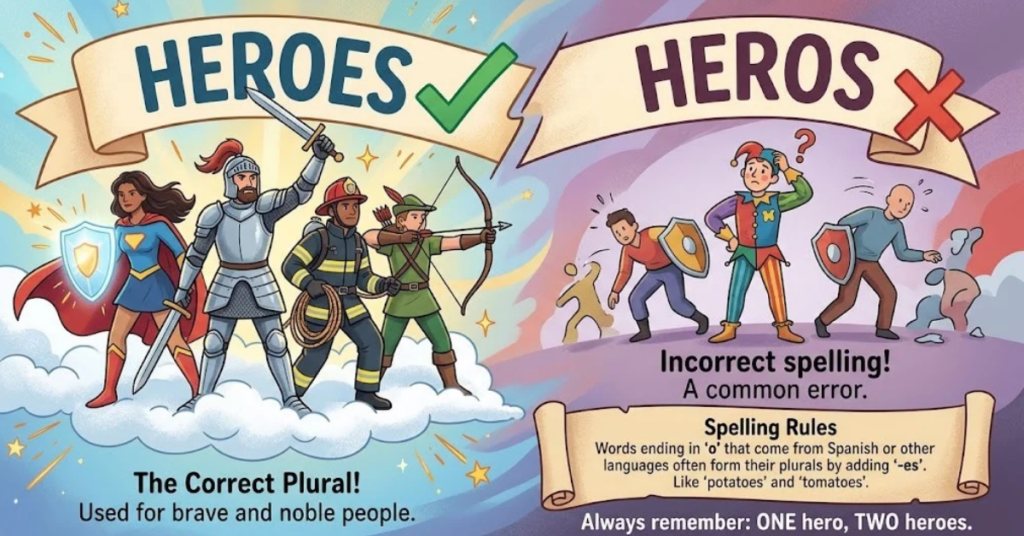
Have you ever typed “heros” and wondered if it looked right? You’re not alone. The heroes vs heros spelling debate is one of the most common English writing mistakes, especially for students, bloggers, and content creators.
The short answer is simple: heroes is the correct plural form of hero, while heros is a misspelling in standard English.
In this guide, you’ll learn why heroes is correct, the grammar rule behind it, common examples, exceptions to similar words, and easy tricks to remember the right spelling every time.
The Quick Answer: Heroes vs Heros
| Word | Correct? | Meaning |
|---|---|---|
| Heroes | Yes | The correct plural of hero. |
| Heros | No | Incorrect spelling in standard English. |
If you’re writing an essay, social media post, article, or email, always use heroes.
Why Is “Heroes” the Correct Spelling?
The word hero follows a common English pluralization rule for nouns ending in -o.
Instead of simply adding -s, many nouns ending in a consonant followed by o take -es to form the plural.
-
Hero → Heroes
-
Potato → Potatoes
-
Tomato → Tomatoes
-
Echo → Echoes
That’s why heroes becomes heroes, not heros.
Understanding the Grammar Rule
The Basic Rule
For many nouns ending in -o after a consonant, add -es.
Examples:
-
Hero → Heroes
-
Echo → Echoes
-
Volcano → Volcanoes
-
Buffalo → Buffaloes
Why Not “Heros”?
Adding only -s breaks the established spelling pattern for hero. While English has plenty of irregular rules, dictionaries and style guides consistently recognize heroes as the only correct standard spelling.
Heroes vs Heros: Examples in Sentences
Seeing the words in context makes the difference obvious.
Correct Examples
-
Firefighters are everyday heroes.
-
The movie celebrates forgotten heroes from history.
-
Our community honored local heroes during the ceremony.
-
Children often imagine superheroes as their favorite heroes.
Incorrect Examples
-
Firefighters are everyday heros.
-
The book tells stories of brave heros.
Why Do People Write “Heros”?
The mistake usually happens because English often forms plurals by simply adding -s.
For example:
-
Book → Books
-
Car → Cars
-
Dog → Dogs
Writers naturally assume hero becomes heros, but hero belongs to a different spelling pattern.
Other reasons include:
-
Typing quickly
-
Autocorrect not catching the error immediately
-
Learning English as a second language
-
Confusion with other -o words that take only -s
Similar Words That Can Be Confusing
English has several words ending in -o, but they don’t all follow the same rule.
Words That Add “-es”
-
Hero → Heroes
-
Potato → Potatoes
-
Tomato → Tomatoes
-
Echo → Echoes
-
Tornado → Tornadoes
Words That Usually Add “-s”
-
Piano → Pianos
-
Photo → Photos
-
Radio → Radios
-
Video → Videos
-
Logo → Logos
This inconsistency is why heroes vs heros confuses so many writers.
Is “Heros” Ever Correct?
In standard English, no.
Major dictionaries—including Merriam-Webster, Cambridge Dictionary, and Oxford English Dictionary—recognize heroes as the correct plural form.
The only time you might encounter Heros is:
-
as a surname,
-
a brand or company name,
-
or a spelling mistake in informal writing.
For general writing, always choose heroes.
The Origin of the Word “Hero”
The word hero comes from the Greek word hērōs, meaning a protector, warrior, or person of extraordinary courage.
As the word entered English through Latin and French, its plural evolved into heroes, preserving the traditional -es ending.
Today, the word refers to people admired for:
-
courage,
-
selflessness,
-
outstanding achievements,
-
or moral strength.
Memory Tricks to Remember “Heroes”
If you struggle with the spelling, these simple tricks can help.
Trick 1: Think of Superheroes
The word superheroes clearly contains heroes, making the correct spelling easier to remember.
Trick 2: Remember “Potatoes”
If you know:
– Potato → Potatoes
then you’ll remember:
– Hero → Heroes
Trick 3: Say It Out Loud
The pronunciation naturally includes an extra syllable:
Heroes → He-roes
That extra sound matches the -es ending.
Common Mistakes to Avoid
When writing about heroes vs heros, avoid these frequent errors.
-
Writing heros instead of heroes
-
Mixing singular and plural forms
-
Assuming every -o word follows the same rule
-
Ignoring spell-check suggestions
A quick proofreading pass can catch this mistake before publishing.
Heroes in Everyday Language
The word appears in countless contexts beyond comic books.
Everyday Heroes
-
Nurses
-
Teachers
-
Firefighters
-
Parents
-
Volunteers
Fictional Heroes

-
Superman
-
Wonder Woman
-
Spider-Man
-
Harry Potter
-
Greek heroes like Achilles and Odysseus
In every case, the plural remains heroes.
Heroes vs Heros: Quick Comparison
| Feature | Heroes | Heros |
|---|---|---|
| Correct English spelling | Yes | No |
| Standard dictionary entry | Yes | No |
| Proper plural of hero | Yes | No |
| Suitable for academic writing | Yes | No |
| Common typo | No | Yes |
SEO Writing Tip
If you’re creating blog content around heroes vs heros, use the keyword naturally instead of repeating it excessively.
Good placements include:
-
the title,
-
introduction,
-
subheadings,
-
image alt text,
-
and the conclusion.
Natural writing improves both readability and search performance.
Frequently Asked Questions (FAQs)
Is “heroes” or “heros” correct?
Heroes is the correct plural spelling. Heros is considered a misspelling in standard English.
Why does hero become heroes?
Because hero follows the English rule where many nouns ending in a consonant plus -o take -es in the plural.
Is “heros” in the dictionary?
No. Standard English dictionaries list heroes as the correct plural form.
What is the plural of superhero?
The plural is superheroes.
Are there exceptions to the “-o” plural rule?
Yes. Some words ending in -o simply add -s, such as photos, radios, videos, and pianos.
How can I remember the correct spelling?
Think of superheroes or compare it with potatoes—both use the -es ending.
Conclusion
The heroes vs heros question has a straightforward answer: heroes is always the correct plural form of hero in standard English, while heros is simply a spelling mistake. The confusion comes from English’s inconsistent plural rules, but remembering that hero behaves like potato and echo makes it much easier to get right.
Whether you’re writing an academic paper, a blog post, or a social media caption, using heroes ensures your writing looks polished and grammatically correct. If you’re looking to strengthen your English even further, explore more grammar and spelling guides to master other commonly confused words.
