
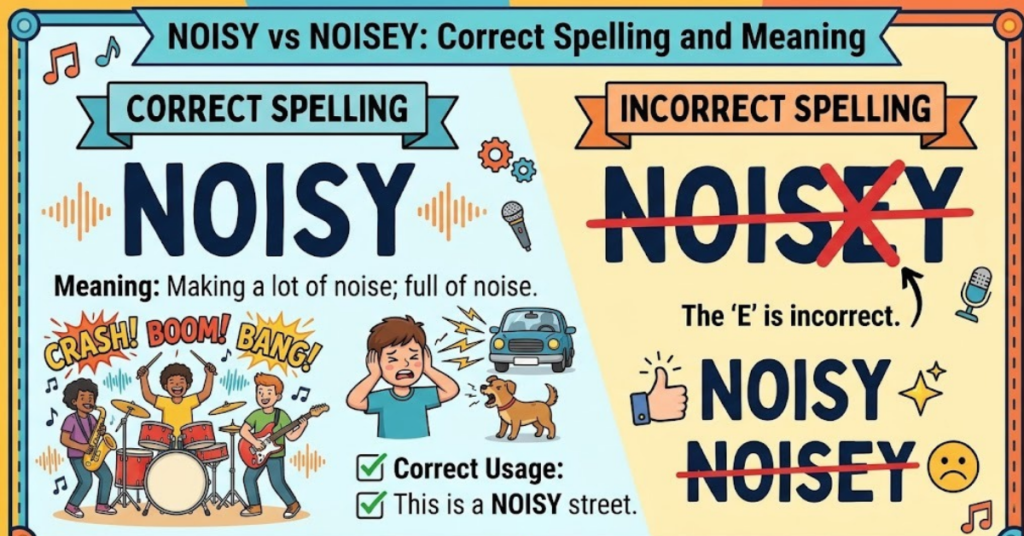
Have you ever paused while writing a sentence because you weren’t sure whether to use noisy or noisey? It is an understandable mistake, especially because English spelling does not always follow predictable patterns. Both versions look similar, sound alike, and appear as possible spellings when you’re typing quickly.
When comparing noisy vs noisey, however, there is a clear answer: noisy is the correct standard English spelling, while noisey is generally considered a misspelling.
The confusion usually comes from the word noise and the way English forms adjectives. Once you understand this spelling rule, you can use the word confidently in emails, school assignments, blog posts, and everyday conversations.
In this guide, we’ll explore the meaning of noisy, explain why noisey is incorrect in standard English, provide practical examples, and answer common questions about the two spellings.
Noisy vs Noisey: What Is the Difference?
The main difference between noisy and noisey is spelling, not meaning or pronunciation.
| Word | Correctness | Meaning |
|---|---|---|
| Noisy | Correct standard spelling | Making a lot of noise or sound |
| Noisey | Generally incorrect in standard English | Usually an attempted spelling of noisy |
The word noisy is used to describe something or someone that produces a lot of sound. For example, a busy street, a crowded classroom, or a barking dog can all be described as noisy.
Noisey is not the accepted standard spelling of this adjective. Although you might encounter it in informal online writing, usernames, brand names, or creative expressions, it should generally be avoided in formal and professional writing.
Quick tip: If you’re writing about a loud environment, a noisy neighbor, or a noisy machine, always choose noisy.
What Does Noisy Mean?
Noisy is an adjective that describes a person, place, animal, object, or situation that produces a lot of sound. It can refer to sounds that are loud, continuous, distracting, or unpleasant.
For example, imagine trying to study while construction workers are operating machinery outside your window. You might describe the environment as noisy because the sound makes it difficult to concentrate.
The word can also describe people who talk loudly, children who play energetically, or machines that operate with noticeable sound.
Examples of Noisy in Sentences
Here are several examples showing how to use noisy correctly:
-
The restaurant was too noisy for a quiet conversation.
-
Our neighbors have a noisy dog that barks throughout the night.
-
The children became noisy during the school break.
-
I moved to another room because the fan was noisy.
-
The traffic outside my apartment makes the street noisy in the morning.
-
The classroom gets noisy when the teacher leaves.
In each sentence, noisy describes something that produces or is characterized by a significant amount of sound.
Is Noisy Always Negative?
Not necessarily. Although noisy often suggests unwanted or distracting sound, its meaning depends on the context.
A noisy construction site might be frustrating, especially if you’re trying to sleep. On the other hand, a noisy birthday party could be full of excitement, laughter, and celebration.
The word describes the sound level or character of a situation rather than automatically expressing whether that sound is good or bad.
Why Is Noisy the Correct Spelling?
The spelling becomes easier to understand when you look at how the adjective is formed from the noun noise.
In English, the ending -y is commonly added to nouns to form adjectives. These adjectives describe something that has, contains, or is characterized by the quality associated with the original noun.
For example:
-
Cloud → cloudy
-
Rain → rainy
-
Sun → sunny
-
Dirt → dirty
-
Noise → noisy
Notice that noise loses its final e before the y is added. The result is noisy, not noisey.
This is a useful spelling pattern to remember, although English has exceptions and not every noun follows the same rule.
Why Do People Write Noisey Instead?
There are several reasons why people may mistakenly write noisey.
1. The original word ends in e. When people see noise, they may assume the e should remain when forming the adjective.
2. English spelling can be inconsistent. Words such as smoky and smokey are a good reminder that spelling patterns are not always obvious, and some words have accepted variants or special uses.
3. Typing habits create mistakes. People often spell words based on how they look or sound rather than checking a dictionary.
4. Autocorrect does not always settle the question. Suggestions can depend on the keyboard, language settings, and personal dictionary. A suggested spelling is not necessarily the standard form.
The simplest solution is to remember that the standard adjective derived from noise is noisy.
Noisy vs Noisey Pronunciation
One reason this spelling question causes confusion is that both versions are generally intended to represent the same pronunciation.
According to the Cambridge Dictionary, noisy is pronounced /ˈnɔɪ.zi/ in both British and American English. In simple terms, it sounds like NOY-zee.
Here is a quick pronunciation guide:
-
Noisy: NOY-zee
-
Noisey: Usually intended to sound like NOY-zee, but it is not the standard spelling of the adjective.
Because the words are normally pronounced alike, listening to someone say the word will not help you determine which spelling is correct. You need to rely on standard English spelling instead.
Noisy vs Noisey in Everyday Writing
Understanding the difference is especially useful when writing messages, schoolwork, professional emails, or online content.
Here are some common situations where noisy is the appropriate choice.
1. Describing a Place
Correct: The shopping mall becomes noisy during the weekend.
Incorrect in standard English: The shopping mall becomes noisey during the weekend.
The adjective describes the amount of sound in the environment.
2. Describing a Person
Correct: My little brother gets noisy when he plays video games.
Incorrect in standard English: My little brother gets noisey when he plays video games.
In this example, noisy describes someone who makes a lot of sound.
3. Describing a Machine
Correct: The old washing machine is noisy during the spin cycle.
Incorrect in standard English: The old washing machine is noisey during the spin cycle.
The word can describe mechanical sounds, whether they come from a washing machine, air conditioner, fan, or engine.
4. Writing for School or Work
Correct: The office is too noisy for employees to concentrate.
Incorrect in standard English: The office is too noisey for employees to concentrate.
In formal writing, using the recognized spelling helps maintain clarity and professionalism.
Related Words: Noise, Noisily, Noisier, and Noisiest
Learning a few related words can help you remember the correct spelling and use it naturally.
| Word | Part of speech | Meaning |
|---|---|---|
| Noise | Noun | A sound, especially one that is loud or unwanted |
| Noisy | Adjective | Making a lot of noise |
| Noisily | Adverb | In a way that makes a lot of noise |
| Noisier | Comparative adjective | Making more noise than something else |
| Noisiest | Superlative adjective | Making the most noise within a comparison |
These words follow the standard spelling pattern used for noisy.
Examples of Related Words
-
Noise: The noise from the street kept me awake.
-
Noisy: The street is noisy at night.
-
Noisily: The children ran noisily down the hallway.
-
Noisier: This room is noisier than the library.
-
Noisiest: That was the noisiest restaurant we visited.
The comparative form noisier and the superlative form noisiest are particularly worth remembering. They do not become noiseyer or noiseyest in standard English.
Is Noisey Ever an Acceptable Word?
Although noisey is generally incorrect when used as the ordinary adjective, you might encounter it in specific contexts.
For example, a person may use Noisey as a username, a creative spelling, or part of a brand name. In these cases, the spelling may be intentional rather than a mistake.
There is also a distinction between informal creativity and standard English. A spelling used for a business, artistic project, or social media account does not automatically become the accepted spelling of the everyday adjective.
If you are writing an academic paper, an article, a business email, or a professional document, use noisy. If you are reproducing a proper name or a deliberately stylized brand, preserve its official spelling.
What About Noisy in Technology?
The word noisy is not limited to loud sounds in everyday life. It also has specialized meanings in technical fields.
For example:
-
Noisy signal: An electronic signal affected by unwanted interference.
-
Noisy data: Information containing irrelevant details, errors, or unexplained variations.
-
Noisy image: A digital image containing unwanted visual speckles or grain.
In these contexts, noisy describes unwanted interference or information rather than simply a loud sound. The standard spelling remains the same.
This broader usage is another reason to learn the correct spelling rather than relying only on how the word sounds.
Common Spelling Mistakes to Avoid
When comparing noisy vs noisey, the most important point is to avoid adding an unnecessary e. However, there are other mistakes worth watching for.
-
Writing noisey instead of noisy in ordinary sentences.
-
Writing noiseyer instead of noisier.
-
Writing noiseyest instead of noisiest.
-
Confusing noisy with noise, which is a noun rather than an adjective.
-
Assuming that every word ending in e keeps that letter when an adjective is formed.
A helpful way to check your writing is to look at the word’s role in the sentence. If you are describing something that makes a lot of noise, you most likely need the adjective noisy.
For example, you would write, “The noisy room disturbed my concentration,” rather than “The noisey room disturbed my concentration.”
Quick Memory Trick: How to Remember Noisy
If you frequently confuse noisy and noisey, try this simple technique.
Start with the word noise, remove the final e, and add y.
NOISE
NOIS + Y = NOISY
Correct standard spelling
You can also remember the phrase: “A noisy room has noise.”
Both noise and noisy are correctly spelled, and the connection between them makes the adjective easier to recall.
With a little practice, you will recognize the correct form without needing to check a dictionary every time.
Frequently Asked Questions About Noisy vs Noisey
1. Is noisy or noisey correct?
Noisy is the correct standard English spelling. Noisey is generally a misspelling when used to mean making a lot of noise.
2. Why is noisey spelled incorrectly?
The spelling noisey usually results from keeping the final e in noise before adding y. In the standard adjective, that e is dropped, producing noisy.
3. Do noisy and noisey sound the same?
They are generally intended to have the same pronunciation: NOY-zee. However, only noisy is the standard spelling of the adjective.
4. What does noisy mean?
Noisy means making a lot of sound or being characterized by considerable noise. It can describe people, animals, machines, rooms, streets, and other environments.
5. What is the plural of noisy?
Noisy is an adjective, so it does not have a plural form in the same way that nouns do. The adjective remains noisy when describing singular or plural nouns.
For example:
-
A noisy child.
-
Noisy children.
6. Is noisier or noiseyer correct?
Noisier is correct. When forming the comparative adjective from noisy, the final y changes to i before adding er.
Example: “The market is noisier than the library.”
7. Is noisiest or noiseyest correct?
Noisiest is correct. It is the superlative form of noisy and describes the loudest or most noise-producing member of a group.
Example: “This is the noisiest room in the building.”
8. Can I use noisey in informal writing?
You may encounter noisey in informal messages, usernames, or creative names, but it is not the standard spelling of the adjective. For clear, correct writing, use noisy.
9. What is the opposite of noisy?
The most common opposite of noisy is quiet. Depending on the context, silent, peaceful, or calm may also express a similar idea.
Example: “The busy street was noisy, but the library was quiet.”
10. What is the difference between noisy and noisome?
These words have different meanings. Noisy describes something that makes a lot of sound, while noisome is a less common word that usually describes something offensive, unpleasant, or harmful, particularly in relation to smell.
Conclusion: Noisy vs Noisey — Which Should You Use?
When it comes to noisy vs noisey, the answer is straightforward: noisy is the correct standard English spelling, and noisey is generally a spelling mistake when used as the same adjective.
Remember that noisy describes something that produces a lot of sound, whether it is a crowded restaurant, a barking dog, a busy street, or a loud machine. It also appears in technical contexts, such as noisy signals and noisy data.
To avoid confusion, remember the simple spelling pattern: noise becomes noisy by dropping the final e and adding y. You can then build on that knowledge with related forms such as noisily, noisier, and noisiest.
The next time you write the word, choose noisy with confidence. If you enjoy learning about commonly confused English words, explore more spelling guides to strengthen your vocabulary and make your writing clearer.
