
Have you ever paused while writing an email, message, or professional document because you weren’t sure whether to write offerring or offering? English spelling can be confusing, especially when adding endings to verbs. However, this particular word has a simple answer.
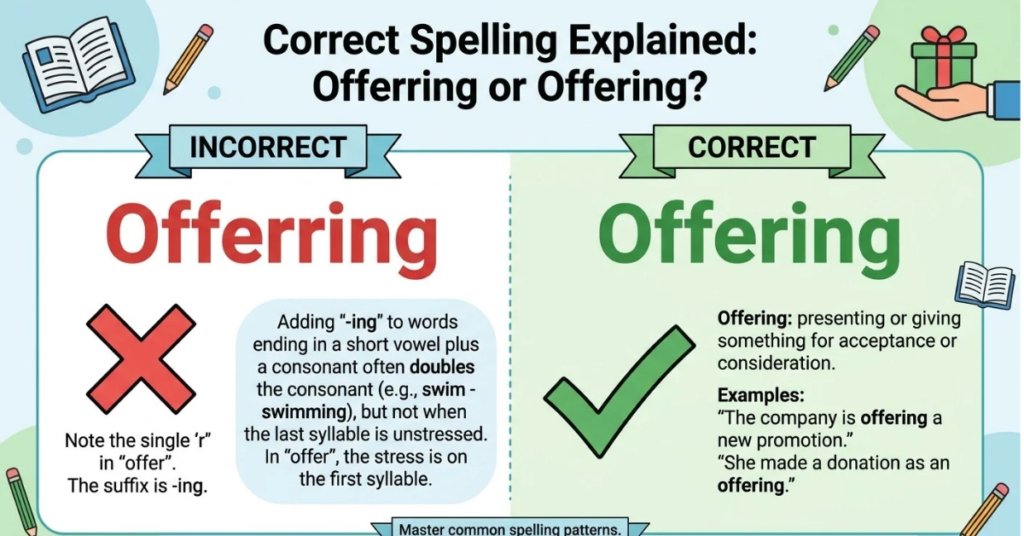
Offering is the correct spelling, while offerring is incorrect. The word offering comes from the verb offer and is used when someone provides something, makes a suggestion, or presents an opportunity to another person. Understanding the spelling rule behind this word can help you avoid similar mistakes in everyday writing.
Offerring or Offering: Which Is Correct?
The correct spelling is offering, with one r after the letter e and two letters f in total.
The incorrect spelling, offerring, contains an extra r. Although it may look reasonable because some English words double their final consonants before adding an ending, the verb offer does not follow that pattern when forming offering.
Here is a quick comparison:
- Correct: Offering
- Incorrect: Offerring
- Base verb: Offer
- Present participle: Offering
- Noun form: Offering
For example, you might write, “Thank you for offering to help me with the project.” Adding -ing to offer produces offering without doubling the final letter.
What Does Offering Mean?
The word offering can have several meanings depending on how it is used in a sentence. It generally refers to something that is presented, provided, or made available to another person.
1. Offering as a Verb Form
Offering is the present participle of the verb offer. It describes the action of giving, presenting, or making something available.
Examples include:
- She is offering to help her friend prepare for the exam.
- The company is offering free delivery on selected products.
- He was offering useful advice during the meeting.
- They are offering several solutions to the problem.
In these examples, offering describes an action that is happening or continuing.
2. Offering as a Noun
The word offering can also function as a noun. In this case, it refers to something provided or presented, such as a product, service, gift, or contribution.
Examples include:
- The store’s latest offering includes affordable home accessories.
- This restaurant has a wide range of vegetarian offerings.
- The artist’s newest offering received positive reviews.
- The company introduced a new service offering for small businesses.
The exact meaning depends on the context, but the spelling remains the same.
3. Offering in Religious Contexts
In religious settings, an offering can refer to a gift or contribution given as part of worship or a religious practice.
For example:
- The congregation brought an offering to the service.
- They made an offering as part of their traditional ceremony.
This use is common in religious writing and conversations.
Why Is Offering the Correct Spelling?
The spelling becomes easier to understand when you look at the base verb.
The word offer ends with two consonants, f and r. When you add the suffix -ing, you simply attach it to the existing word.
Offer + ing = Offering
You do not need to add another r because the original spelling already contains the letters required to form the word.
Compare these examples:
| Base word | Correct -ing form |
|---|---|
| Offer | Offering |
| Open | Opening |
| Enter | Entering |
| Suffer | Suffering |
| Deliver | Delivering |
These words retain their original final consonants when the -ing ending is added.
Offering vs. Other Commonly Confused Words
English has many words that sound similar or follow different spelling rules. Comparing them can help you remember the correct form.
Offering vs. Offer
Offer is the base verb, while offering is its -ing form or a noun.
- Offer: I want to offer you some advice.
- Offering: She is offering helpful advice.
- Offering as a noun: The new product is an exciting offering.
Both forms are correct, but they serve different grammatical purposes.
Offering vs. Offered
Offered is the past tense and past participle of offer. It describes an action that happened in the past or is used with an auxiliary verb.
Examples:
- She offered me a seat.
- The company offered a discount last week.
- They have offered several alternatives.
By contrast, offering often describes an ongoing action or something being presented.
Offering vs. Offerring
The difference between these two spellings is simple: offering is correct, and offerring is a spelling mistake.
Remember that the base word is offer, not offerr. Adding -ing does not change the spelling of the original word.
Common Mistakes When Using Offering
Even though offering is a straightforward word, writers sometimes misspell it or use it incorrectly in sentences.
Here are a few mistakes to watch for:
1. Adding an extra r
Incorrect: The company is offerring a new service.
Correct: The company is offering a new service.
2. Confusing the noun and verb forms
Incorrect: The company offering a discount yesterday.
Correct: The company offered a discount yesterday.
The second sentence uses the past tense because the action happened yesterday.
3. Using the wrong verb structure
Incorrect: She is offer to help.
Correct: She is offering to help.
After is, use the -ing form when describing an ongoing action.
4. Forgetting the context
The word offering can describe an action or a thing. Check the surrounding sentence to ensure that the word fits its grammatical role.
Tips to Remember the Correct Spelling of Offering
If you frequently confuse offerring with offering, a few simple strategies can help.
- Start with the base word: Remember that the correct verb is offer.
- Add the suffix: Attach -ing directly to form offering.
- Avoid adding another r: The word already contains the correct spelling.
- Read your sentence aloud: This can help you identify awkward grammar, although it may not reveal every spelling mistake.
- Use a spell-checker: A reliable spelling tool can flag offerring in most standard English settings.
With regular practice, the correct spelling will become easier to recognize and remember.
Frequently Asked Questions
1. Is it offerring or offering?
Offering is the correct spelling. Offerring is incorrect because it contains an unnecessary extra r.
2. Why is offering spelled with one r after the e?
The base word is offer. When you add -ing, the spelling remains unchanged before the suffix, producing offering.
3. What is the meaning of offering?
An offering can mean the act of providing something, such as help or a service. It can also refer to something presented or made available, including a product, gift, or contribution.
4. Is offering a noun or a verb?
Offering can be both. It functions as a verb form in “She is offering help” and as a noun in “The company’s latest offering is popular.”
5. What is the past tense of offer?
The past tense of offer is offered. For example, “She offered to help me with my assignment.”
6. What is the plural of offering?
The plural is offerings. For example, “The shop introduced several new offerings this season.”
7. Is offering the same as giving?
The words have related meanings, but they are not always interchangeable. Offering often means presenting something for someone to accept, while giving generally refers to transferring or providing something.
8. How do you use offering in a sentence?
You can write, “The company is offering a special discount to new customers.” Here, offering describes the action of making a discount available.
Conclusion
When choosing between offerring or offering, always use offering. It is the correct spelling of the -ing form of the verb offer and can also function as a noun referring to something presented or provided.
The easiest way to remember the rule is to start with offer and add -ing without doubling the final r. Whether you’re writing an email, preparing a professional document, or creating online content, using the correct spelling helps keep your writing clear and credible.
If you enjoy learning about commonly confused English words, explore more spelling guides to strengthen your grammar and make everyday writing easier.
