
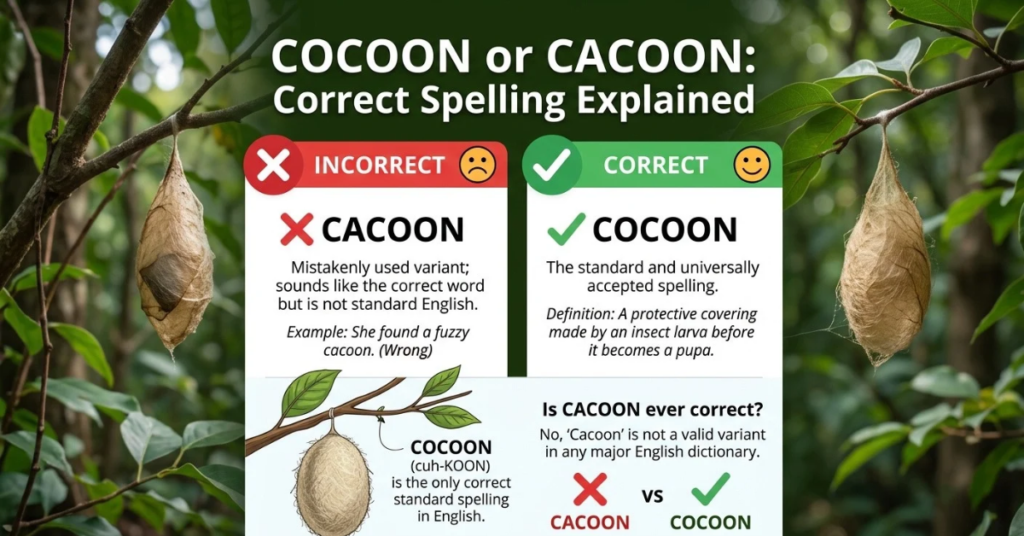
Have you ever written the word cacoon and wondered whether it looked right? You are not alone. Many people confuse cacoon or cocoon because both spellings sound exactly the same when spoken aloud. However, only one is accepted as the standard English spelling.
The correct spelling is cocoon, with two O’s in the middle. A cocoon is a protective covering made by certain insects, especially moth caterpillars, during a stage of their development. The word also appears in everyday expressions, films, and discussions about nature.
In this guide, we will explain the difference between cacoon and cocoon, explore the connection between a cocoon and a butterfly, and answer common spelling questions.
Cacoon or Cocoon: Which One Is Correct?
Cocoon is the correct spelling. The word cacoon is a common misspelling and should generally be avoided in formal writing, school assignments, professional documents, and online articles.
Although both words may sound identical, their written forms are different. If you are unsure which version to use, remember that the correct word begins with C and contains two O’s: cocoon.
Here is a quick comparison:
| Word | Is It Correct? | Meaning |
|---|---|---|
| Cocoon | Yes | A protective covering formed by certain insects |
| Cacoon | No, in standard English | A common misspelling of cocoon |
For example:
- Correct: The caterpillar spun a cocoon before its transformation.
- Incorrect: The caterpillar spun a cacoon before its transformation.
The easiest way to avoid this spelling mistake is to remember the familiar word coo at the beginning of cocoon.
Is It Cacoon or Cocoon? Understanding the Meaning
A cocoon is a protective case or covering created by certain insects around themselves during a stage of development. Depending on the species, it may be made from silk produced by the insect or from a combination of silk and other materials.
Cocoons can serve several purposes. They may protect a developing insect from environmental conditions, predators, or physical disturbance while it undergoes important changes.
The word also has a broader meaning in everyday English. Someone might describe a comfortable bedroom as a cocoon because it offers privacy, warmth, and a feeling of safety.
What Is the Origin of the Word Cocoon?
The English word cocoon comes through French cocon, which is associated with the French word coque, meaning a shell or husk. Its spelling reflects this historical development rather than the way some people might expect to spell it based on pronunciation.
This background helps explain why cocoon is the accepted form, while cacoon is not the standard spelling.
Cacoon or Cocoon Butterfly: What Is the Difference?
When searching for cacoon or cocoon butterfly, people are usually asking about the protective stage in a butterfly’s life cycle. However, there is an important biological distinction: butterflies and moths do not all develop in exactly the same way.
A butterfly’s life cycle typically includes four stages:
- Egg: The butterfly lays eggs, often on a plant that will provide food for the caterpillar.
- Caterpillar: The egg hatches, and the caterpillar feeds and grows.
- Pupa: The caterpillar changes into its adult form inside a protective developmental stage.
- Adult butterfly: The fully developed butterfly emerges, expands and dries its wings, and eventually begins the reproductive cycle.
Do Butterflies Make Cocoons?
Most butterflies do not spin cocoons. Instead, they form a pupa, commonly called a chrysalis, in which the transformation into an adult butterfly takes place.
Moths, on the other hand, are well known for producing cocoons. Many moth caterpillars spin silk around themselves before entering the pupal stage.
There are exceptions and variations among insect species, so the terms should not be treated as interchangeable in every situation. A chrysalis is the pupa itself, while a cocoon is a protective covering around a pupa when one is present.
Cocoon vs. Chrysalis: Key Differences
| Feature | Cocoon | Chrysalis |
|---|---|---|
| Meaning | Protective covering | The pupal stage of a butterfly |
| Commonly associated with | Moths and some other insects | Butterflies |
| Made from silk? | Often, yes | Not typically a separate silk covering |
| Main role | Provides protection around the developing insect | The insect develops into its adult form |
Understanding this difference makes it easier to use the correct terminology when writing about butterflies, moths, or insect development.
Why Do People Spell Cocoon as Cacoon?
There are several reasons people write cacoon instead of cocoon. The most common is that English spelling does not always match pronunciation in an obvious way.
Here are a few factors that contribute to the mistake:
- Similar pronunciation: Both spellings are often pronounced the same way, so the difference is difficult to hear.
- Unfamiliar word patterns: People may remember how a word sounds without remembering its exact spelling.
- Typing mistakes: A quick typo can easily go unnoticed, especially when writing on a phone or computer.
- Limited exposure: Someone who rarely reads or writes the word may not recognize the standard spelling immediately.
Fortunately, the correction is simple. Whenever you mean the insect’s protective covering, use cocoon.
How to Remember the Correct Spelling
Try these simple techniques:
- Write the word slowly: C-O-C-O-O-N.
- Associate it with the phrase “cozy cocoon,” which can help you remember the double O.
- Use a spell-checking tool when editing articles, assignments, or professional documents.
- Read the word in a sentence to become more familiar with its appearance.
Repeated exposure to the correct spelling is usually enough to make it easier to remember.
Cacoon or Cocoon Movie: Is There a Film by That Name?
People searching for cacoon or cocoon movie are often looking for the film Cocoon, released in 1985. The title uses the correct spelling, with two O’s in the middle.
Directed by Ron Howard, Cocoon is a science-fiction film about a group of older adults who encounter mysterious extraterrestrial beings and experience an unexpected change in their lives. The movie combines science fiction with themes of aging, friendship, vitality, and the desire to feel young again.
The film received considerable recognition and won two Academy Awards: Best Supporting Actor for Don Ameche and Best Visual Effects. A sequel, Cocoon: The Return, followed in 1988.
If you are searching for the movie online, enter Cocoon (1985) rather than Cacoon. Including the release year can also help you find the correct film more quickly.
How to Use Cocoon in a Sentence
The word cocoon can be used as both a noun and a verb. As a noun, it refers to a protective covering or, figuratively, a sheltered environment. As a verb, to cocoon means to surround or shelter someone or something.
Here are some examples:
Cocoon as a Noun
- The moth caterpillar built a cocoon on a branch.
- The developing insect remained protected inside its cocoon.
- She turned her bedroom into a cozy cocoon during the winter.
Cocoon as a Verb
- The thick blanket seemed to cocoon him from the cold.
- She likes to cocoon herself at home with a book on rainy evenings.
- The curtains cocooned the room in soft light.
These examples show that the word is useful in both scientific writing and everyday conversation.
Common Words Related to Cocoon
Learning a few related words can help you understand the term more clearly and use it accurately.
- Caterpillar: The larval stage of a butterfly or moth.
- Pupa: The developmental stage in which certain insects transform into adults.
- Chrysalis: The pupal stage of a butterfly.
- Silk: A fine natural fiber produced by certain insects, including many moth caterpillars.
- Metamorphosis: The biological process through which an insect changes its body form during development.
- Shelter: Something that provides protection, a meaning closely related to the figurative use of cocoon.
Although these words are connected, they do not all mean the same thing. In particular, a cocoon is a covering, while a pupa is a developmental stage.
Frequently Asked Questions
1. Is it cacoon or cocoon?
Cocoon is the correct spelling in standard English. Cacoon is a common spelling mistake and should not be used when referring to an insect’s protective covering.
2. How do you spell cocoon correctly?
The correct spelling is C-O-C-O-O-N. It starts with C, followed by O, C, two O’s, and N.
3. Is it spelled cacoon or cocoon?
It is spelled cocoon, not cacoon. Both forms may sound similar when spoken, but only cocoon is the standard spelling.
4. Do butterflies live in cocoons?
Most butterflies develop inside a chrysalis rather than a silk cocoon. Many moth caterpillars, however, spin cocoons to protect themselves during the pupal stage.
5. What is the difference between a cocoon and a chrysalis?
A cocoon is a protective covering spun by certain insects, while a chrysalis is the pupal stage of a butterfly. A chrysalis is part of the insect’s development, whereas a cocoon is a covering that may surround a pupa.
6. What is the plural of cocoon?
The plural of cocoon is cocoons. For example, “Several cocoons were attached to the branches.”
7. What does cocoon mean in everyday language?
In everyday language, cocoon can describe a comfortable, private, or sheltered environment. For example, someone might say they enjoy cocooning at home on a cold evening.
8. Is Cocoon a movie?
Yes. Cocoon is a science-fiction film released in 1985 and directed by Ron Howard. It explores themes of aging, friendship, and extraterrestrial life.
Conclusion
When deciding between cacoon or cocoon, remember that cocoon is the correct spelling. The word describes a protective covering formed by certain insects and can also refer to a comfortable, sheltered environment.
If you are writing about a butterfly, remember that most butterflies develop in a chrysalis, while many moths spin cocoons. And if you are looking for the science-fiction movie, search for Cocoon (1985) to find the correct title.
Keep the spelling C-O-C-O-O-N in mind, and you will be able to use the word confidently in schoolwork, articles, and everyday writing. For more helpful spelling guides, explore other commonly confused English words and their correct usage.
