
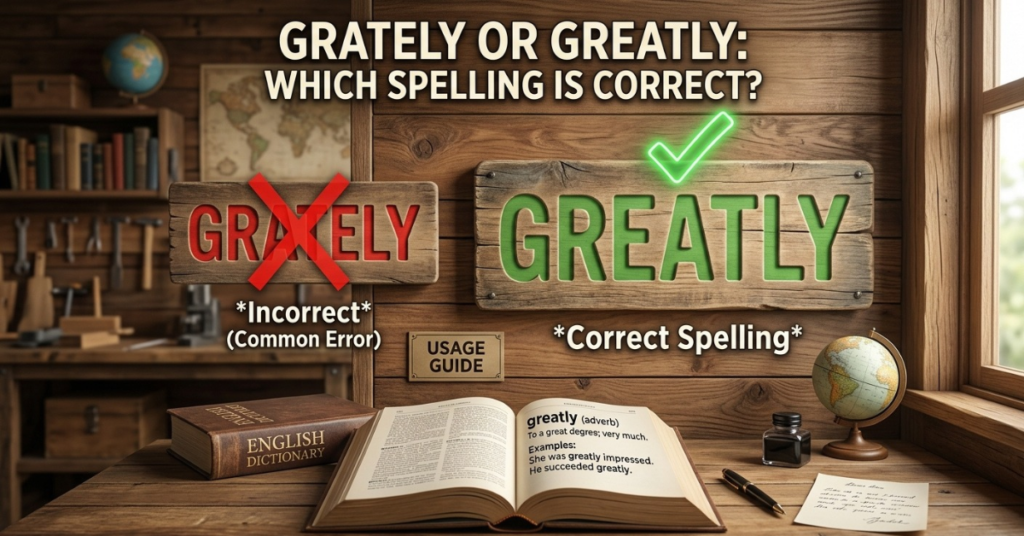
Have you ever written “grately appreciated” in a message and wondered whether the spelling was right? You’re not alone. Many people confuse grately or greatly because both forms look similar, but only one is recognized as the correct standard English spelling.
The correct word is greatly. Whether you’re writing a professional email, thanking someone for their help, or explaining how much you miss a person, understanding the difference can help you communicate more clearly. In this guide, we’ll explain the meaning of greatly, show you how to use it correctly, and answer common questions about this frequently confused spelling.
Grately or Greatly: Which Is Correct?
Greatly is the correct spelling, while grately is a misspelling in standard modern English.
The word greatly is an adverb derived from the adjective great. It describes something that happens to a significant degree or extent. You can use it to express how much something matters, how strongly you feel about something, or how much a situation has changed.
Here is a quick comparison:
| Word or phrase | Correct? | Explanation |
|---|---|---|
| Greatly | Yes | The standard English spelling |
| Grately | No | A common spelling mistake |
| Greatly appreciated | Yes | A polite way to express gratitude |
| Grately appreciated | No | The word is misspelled |
For example:
- Correct: Your support is greatly appreciated.
- Incorrect: Your support is grately appreciated.
The difference comes down to a single letter, but using the correct spelling makes your writing look more polished and professional.
What Does Greatly Mean?
The word greatly means to a large extent, considerably, or very much. It emphasizes the degree or intensity of an action, feeling, or change.
People commonly use it in everyday conversations, workplace communication, formal writing, and personal messages.
Consider these examples:
- “Your advice helped me greatly.” This means the advice was very helpful.
- “The situation has greatly improved.” This means the situation has improved considerably.
- “I greatly appreciate your kindness.” This expresses sincere and strong appreciation.
- “You are greatly missed.” This means someone misses the person very much.
The exact meaning depends on the sentence, but greatly generally adds emphasis to the word or action it describes.
Why Do People Confuse Grately and Greatly?
There are several reasons people make this spelling mistake. First, English spelling doesn’t always follow predictable patterns, especially when words change form. Second, when people write quickly, they may spell words according to how they think they should look.
The adjective great ends in “eat,” and its standard adverb form is created by adding “-ly”:
Great + ly = Greatly
It does not become “grately.” Although grately might look like a reasonable spelling at first glance, it is not the accepted standard form.
A Simple Way to Remember the Correct Spelling
Think of the word great first. Since greatly comes from great, keep the complete base word and add “ly.”
- Great → Greatly
- Careful → Carefully
- Beautiful → Beautifully
- Helpful → Helpfully
Remembering the original adjective can help you avoid similar mistakes in your writing.
Greatly Appreciated or Grately Appreciated?
If you’re writing a thank-you message, professional email, or social media caption, the correct expression is greatly appreciated.
This phrase communicates that someone’s help, effort, time, kindness, or support is valued. It is widely used in both formal and informal communication.
Examples of Greatly Appreciated in Sentences
Here are some natural ways to use the expression:
- “Your time and effort are greatly appreciated.”
- “Any assistance you can provide would be greatly appreciated.”
- “Your continued support is greatly appreciated.”
- “The thoughtful gift was greatly appreciated.”
- “Your feedback on my portfolio would be greatly appreciated.”
The phrase is especially useful when you want to sound polite without making your message unnecessarily long.
Is Greatly Appreciated Formal or Informal?
The expression works in both settings, although it is particularly common in professional communication.
For example, you might write:
- Professional: “Your consideration of my application would be greatly appreciated.”
- Workplace: “Your help with this project is greatly appreciated.”
- Casual: “Thanks for helping me out. I really appreciate it!”
If you want a warmer or more conversational tone, “I really appreciate it” is often a good alternative.
Greatly Appreciated Synonyms
If you want to avoid repeating the phrase greatly appreciated, several alternatives can express gratitude. The best choice depends on the tone of your message.
| Synonym or alternative | Best use |
|---|---|
| Highly appreciated | Professional and general communication |
| Deeply appreciated | Sincere, heartfelt gratitude |
| Truly appreciated | Warm and genuine messages |
| Much appreciated | Short, everyday communication |
| Valued | Expressing the importance of someone’s help |
| Gratefully acknowledged | Formal recognition of assistance |
| Thankful for | Personal or professional messages |
| Very much appreciated | Emphasizing gratitude |
Examples Using Greatly Appreciated Synonyms
Instead of writing, “Your help is greatly appreciated,” you could say:
- “Your help is deeply appreciated.”
- “Your assistance is much appreciated.”
- “I truly value your support.”
- “I’m very thankful for your help.”
- “Your contribution is highly valued.”
These alternatives have slightly different tones. For instance, “deeply appreciated” can sound more heartfelt, while “much appreciated” is concise and suitable for everyday emails.
Greatly Missed or Grately Missed?
The correct expression is greatly missed, not grately missed.
This phrase is used when you want to express that someone’s absence is strongly felt. It can appear in personal messages, farewell notes, memorials, social media captions, and messages to friends or family.
Examples include:
- “You are greatly missed by everyone here.”
- “Your presence is greatly missed at family gatherings.”
- “She is greatly missed by her friends and colleagues.”
- “Your kindness and laughter are greatly missed.”
In emotional or personal writing, you can also use alternatives such as “deeply missed,” “truly missed,” or “missed so much.”
For a more natural conversational sentence, you might write, “I miss you so much.” For a formal tribute, “You are greatly missed” can sound appropriate and respectful.
Greatly Synonyms and Similar Words
The word greatly has several synonyms, but not every alternative works equally well in every sentence. Since greatly describes the degree of something, choose a replacement that fits the meaning and grammar of your sentence.
Common synonyms include:
- Considerably
- Significantly
- Substantially
- Immensely
- Profoundly
- Extremely
- Very much
- To a great extent
Examples of Greatly Synonyms in Sentences
1. Considerably: “The new system has considerably improved productivity.”
2. Significantly: “Her confidence has significantly increased.”
3. Substantially: “The renovation substantially improved the building’s appearance.”
4. Immensely: “I enjoyed the experience immensely.”
5. Profoundly: “The experience profoundly affected her perspective.”
Although these words share similar meanings, they are not always interchangeable. For example, “deeply appreciated” sounds natural, while “substantially appreciated” is generally less idiomatic when expressing gratitude.
Common Mistakes When Using Greatly
Even after learning the correct spelling, it’s helpful to understand a few common writing mistakes.
1. Writing Grately Instead of Greatly
Incorrect: “Your kindness is grately appreciated.”
Correct: “Your kindness is greatly appreciated.”
Always retain the complete spelling of great before adding “-ly.”
2. Using Greatly When Another Word Fits Better
Greatly is suitable for expressing degree, but sometimes another word sounds more natural.
For example:
- Less natural: “I greatly enjoyed the movie.”
- More conversational: “I really enjoyed the movie.”
Both sentences are grammatically acceptable. The second simply sounds more natural in many everyday conversations.
3. Repeating Greatly Too Often
Using the same word repeatedly can make writing feel repetitive. Consider switching between greatly, considerably, deeply, or very much when the context allows.
For example, instead of writing, “Your help is greatly appreciated, and your support is greatly valued,” you could write, “Your help is deeply appreciated, and your continued support means a lot.”
This approach keeps your message clear and engaging.
Frequently Asked Questions
1. Is it grately or greatly?
Greatly is correct. Grately is a common misspelling and should be avoided in standard English writing.
2. Is greatly a real word?
Yes. Greatly is a standard English adverb derived from the adjective great. It means to a large degree, considerably, or very much.
3. Is it grately or greatly appreciated?
The correct expression is greatly appreciated. It is commonly used to thank someone or acknowledge their effort, support, time, or kindness.
4. What is the meaning of greatly appreciated?
Greatly appreciated means valued or appreciated very much. For example, “Your feedback is greatly appreciated” means that the feedback is genuinely valued.
5. What is a synonym for greatly appreciated?
Common alternatives include deeply appreciated, highly appreciated, truly appreciated, much appreciated, and sincerely valued. “Deeply appreciated” is particularly suitable for expressing heartfelt gratitude.
6. Is it greatly missed or grately missed?
The correct phrase is greatly missed. It means that someone’s absence is felt very strongly.
7. Can I use greatly in a formal email?
Yes. Greatly is appropriate in formal emails, business correspondence, academic writing, and professional messages. For example, “Your consideration would be greatly appreciated” is a polite and professional expression.
8. What is another word for greatly?
Depending on the context, alternatives include considerably, significantly, substantially, immensely, and profoundly. Choose the word that best matches the intended meaning.
9. Why is grately incorrect?
Grately is not the standard spelling of the intended word. The correct form is created by adding “-ly” to great, resulting in greatly.
10. How can I remember the spelling of greatly?
Remember the base word great. Add “-ly” without changing its spelling: great + ly = greatly. This simple trick can help you avoid the mistake.
Conclusion
When deciding between grately or greatly, the answer is straightforward: greatly is the correct spelling. The word means to a large extent or very much, and it appears in common expressions such as “greatly appreciated” and “greatly missed.”
Remember to keep the original spelling of great when adding “-ly.” If you’re writing an email, a thank-you note, or a personal message, using the correct word will help your writing sound clear and confident.
For more useful English spelling guides, explore other commonly confused words and their meanings to strengthen your everyday writing and communication skills.
